


Technology
Test 3 20260303
Read more


A realistic assessment needs three lenses at once: what is happening inside the industry, where supply-chain vulnerabilities sit, and how governments are changing the operating environment. Recent Sinolytics analysis shows why those lenses need to be combined: China's compute competition is moving toward integrated systems, domestic CPU adoption is being shaped by public procurement, and Huawei is presenting packaging-led scaling as an alternative route under technology constraints.
Progress is selective. Chinese firms are becoming more competitive in some mature-node and niche segments, while constraints remain in leading-edge technologies. That distinction matters for companies assessing Chinese suppliers. Judging every supplier against the global frontier gives an incomplete picture. The relevant question is whether a supplier is credible and competitive for the specific chip category and application that matters to the business.
Semiconductor exposure does not begin and end with the chip itself. It extends across the chain from raw materials to the end product. Companies should look beyond official announcements. They need to know where governments can affect access to critical inputs, whether policy commitments are being implemented, and whether changes in export conditions are likely to last.
China's semiconductor landscape is shaped by national policy, local implementation, industrial parks, funding programs, supplier development, export conditions, import controls, and market-access restrictions. These measures do not operate separately from the industry. They affect which capabilities can develop, which suppliers can scale, and which options remain available to companies operating across borders.
Recent Sinolytics analysis of WAIC shows Chinese vendors presenting supernodes as integrated AI compute systems rather than competing only on standalone chip performance. The comparison therefore shifts toward coordination across chips, interconnects, memory access, software, and architecture. The headline card count is not enough: vendors use different measures of scale, so system claims need to be assessed carefully.
Read the WAIC analysis on China's supernode race
The Xinchuang initiative is using public procurement to support domestic CPUs and a wider domestic IT ecosystem. The policy spans chips, operating systems, databases, and applications. Domestic CPUs still represent a small share of China's overall CPU market, but their position in public-sector procurement shows how policy can create a protected market for local suppliers and help them scale.
Read the analysis of China's CPU self-sufficiency policy
Huawei's Tau Scaling Law frames semiconductor performance improvements around coordination across devices, circuits, chips, and systems, rather than transistor shrinkage alone. The approach reflects both rising costs along the traditional path and tighter access to advanced technologies. It also depends on progress across EDA tools, chip design, manufacturing, packaging, materials, and system integration.
Read the analysis of Huawei's Tau Scaling Law
Sishi Xie follows China’s semiconductor landscape, including the local supplier ecosystem, specific chip categories, industrial policy, and localization strategy. She also tracks new products from Chinese suppliers, their claims, their roadmaps, and how credible those roadmaps are.
“The sector's progress is much more selective: Chinese firms are becoming increasingly competitive in some mature-node and niche segments, even though they still face major constraints in leading-edge technologies.” — Sishi Xie
This is the first discipline the cluster needs: do not treat “China’s semiconductor industry” as a single capability. Look at the category, the supplier, the application, and the constraints that apply to each.
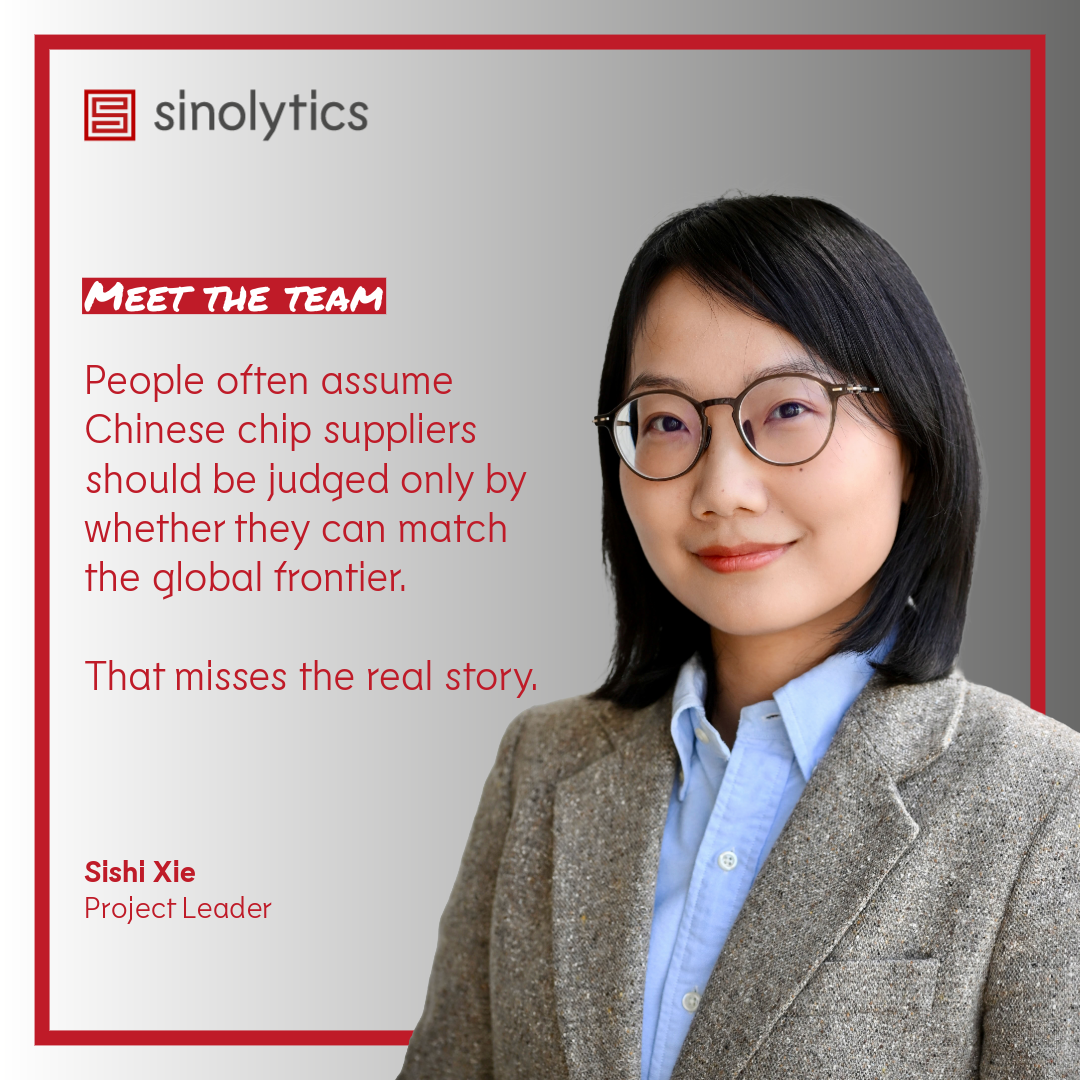
Sishi also describes a fragmented industry with hundreds of companies across the supply chain. Compared with the United States and Europe, the sector is still developing, and some consolidation is likely over time.
For companies, that raises practical questions:
Dr. Jost Wübbeke has followed raw materials and supply chains for years. His perspective starts with the relationship between economic structures and political influence.
“Supply chains more broadly are fascinating because you look at the whole chain, from the raw material all the way to the end product, and then ask: where are the vulnerabilities to political influence?” — Dr. Jost Wübbeke
That question is central to semiconductor analysis. A company may focus on a chip supplier while missing dependencies further upstream or downstream.
Jost also emphasizes the gap between public headlines and actual implementation. In the raw-materials context, he asks whether exports from China are genuinely open again and whether public promises were actually kept.
The same discipline applies to semiconductor supply chains. Companies should distinguish between:
Leonhard Xu focuses on the geo-economic dynamics shaping U.S.–China and EU–China relations. His work covers export controls, market-access measures, and the way governments use economic interdependence as a policy tool.
“Export controls are a big part of this, but also import controls and market-access restrictions in both the US and China.” — Leonhard Xu
This lens places semiconductors in their wider policy environment. The relevant question is not only what a company can source today. It is also how policy changes could affect access, market participation, supplier relationships, and the ability to operate across borders.
Leonhard's broader focus includes China's foreign and economic policy, as well as legal tools related to supply-chain security and anti-extraterritorial measures. That makes his perspective useful for tracking how the rules around critical technologies may change.
Assess specific suppliers and chip categories rather than making broad judgments about China's semiconductor industry. Compare product claims with demonstrated capability, application requirements, and roadmap credibility.
Separate mature-node and niche segments from leading-edge technologies. The competitive picture may differ sharply between them.
Map the chain from raw materials to the end product. Look for points where political influence, export conditions, or supplier concentration could affect the business.
Track both national frameworks and local implementation. Industrial parks, funding programs, and local supplier ecosystems can reveal how policy is being translated into industrial capacity.
Monitor export controls, import controls, and market-access restrictions. Assess what they change in practice, not only what they say on paper.
Test whether a development is visible in products, supplier performance, implementation, or actual access. Headlines are a starting point, not a conclusion.
China's semiconductor development is neither a simple story of self-sufficiency nor a story of uniform technological weakness. The picture is more uneven: strong in some mature-node and niche segments, constrained in leading-edge technologies, fragmented across many companies, and shaped by policy and geopolitical tools.
For decision-makers, the task is to identify where capability is becoming credible, where dependencies remain, and which changes could affect the supply chain in practice. That requires looking beyond broad labels and following the evidence at the level of suppliers, chip categories, implementation, and policy tools.
If China's semiconductor development affects your supply chains, supplier assessments, market access, or technology exposure, we can help you assess what is changing, and what to watch next.

