


Technology
The new space race: China's bid to rival Starlink
Read more


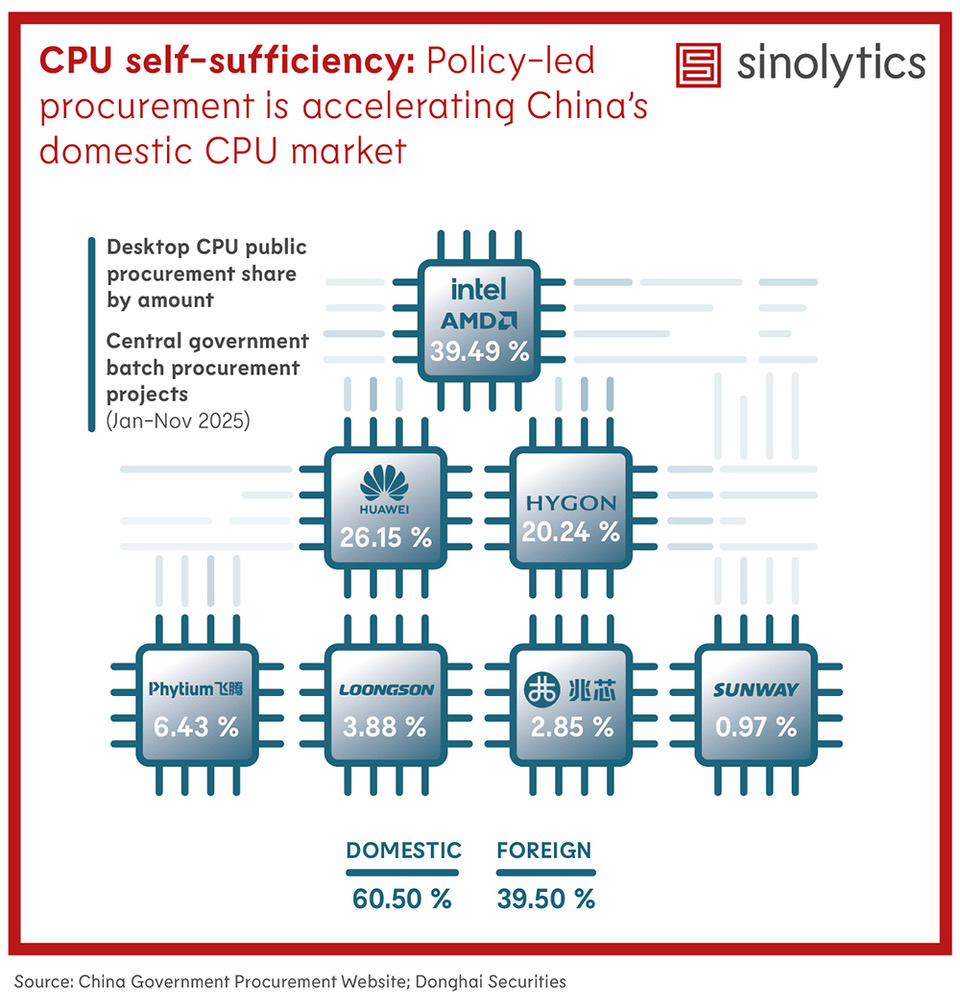
At the heart of China's CPU strategy is the Xinchuang initiative, a top-down industrial policy designed to build a secure and self-reliant domestic IT ecosystem. This program spans the entire technology stack, from chips and operating systems to databases and applications. A core component of this strategy is leveraging the power of public procurement. By mandating the use of local technology in government and state-owned enterprise (SOE) projects, Beijing is creating a vast, protected market for its domestic firms. The results are already striking: while domestic CPUs account for only about 20% of China's overall CPU market, they captured a commanding 61% of desktop PC procurement in the public sector in 2025.
This policy-driven demand has fueled the rise of local CPU champions. Huawei's Kunpeng and Hygon Information Technology are the current frontrunners, benefiting from stronger performance, a more mature software ecosystem, and wider market acceptance within the Xinchuang framework. These companies have become the primary beneficiaries of the government's localization push. While foreign brands still lead China’s overall CPU market, policy is rapidly creating a captured market for domestic champions in the public sector. This guaranteed demand allows these firms to scale production, invest in R&D, and refine their products without direct competition from established global players like Intel and AMD within this segment.
To mitigate risks and foster innovation, Chinese CPU vendors are not betting on a single technology. Instead, they are pursuing three main paths simultaneously. The first involves licensing the dominant x86 architecture, as seen with Hygon (which has a joint venture with AMD) and Zhaoxin (a JV with VIA Technologies). The second path utilizes the Arm architecture, a popular choice for its efficiency, with Huawei’s Kunpeng and Phytium Technology as key players. The third and most ambitious path is the development of entirely indigenous architectures, such as Loongson’s LoongArch and Sunway’s SW-64. This diversified approach allows China to explore different technological trade-offs and reduces its reliance on any single foreign-controlled instruction set.

