


China Policy
Fiscal policy 2026: Beijing doubles down on strategic spending and investment to counter economic headwinds
Read more


In this “Meet the Team” interview, Theresa talks with Leonhard about how these relationships are evolving, why Japan is a useful test case for China’s expanding toolkit, and what “good analysis” looks like when the rules can change overnight.
Leo: Right now I’m mainly focused on three areas.
First, U.S.–China relations, both the high-level political relationship and the regulatory developments underneath it. Export controls are a big part of this, but also import controls and market-access restrictions in both the US and China.
Second, EU–China relations, especially against the backdrop of a more volatile U.S. relationship. I’m watching how EU China policy develops in Brussels, the Commission and Parliament, as well as how the consensus in member states shift. Right now, we are seeing a broader shift in the EU's China policy, underpinned by a series of legislative proposals aimed at strengthening trade defense and de-risking in critical technology sectors, all while seeking to maintain economic and investment ties. A key question is how, and with which countermeasures, China will respond, and whether EU–China relations will eventually stabilize or continue to deteriorate.
Third, I focus on the broader direction of China’s foreign and economic policy. Over recent years, China has moved from a more defensive posture in response to Western restrictions toward a more self-confident, sometimes more offensive, strategy, including legal tools related to supply chain security and anti-extraterritorial measures.
I also look at China’s relationship with Japan because it’s a particularly useful test case: China has applied a wide range of geo-economic instruments there, and in a relatively advanced way: from export restrictions to other tools, including consumer boycotts. That makes Japan a good place to see how China’s toolkit works in practice and to draw lessons that could matter for other relationships, including Europe, if tensions worsen.
Geopolitics has always affected business, think of how bifurcated the world was during the Cold War. But what changed over the last decade is that geopolitical tensions between major powers have intensified once again, this time in a far more economically and technologically interdependent world. And because these powers now view interdependence not as a source of prosperity but as a source of insecurity and geopolitical leverage, economic tools are increasingly being used as instruments of power. This, in turn, is leading all sides to reduce their critical dependencies on one another.
Under the first Trump administration, there was indeed a noticeable shift. He not only repopularized the use of tariffs, but also expanded the use of other geo-economic instruments, such as the Entity List, particularly targeting China. That trend of trade and technology restrictions then expanded massively under the Biden administration, including broader export controls in critical technology areas such as semiconductors. Under Trump 2.0, we are seeing this broader trend continue.
Given that interdependence persists while tensions are nowhere near declining, we will likely continue to see a much more aggressive use of geo-economic instruments, which raises the disruption potential for companies.
It’s mixed. Awareness has clearly increased. In Europe, Russia’s invasion of Ukraine in 2022 was a major trigger. And crises have been stacking, one after another.
Some companies are adapting; others still treat geopolitical disruption as a secondary effect. The ones that adapt faster can gain a competitive advantage. And geopolitics can hit companies very hard, negatively, but sometimes also positively, depending on sector and positioning.
Certain sectors are increasingly treated as strategic and receive regulatory preferences or major subsidies across jurisdictions. Semiconductors are a prime example, you see large-scale efforts in the U.S., EU, Japan, South Korea, and also China to localize or regionalize production and reduce dependence on foreign suppliers.
You see similar dynamics in batteries (battery cells and materials) where the U.S. and Europe have increased policy attention significantly.
The last year was shaped by shifts in the U.S.–China relationship, and how quickly it could swing. After the “Liberation Day” tariffs episode in April, tariffs moved in an “roller coaster,” at points up to 145% and then rapidly down again.
What stood out to me was how strongly China expanded its export-control policy, and that the potential damage in the U.S. was significant enough that the U.S. had to back off. In that sense, China demonstrated a form of geo-economic escalation leverage in the standoff, and that will likely shape how China is perceived by the U.S., Europe, and others in the coming months and years.
Again, it’s mixed. There can be a bit of fatalism in parts of the EU policy community, given economic challenges and political polarization, and the pressure of managing relationships with China, the U.S., and Russia at once.
But Europe does have leverage if it is willing and able to use it. Europe supplies important goods to both the U.S. and China. A clear example is semiconductor manufacturing equipment: China still depends on European inputs (even if the most advanced tools are restricted). Europe is also a crucial market for Chinese exports, one of the remaining very large markets that is still relatively open.
The challenge is credibility and internal alignment: member states and interests don’t always want to play the cards Europe has, which can weaken Europe’s negotiating position because threats of strong countermeasures may not be believed.
One area is overlapping regulatory systems that create real conflicts, especially around sanctions and export controls.
We’re seeing China build instruments that can restrict actors inside China from complying with foreign sanctions/export controls, and cases where China has prohibited companies from providing information to the EU in the context of subsidy investigations.
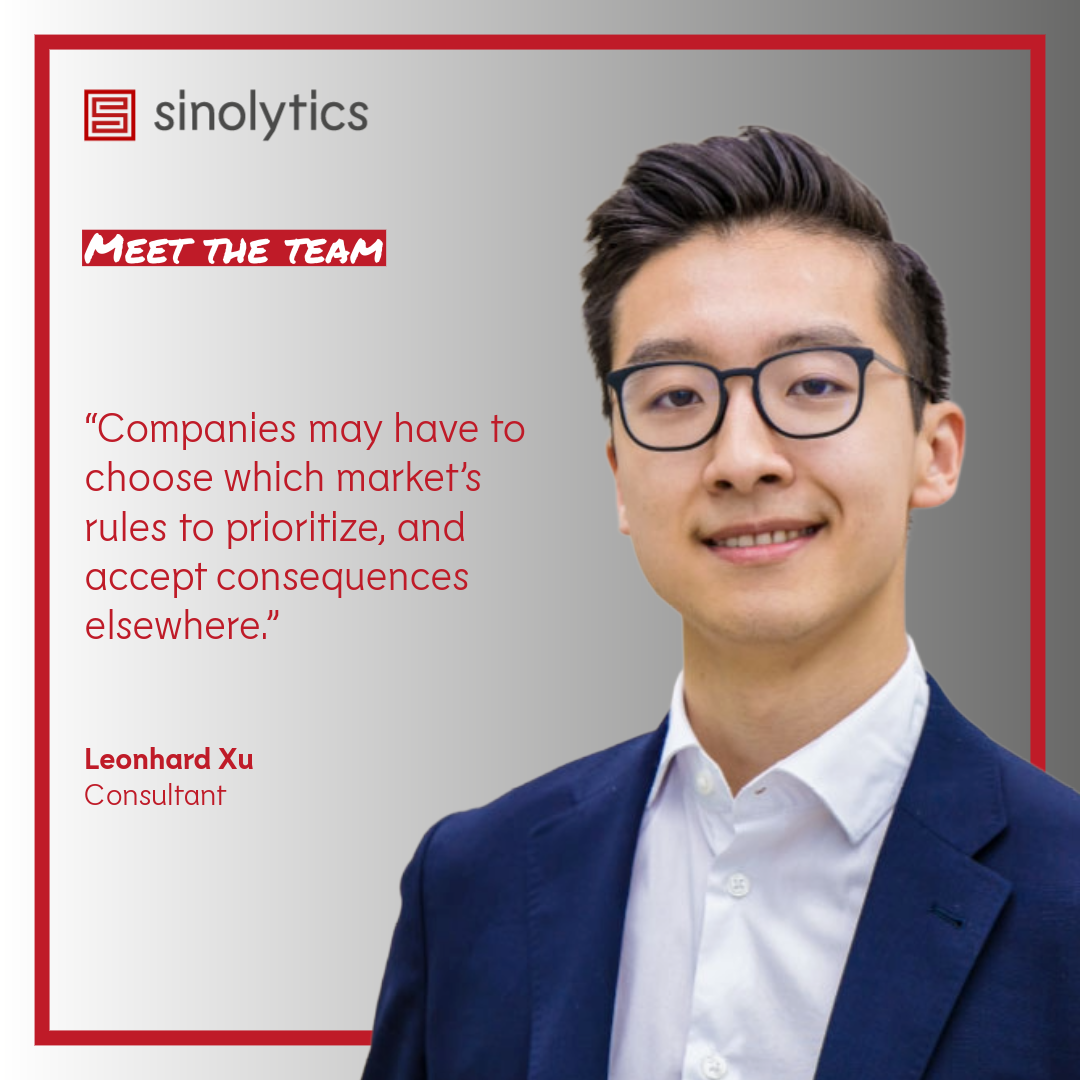
These conflicts can create “lose-lose” situations: companies may have to choose which market’s rules to prioritize and accept consequences elsewhere. Often there isn’t a low-risk mitigation option because the outcome depends on political dynamics beyond the company’s control.
Two things stand out. First, being able to spot signs that a relationship may shift before it becomes obvious. Second, going beyond surface summaries and into the details of regulations and instruments, then mapping what they actually mean for specific supply chains. It also matters to look beyond direct suppliers and understand second- and third-tier dependencies, because disruptions can travel through surprising choke points.

