


Geolytics
India as a cleantech partner: Cheaper than Europe, but more expensive than China
Read more


While the United States and China remain indispensable trading partners despite diversification efforts, many middle powers are actively searching for alternatives. In this context, one transregional network is still widely overlooked in Europe: the Comprehensive and Progressive Agreement for Trans Pacific Partnership (CPTPP).
The predecessor agreement, Trans Pacific Partnership (TPP), formed a core pillar of President Obama's Indo-Pacific strategy: set rules, bind partners, and constrain China's growing influence. After the U.S. withdrawal in 2017, Japan assumed leadership. Instead of collapsing, the agreement expanded.
In 2024, the United Kingdom joined, bringing membership to twelve countries representing roughly 15% of global GDP and about 7% of the world’s population. Other members include Australia, Brunei, Chile, Canada, Malaysia, Mexico, New Zealand, Peru, Singapore, and Vietnam.
Globally binding rules are currently difficult to achieve — especially without participation from the U.S. and China. Regional trade frameworks like CPTPP therefore offer a pragmatic solution. They provide legal certainty, investment stability, and predictable standards, even if they cannot replace the World Trade Organization.
The data supports this: intra-CPTPP trade has grown significantly since 2018, reaching USD 974.3 billion in 2024 — evidence of deepening value chains. Trade between the bloc and the European Union, however, has stagnated. Closer integration could change that.
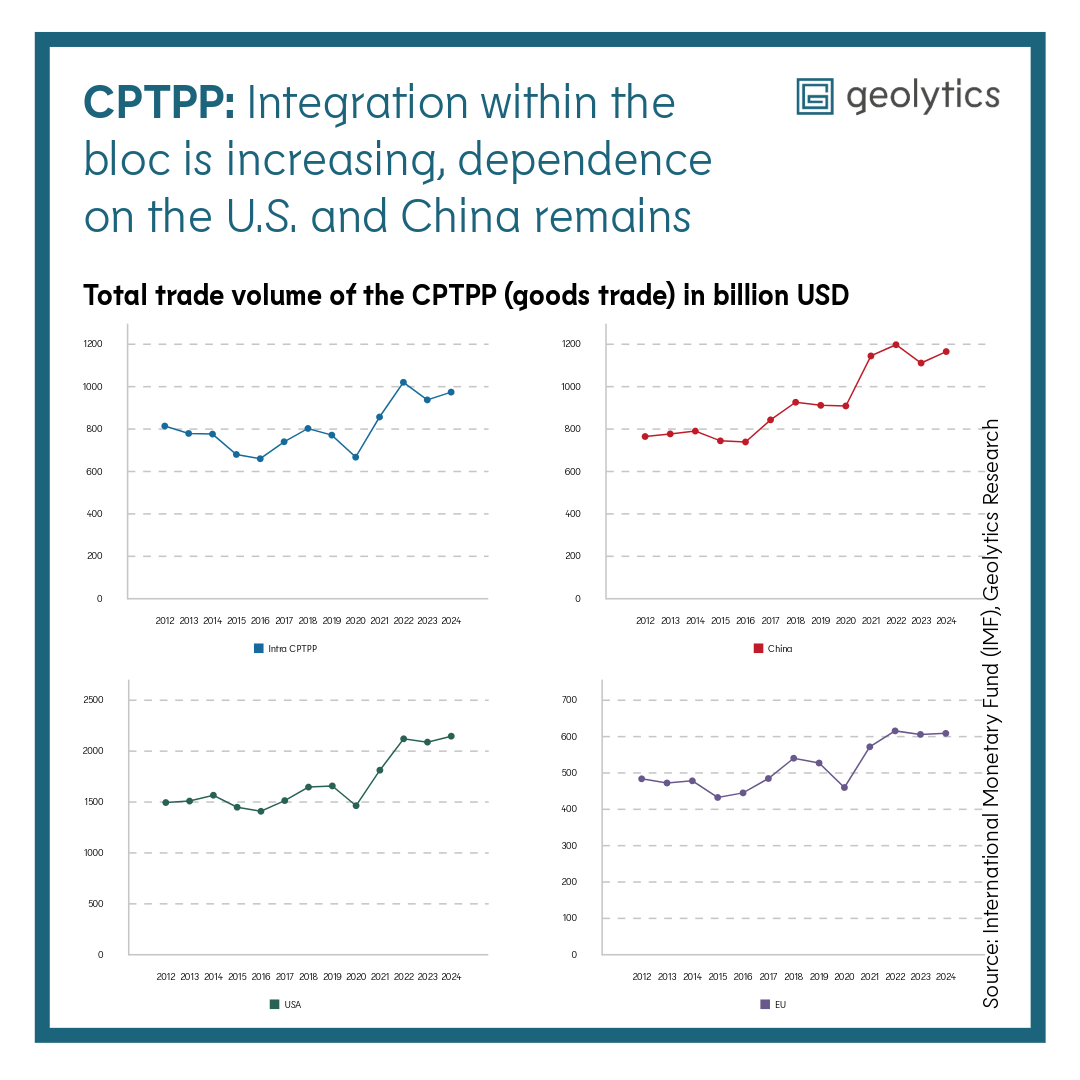
The agreement's appeal is growing. Costa Rica and Uruguay are negotiating accession, while nine additional applications have been submitted — including from China, Indonesia, and Ukraine. South Korea has also recently renewed its interest.
Not all applications are realistic — especially China's — but the geopolitical signal is unmistakable.
Economic gravity continues shifting toward the Indo Pacific. CPTPP members such as Australia, Canada, and Chile are also key suppliers of critical raw materials, making them directly relevant for Europe's resilience agenda.
Initial political steps are already underway: on November 20, 2025, the EU and CPTPP launched a joint trade and investment dialogue covering diversification, digital trade, and WTO reform.
A full EU accession to the CPTPP is unlikely in the foreseeable future. The process would be lengthy and internal EU political frictions — particularly regarding agriculture — remain significant. What is emerging instead is a structured partnership: compatible rules and standards, gradual reduction of non-tariff barriers, and a framework that can deepen rapidly.
CPTPP is not a cure-all. But it demonstrates that rules-based trade can function without direct U.S. leadership and without China's participation.
For Europe, this implies deeper economic anchoring in the Indo-Pacific, a region that accounted for nearly 40% of global trade in 2024 and whose trade with the EU increased by almost 60% between 2014 and 2024.
This article was originally published on F.A.Z. Pro Weltwirtschaft.

