


Geopolitics
What are the key implications of Mexico’s tariff overhaul for China?
Read more


In this conversation, we spoke about what drew him into raw materials and supply chains in the first place, why semiconductors take up most of his bandwidth these days, and what makes a geopolitical analysis actually useful for companies.
Jost: I need to go a bit back in time. This might sound a little weird, but back in 2010, when the whole rare earths topic first came up, it really fascinated me.
I’ve always been drawn to topics that are kind of specialized, things not everyone talks about. And rare earths were exactly that: very niche, but at the same time something that ended up affecting a huge part of the world. What fascinated me was understanding that link, how the raw materials economy and political influence connect. Today it gets much more attention than back then, but I still find it extremely interesting.
Jost: In the raw materials space, it’s always interesting to see what implementation actually looks like. Things might feel a bit calmer in the media right now, companies probably feel it less “calm” than the headlines suggest, but the real question is: what’s actually happening? For example: is export from China fully open again or not? Were the promises that were made actually kept? The interesting part is often digging out facts that aren’t obvious, and then sharing those with our clients.
And beyond raw materials: supply chains more broadly are fascinating because you look at the whole chain, from the raw material all the way to the end product, and then ask: where are the vulnerabilities to political influence? I like that it combines a very precise, technical understanding of the supply chain with a more interpretive perspective. You need analytical discipline, but also a kind of creativity, in the sense of spotting where vulnerabilities might be.
Jost: Honestly, about 90% of my work is related to semiconductors. That’s because semiconductor supply chains are particularly vulnerable to political tensions, and because semiconductors are essential for the modern economy. So it’s about supply chains, but also beyond that: capacity, dependencies, localization measures, industrial policy, innovation… it’s a broad spectrum.
Jost: I think what we always try to do at Geolytics is make geopolitics easy to understand in a corporate context. You can do deep research and be truly “native experts” in the field, understand the technology and the market dynamics precisely, but then you still need to package it so it actually lands with decision-makers. That’s the tension: having a lot of knowledge and making it usable. And we don't stop at the analysis. We go into the company's actual supply chain, the manufacturing footprint, the R&D locations, really looking at the company in detail. Combining those levels is a big part of what makes our work distinctive.
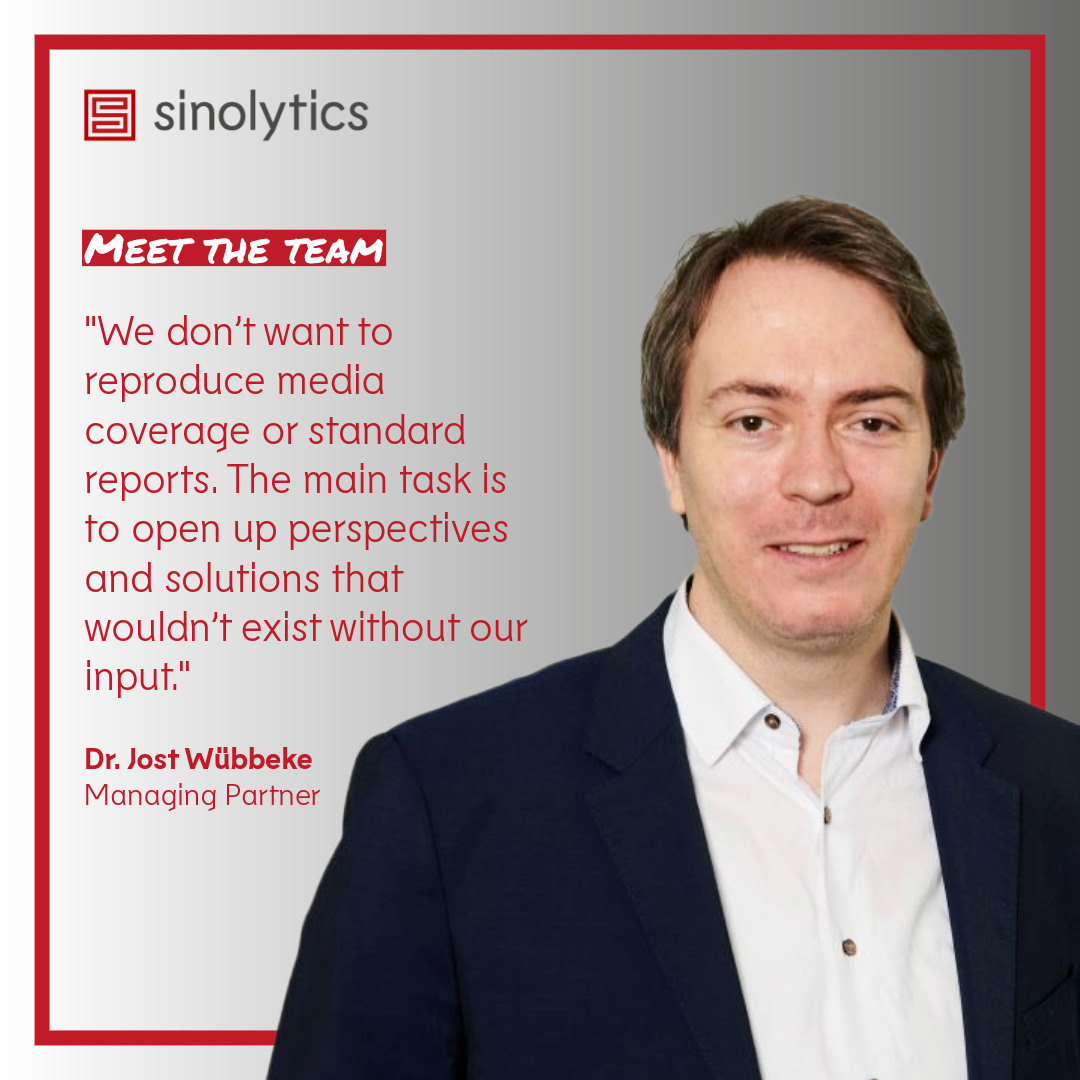
Also: because we understand both the technical and political dimensions, the analysis tends to be sharper, and sometimes different from what you'd find in the mainstream. We look in places others might not. Finding those "hidden truths" is the interesting part, and that's also the value for clients. We don't want to tell people what’s obvious by reproducing media coverage or standard reports. The main task is to open up perspectives and solutions that wouldn't exist without our input.
Jost: That's a hard question. One thing we deal with every day is the gap between how "de-risking" is understood politically and how it's implemented in companies. In politics, you can sense some frustration that it isn't moving forward, and that dependencies on China are, in some areas, actually increasing.
But if you come from practice, you develop a much more precise picture of what de-risking can do, and what it can't. I think politics would benefit from trying harder to understand what de-risking can realistically look like at the company level. That understanding is still underdeveloped.
And in raw materials, something else that's underestimated is that dependency isn’t just about raw materials as such, but about refined products. China's strength isn't only in mining, it's especially in processing. Plus there's dependency in intermediates and specific technologies. Batteries and cathode materials are one example, but it goes far beyond that. Our dependency on China for intermediates is significant, and that can create real problems for a de-risking agenda.
Jost: Partly, yes. We do see shifts, and you can reduce a China footprint in certain areas. But I'm cautious about looking for overly fast solutions that make the KPIs look nice. You can move your Tier 1 or Tier 2 supplier to Vietnam or Malaysia, and on your dashboard it looks great. But if upstream tiers are still supplied from China and those inputs simply flow into Vietnam or Malaysia, you haven't gained much. So with de-risking, we need to be careful that it doesn't turn into cosmetics.
From a macroeconomic perspective, it's attractive to use benchmarks like "China share of exports to Europe." But from a company perspective, de-risking needs to be about a different question: in the event of political disruption, China, tariffs, whatever, how do I make the supply chain resilient? And de-risking doesn't always have to mean "less China." Companies and politics often understand risk differently.
Jost: Yeah, definitely. I think people just tick differently. For me it's about balance, what fulfills me in my work. I enjoy management responsibilities, but I also want to stay in the topics. Because I believe you can only talk about topics authentically if you really know what you're talking about. I'm kind of in a middle role. It’s important to pass on methodology, how you approach topics, and also to have an accurate sense of what assessments make sense and which don't. That critical questioning is really important.
We're living in a time where "truth" has become a pretty tradable, flexible good. So for me, a fact-based approach is essential, almost inductive: first understand the object, then form a statement. Whenever I see a statistic or a claim, I ask: what's the primary source? Where does it actually come from? Only then can you understand whether it's right or not.
Jost: Yes, absolutely. Back then, we saw a gap in China-specialized consulting for companies, especially connected to political and regulatory frameworks. I don't know that something like that existed in the same way ten years ago. Sure, there were big consulting firms and there were geopolitical consultancies. But combining that with deep China expertise,that wasn't really out there. And I think our development has shown that this gap was real.
The gap is also in our approach: we understand political developments, but we can also break them down to the level of individual companies, in a very detailed way. Often you find people who understand companies very well but not politics, and others who understand politics but not companies. That connection is where we found our place. And that's also the idea behind Geolytics, because this approach isn't limited to China.

