

Technology
China's embodied intelligence frenzy: Capital, big tech, automakers, and policy warnings
Read more


The harder task is separating meaningful signals from noise. Model launches, funding announcements, benchmark scores, and geopolitical claims can all reveal something. None of them provides the full picture on its own. A useful assessment starts with the wider system: chips, compute, models, applications, robotics, AI regulation, commercial adoption, and geopolitics. Together, these elements shape the business implications of China’s AI strategy.
The relevant question is not whether China is “winning” the AI race. It is where capabilities are becoming usable, where constraints are binding, and what those developments mean for specific companies.
The answer is not contained in model releases alone. China's AI development is shaped by the interaction between hardware, computing capacity, software, products, users, regulation, and industrial policy. Some developments matter because they improve technical capabilities. Others matter because they make existing products more useful, cheaper, faster, or easier to deploy. Still others matter because they change the conditions under which companies can access technology, data, suppliers, and markets.
A technical advance becomes more strategically relevant when it changes what companies can do, what they need to buy, or what they can no longer assume. That requires looking at adoption. Is AI being integrated into products and workflows that users already rely on? Can companies sustain the product beyond the initial launch? Are customers changing their behavior? Are suppliers, regulators, and competitors responding?
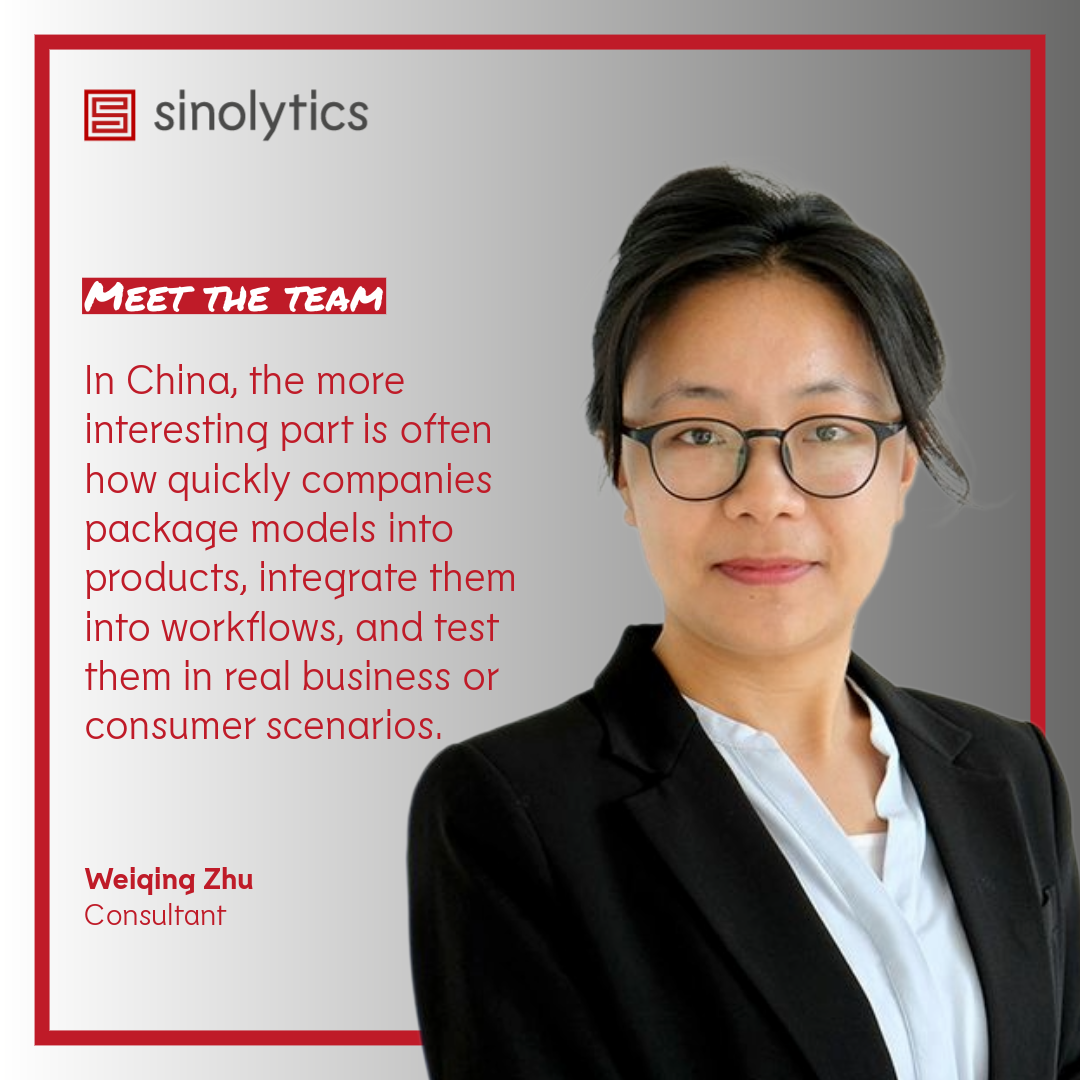
A common analytical mistake is to treat attention as evidence of importance. A headline can be widely repeated without being technically meaningful, commercially durable, or relevant to a company's exposure. Observers can also miss the significance of application-level progress when they focus only on comparisons between foundation models. Weiqing Zhu points to the speed with which Chinese companies package models into products, integrate them into workflows, and test them in business and consumer settings. That movement from model to application deserves separate attention.
Decision-makers should monitor developments that can be linked to a business question:
The goal is not to predict every next release, but to identify which signals deserve attention before they become business problems.
Mengying Tao follows China's AI ecosystem from chips and compute to models, applications, and robotics. Her approach starts with the details: what is being built, how it performs, and how the different parts of the ecosystem fit together.
“I mainly follow developments across the AI value chain in China. That includes chips, compute, models and applications, but also the question of how these pieces interact and where the ecosystem is moving.” — Mengying Tao
This perspective changes the unit of analysis. Instead of asking whether a single model is competitive, companies can ask where bottlenecks are shifting, which capabilities are becoming available, and how developments are moving into products.
Weiqing Zhu combines AI research with engineering and data work. Her perspective highlights a part of China's AI ecosystem that is easy to overlook when analysis stays at the level of frontier models: the integration of AI into products and services that people already use.
“I think China's companies are quite practical. They first develop things people would actually use. The commercial ecosystem can be very smooth for some products, because AI is integrated into existing apps and services.” — Weiqing Zhu
She also emphasizes the discipline required to assess claims rather than repeat them:
“You have to be objective and figure out where the information comes from and whether it's realistic.” — Weiqing Zhu
For companies assessing commercial relevance, this points to a different set of questions. How quickly can a capability be packaged into a product? Which workflows can it improve? What does the user experience look like at scale? And can an initial advantage be sustained when competition intensifies?
Shengyi Zhang follows AI safety regulation, supply chains, and the geopolitical dimensions of U.S.–China technology competition. Her central concern is not the volume of available information. It is the quality of the conclusions drawn from it.
“The ability to distinguish what is actually significant from what is hype is, in my view, the core skill.” — Shengyi Zhang
She is also watching China's growing focus on AI safety. She describes it as an increasingly government-driven priority rather than a concern left to industry alone.
“China is signaling that it wants to be a serious actor on AI governance, not only on AI development.” — Shengyi Zhang
For companies, the implication is that technical progress, regulation, and geopolitical constraints cannot always be assessed separately. A change in one area can alter the commercial meaning of developments in another.
Yuqi Cheng works at the intersection of AI, digital tools, and geopolitical analysis. Her role is to turn expert content into workflows that help users decide what matters, what may affect their business, and what to watch next.
“I help the company to turn rapid advances in AI into practical value by building agent infrastructure and tools around our expert content.” — Yuqi Cheng
A system can produce more information without helping a company make a better decision. Useful decision-support requires clear definitions, relevant context, disciplined sourcing, and a workflow that connects a development to impact and next steps.
For companies, the practical loop is:
signal → relevance → business impact → scenarios → indicators to watch
Track chips, compute, models, applications, and robotics together. A model release may be less important than the infrastructure, deployment conditions, or application ecosystem behind it.
Look for repeated use in products and workflows, not only demonstrations or pilot announcements. The key question is whether companies can turn technical capability into durable value.
Monitor the development of AI safety and governance requirements, including how broad priorities become more specific rules, standards, and implementation expectations.
Assess export controls, supply-chain dependencies, market-access conditions, and the changing availability of technologies and components. These constraints shape China's development options and the choices available to companies operating across borders.
Test every major development against three questions:
A development does not need to satisfy all three to matter. But companies should know which type of significance they are looking at.
China's AI development is neither a simple story of catch-up nor proof of inevitable leadership. It is a moving system with genuine strengths, real constraints, uneven performance, and significant uncertainty. For decision-makers, the task is not to keep up with every announcement. It is to build a reliable view of what is changing, where the change is happening, and how it could affect the business. That means looking beyond the hype without dismissing the underlying development.
If China’s AI development affects your markets, technology choices, supply chains, or regulatory exposure, we can help you assess what matters.
