


Technology
China's AI growth continues, with adoption gradually shifting toward industrial applications
Read more


Mengying: I mainly follow developments across the AI value chain in China. That includes chips, compute, models and applications, but also the question of how these pieces interact and where the ecosystem is moving. A big part of my work is monitoring market developments: what new models and AI chips are coming out, how they perform, and how the Chinese tech community reacts, especially in the early stages. I also look closely at robotics, including the chips, models, and hardware components behind it. That is one of the areas I find particularly interesting right now.
Mengying: Yes, exactly. I usually start from a very detailed level: how models are developing, what chip capabilities are behind them, how AI is being adopted vertically, how different parts of the ecosystem interact. That is also the kind of work that suits me best.
Mengying: I think this kind of work pushes you in that direction. You have to engage with the technical details. You need to understand what you are talking about - otherwise you cannot do good analysis. So yes, I would say the nature of the work makes you a bit nerdy over time.
Mengying: Honestly, I would not even frame it as “the past year.” In AI, even that already feels too long. I would say the past three months - or even the past month. The pace is extremely fast.
One of the biggest shifts is that the conversation is no longer just about chatbots that answer questions. It is increasingly about agents - systems that are integrated into workflows and actually carry out tasks. I don’t think we are there yet, but the direction is clear, and I think it will move quickly. In a way, AI can be an employee, right? Really a legit one.
Another change is how fast China can catch up in advanced chip capacity. It is clearly a joint effort between political will and corporate drive. We are already seeing model and chip companies working more closely together, like the recent DeepSeek V4 and Huawei Ascend case. The second half of this year will give us a better sense of whether it can really scale.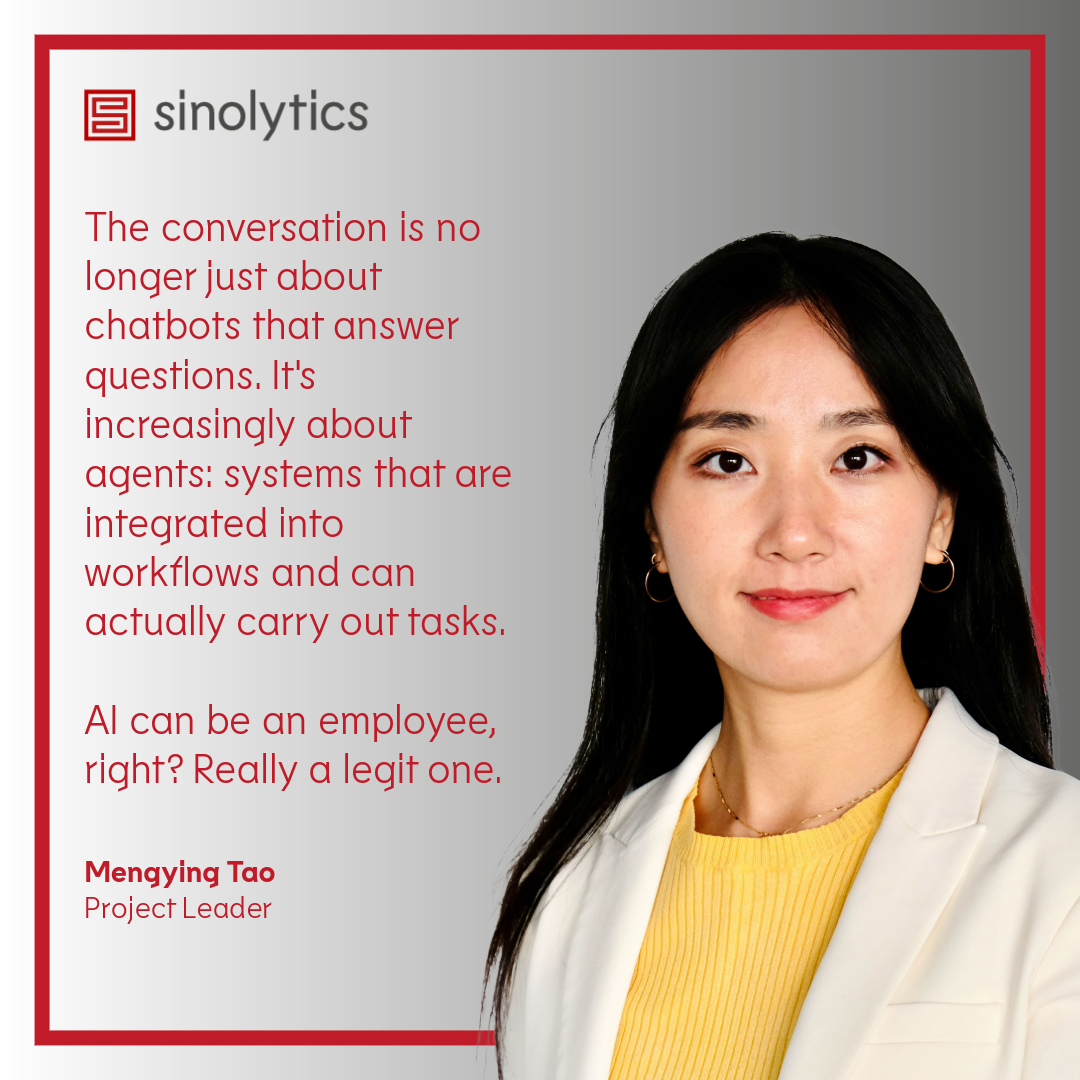
Mengying: Yes, definitely. Agentic AI is one of the topics I am following most closely, partly because I want to understand what it will actually mean for work, productivity, and everyday routines. At the same time, I am also paying very close attention to the Chinese chip industry, especially equipment makers and GPU designers. That is another space where a lot is happening right now.
Mengying: AI chip capabilities, especially among major Chinese players. Then of course the capabilities of Chinese AI models. And AI governance is also a major topic. Those are some of the issues that come up again and again right now.
Mengying: No, I do not think you can treat it that way. The topic is moving too quickly, and the implications are too real. Of course there is a lot of attention, a lot of speed, and a lot of big claims. You have to look more carefully: What is actually new? What is solid? What is mostly narrative? And what does it mean in practice for companies? That is really where my work starts.
Mengying: I could imagine more companies asking what follows from all the developments for their own AI strategy in China. Especially when rolling out AI-enabled products amid China-specific compliance, competition, and geopolitical risks.
And then there is robotics. That is clearly an emerging field. We are seeing early questions about whether this is the right time to enter the market. At the same time, competition there is very intense. That is exactly why it is a space worth watching closely.
Mengying: A good starting point is my white paper on China’s Path to AGI. Also, I regularly write on AI topics for the Sinolytics.Radar which can be read in our blog.
• White paper: China’s Path to AGI
• Sinolytics.Radar: What the Meta-Manus case means for tech companies
Mengying: Good analysis in this field requires both granular observation and strategic interpretation. It starts with the nitty-gritty details, which means following policy signals, product updates, developer communities, social media discussions, KOLs, etc., and then connecting the dots to identify trends and assess their business impact. The real picture is often far more complex than simplified narratives suggest.

