


Technology
China's semiconductor M&A: More deals, rising failure rates
Read more


China's foreign investment security review framework has evolved gradually since the mid-2000s, but it has rarely been used in practice. Beyond a few known examples, such as Carlyle–XCMG in 2005 and Yonghui–Zhongbai in 2018, the recent Meta-Manus case stands out as the first high-profile AI-related foreign acquisition publicly reported to have been blocked under this mechanism.
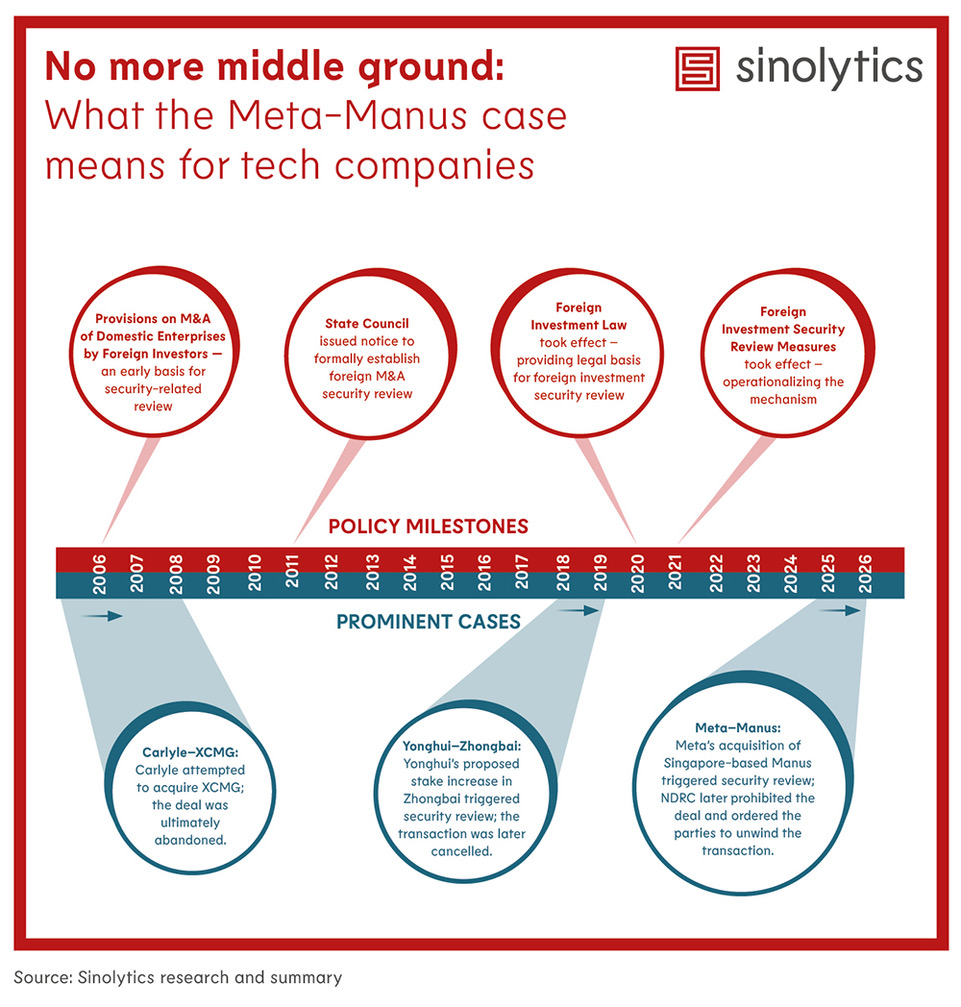
Manus's move to Singapore may have helped dilute its "China" label and reassure Silicon Valley investors. But the deal still fell within Beijing's regulatory radar, as Manus' people, technology, and data assets remain closely tied to China. With AI now a core arena of US-China tech competition, both sides are tightening scrutiny over where advanced AI capabilities move.
By blocking the deal, Chinese regulators appear to be drawing a firm line: similar transactions are increasingly unlikely to be approved going forward. Media reports also suggest that several leading Chinese AI companies, including Moonshot AI, StepFun, and ByteDance, have been informally advised not to accept U.S. or other foreign investment without prior clearance.

