


Technology
China's desktop AI: Office agent market is consolidating around the ecosystems of Tencent, Alibaba, and ByteDance
Read more


Weiqing: I think my work is generally divided into two directions. On one hand, I do AI research, looking at China's AI ecosystem in detail: technical progress, the broader atmosphere, and different opinions from industry and scholars. On the other hand, I work on internal digitization and data-related work that supports our consulting, thinking about how AI influences industries and what it means in practice.
Weiqing: I think China's companies are quite practical. They first develop things people would actually use. The commercial ecosystem can be very smooth for some products, because AI is integrated into existing apps and services.
When I was in China recently, I felt there were many small integrations across different apps. For a large share of day-to-day use cases, AI can already handle the tasks. The next phase is how companies will push it forward and sustain their position from a technical and commercialization perspective.
Weiqing: Yes. There is always hype, especially in China's AI development, moments where people feel excited. But some of it is exaggerated. You have to be objective and figure out where the information comes from and whether it's realistic. This takes time and experience: to identify the reality behind the hype, and to understand the government's attitude and the companies' attitude, especially when you talk about chips, where export controls matter and domestic development takes time.
Weiqing: I separate it. For China, I like to keep a close eye on major AI companies and follow their latest model releases, product launches, and research updates. I also spend time reading discussions among industry opinion leaders, researchers, and engineers, which often gives me a good sense of what people in the field are paying attention to. Outside of China, I stay informed through news, platforms like X and YouTube, and podcasts featuring industry practitioners and experts. And yes, I also sign up for services and try things. But over time you learn you can't keep up with everything, you have to keep a smaller set of tools that are actually useful.
Weiqing: If you take a month off, you come back and there's a lot to catch up on. The competition has become even more aggressive, and the pace of new product releases, especially in China. has been intense. Also, a lot of companies are moving "toward agents," and I'm interested in how that will change the ecosystem.
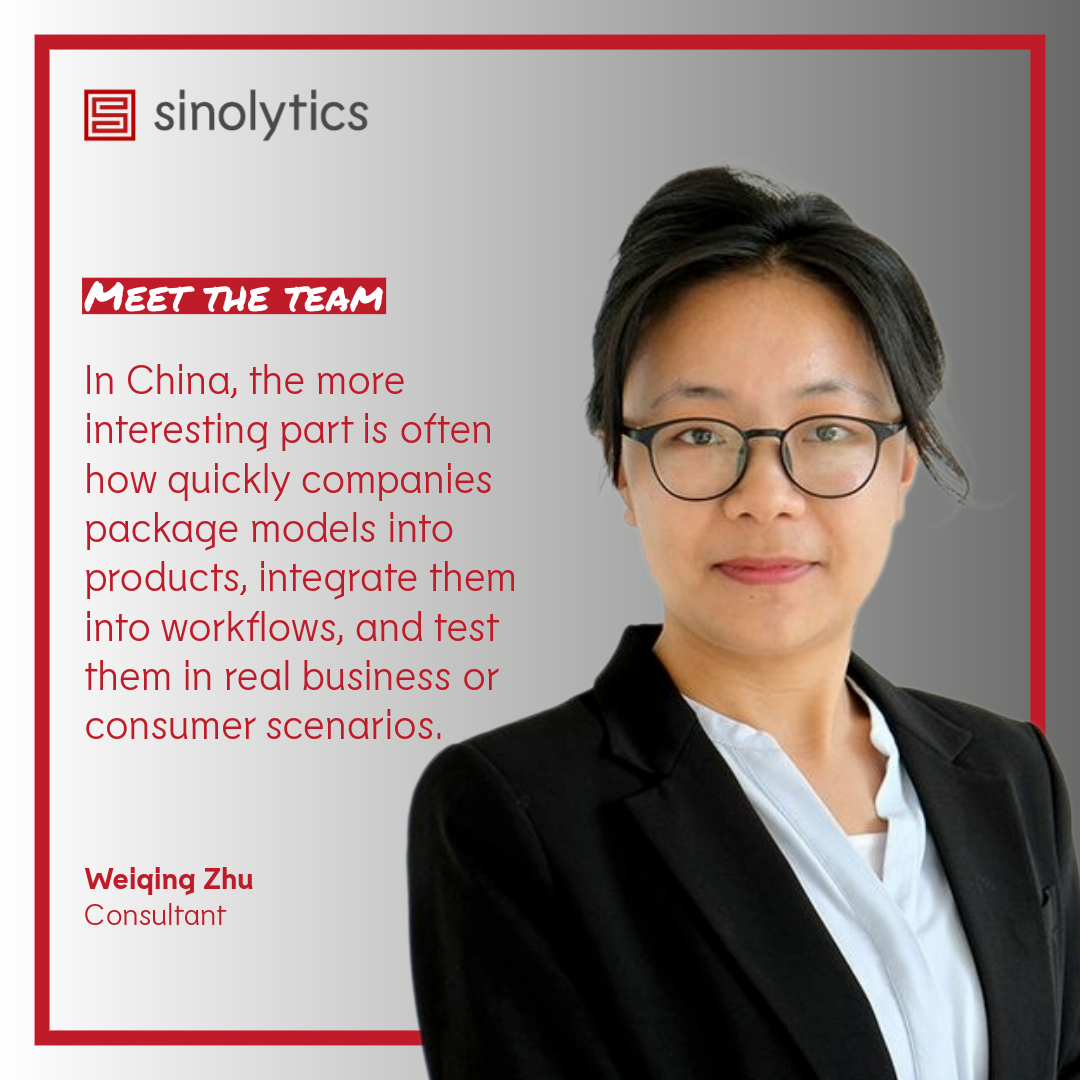
Weiqing: I would say they often underestimate the execution speed and application focus of China's AI ecosystem. Outside observers usually compare foundation models directly, for example, whether a Chinese model is as good as GPT or Claude. But in China, the more interesting part is often how quickly companies package models into products, integrate them into workflows, and test them in real business or consumer scenarios. That ability to move from model to application is probably still underestimated.
Weiqing: One example is my work on Geolytics.Hub. I was involved in designing parts of the underlying data architecture and information structure that allow analysis and research outputs to be stored consistently, retrieved efficiently, and delivered in a way that users can actually work with. What I like about this project is that it's not just an internal prototype: large parts of Geolytics.Hub are already accessible to clients and demo users. And for clients, parts of the Hub can also be delivered in a more structured way via an API (where relevant). For me, "juggling data" is not just about managing information, it is about building systems that turn information into something people can reliably access, search, and use.
Weiqing: From my perspective, people often underestimate how much AI depends on the quality and structure of the underlying information. Models are only one part of the story. If information is difficult to find, inconsistent, or poorly organized, even very capable models will struggle to produce reliable results. One thing I find interesting is that as AI becomes more powerful, high-quality data and analysis become more valuable, not less. AI can help process information faster, but it cannot replace the need for trustworthy, well-structured information in the first place. Working closely with data also makes you very aware of what is realistic, what is easy to prototype versus what is difficult to make reliable and useful over the long term.
