


Technology
China's AI+ Energy Plan: New opportunities and new barriers for foreign firms
Read more


A comparison of monthly active users (MAU) between January and March 2026 shows that Doubao continues to dominate in scale, with MAU roughly twice that of the second-largest player in March 2026. This confirms its strong lead in the current market landscape. This position was largely driven by large-scale promotional campaigns during the Chinese New Year period, with major players such as Alibaba, Tencent, and ByteDance investing heavily in user acquisition and ecosystem-driven engagement.
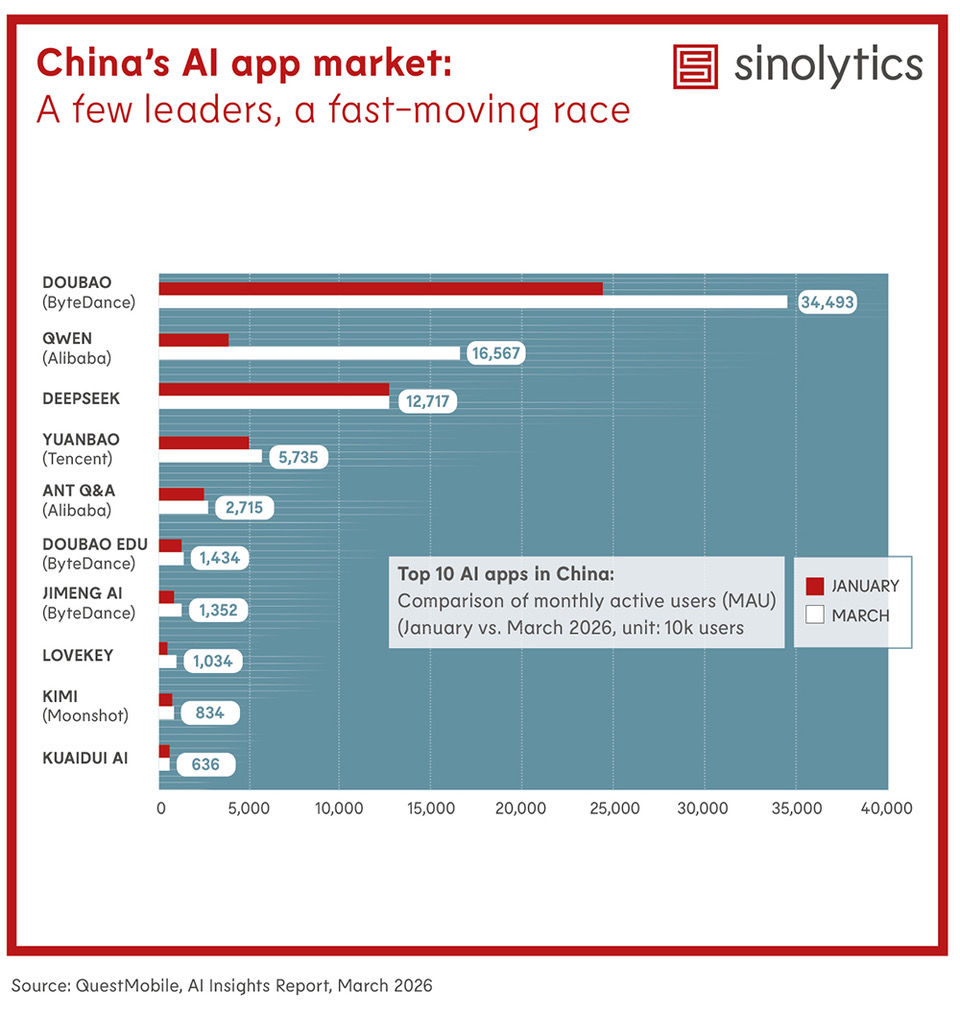
Despite the emergence of clear leaders in terms of scale, the Chinese AI app market remains highly fluid. Between January and March 2026, leading platforms were able to add tens of millions of users within a short time frame, demonstrating that market shares can still shift materially. For example, Qwen recorded the strongest MAU growth over the period, highlighting that competitive positions remain contestable. This indicates that large-scale user gains relative to competitors are still achievable at this stage of market development.
DeepSeek shows only marginal MAU growth between January and March 2026, increasing by just 63 units. This indicates that the rapid user expansion observed during its breakout phase in early 2025 has slowed, suggesting a transition toward a more stable growth trajectory. Despite limited participation in large-scale promotional campaigns, the platform has maintained a stable user base, indicating resilient underlying demand. Recent hiring activity shows a stronger focus on product roles, indicating a potential increase in efforts on application development.
While leading apps such as Doubao have achieved substantial scale, this growth comes with high computational costs. Daily token consumption has increased sharply, rising from relatively low levels in 2024 to over 100 trillion tokens within less than two years.
At this scale, platforms rank among the most compute-intensive globally. As a result, they are beginning to explore monetization strategies, with Doubao reportedly preparing to launch subscription-based pricing tiers, signaling a shift from growth-driven expansion toward greater sustainability.

