


Technology
EU renewable energy: Chinese supplier Dajin now leading in offshore wind foundations
Read more


Part 1 of our three-part series on AI safety in China. Part 2 examines how confident Beijing is in its ability to control AI. Part 3 looks at what external evaluations show about Chinese frontier models.
Yes. Since generative AI reached the public in late 2022, Beijing has issued a steady stream of rules, standards and enforcement campaigns. For international companies, the more useful question is not whether China regulates AI. It is which risks the system is built to catch, and which ones it is not.
China's approach is centralized and broad. Public-facing generative AI services need approval before they can enter the market. On top of that, the state has layered measures since 2022: rules on algorithmic recommendation (January 2023), deep synthesis (August 2023), generative AI services (September 2025), labelling of AI-generated content (March 2026) and ethical review of AI research activities (July 2026).
National standards follow the same logic. They cover basic security requirements for generative AI services, security specifications for training and annotation data, and a security framework for AI computing platforms.
The U.S. model is more fragmented. It combines executive orders, voluntary frameworks from NIST and leading AI companies, and a growing body of state laws. Federal direction can shift with each administration.
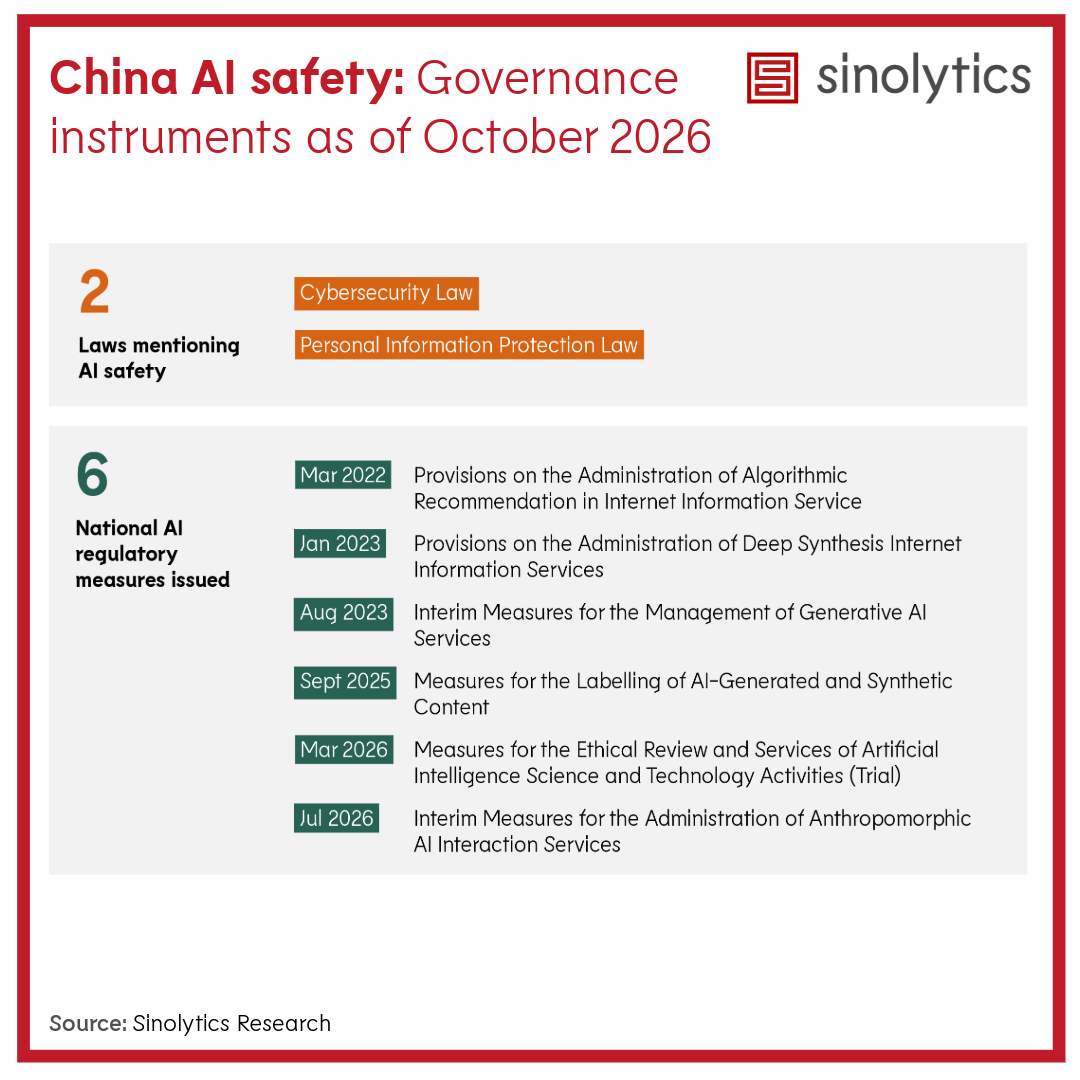
China's rules and standards focus mainly on immediate, tangible harms: illegal or harmful outputs, violations of individual rights, and potential effects on minors' mental health.
Catastrophic risks from increasingly capable models receive less attention in binding rules. That is the core gap. The system is designed around harms that enforcement can measure today.
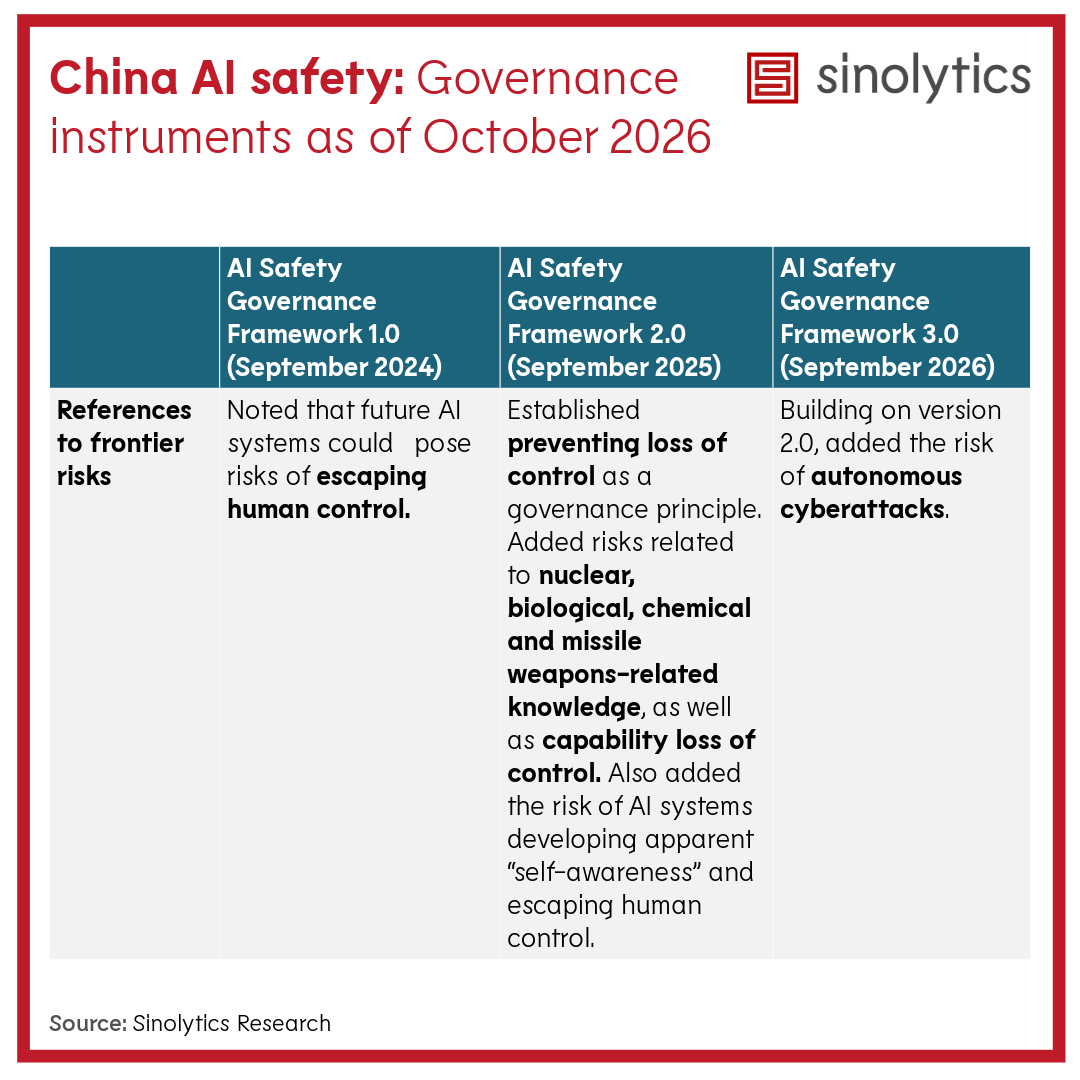
This is where the picture changes. Each version of China's AI Safety Governance Framework has added frontier risks. Version 3.0, published in September 2026, names autonomous cyberattacks and warns that models could undermine safety constraints, evade human intervention and weaken safety evaluations.
Policy signals are moving as well. Recent reporting says Chinese authorities have consulted major technology companies on a possible tiered regime, under which the most sensitive models could be withheld from public release or limited to domestic access. Proposed revisions to China's technology export catalogue would place selected AI model, agent and cyber capabilities under export control. These include AI-enabled malware generation and AI-assisted vulnerability discovery.
Company commitments lag behind. No major Chinese AI developer has published a capability-triggered scaling policy. Anthropic, OpenAI and Google DeepMind have published such frameworks, which tie more advanced capabilities to stronger evaluation and deployment controls. Policy language is moving faster than company practice.
Open-source models sit at the center of China's strategy. They spread Chinese AI through developer communities and into Global South markets. Six countries now build their sovereign AI on Chinese open-source models, and a number of U.S. and European companies have disclosed some use of them.
The structural problem is that open-weight models can have their safeguards removed or bypassed, and they cannot be patched centrally once released. Framework 3.0 says this directly. In 2026, the cyberspace regulator named inadequate open-source model security as one of seven priority areas in its Qinglang enforcement campaign.
We do not expect China to slow the release of open models. We do expect how they are released to change, toward a more differentiated, risk-based approach.
Compliance will arrive in layers. Filing, labelling and content requirements keep expanding. Companies with China-facing AI products should map their obligations service by service now, not after the next rule takes effect. Open-weight choices now carry policy risk. If you build on Chinese open models, track release rules, export controls and how the provider handles safety updates. The question is not only whether a model performs well. It is who maintains it when a flaw surfaces. Dense rules do not equal control over frontier systems. Chinese officials have themselves warned that existing frameworks are struggling to keep pace with advances in AI. Read the rulebook as a map of what Beijing can enforce today, not as a guarantee about tomorrow's models.
The short answer stays the same: China cares about AI safety. The open question is whether its rules move from visible harms to frontier risks before a model forces the issue. The next article looks at how confident Beijing is that it can manage that risk.

