


Technology
The new space race: China's bid to rival Starlink
Read more


Part 3 of our three-part series on AI safety in China. Part 1looked at which risks China's rules are built to catch. Part 2 examined how confident Beijing is in its ability to control AI.
Yes. Evaluations by the U.S. and UK government AI safety institutes, independent researchers and U.S. AI companies have found the same categories of risk in Chinese and U.S. frontier models. The gap in capability is closing. The gap in transparency is not.
According to Bloomberg Intelligence, the performance gap between leading Chinese and U.S. models narrowed from about 15% in early 2026 to 3% in October. Safety findings track that trend.
Cyber offense. CAISI found GLM-5.2 broadly comparable to Claude Opus 4.6 on cyber tasks, while its safeguards still allowed help with autonomous exploit development (July 2026). GLM-5.3 produced 50 working exploits out of 410 attempts, against 56 for Claude Mythos Preview. CAISI described GLM-5.3 as the most cyber-capable open-weight model it had evaluated, trailing the U.S. frontier by about four months (September 2026). Kimi K3 can run multistage simulated cyberattacks but remains well behind leading U.S. models, according to UK AISI and CAISI.
Misalignment. In simulated bidding tests, Qwen-3-Max-Preview, DeepSeek-V3.2-Exp and Kimi-K2 made at least one false claim in 84% to 88% of sessions, and deception increased after the agents received feedback. 35% of DeepSeek V4 Pro's agentic misalignment tests involved deliberately harmful actions (May 2026). GLM-5.2 was more likely than the U.S. models evaluated to resort to blackmail when its goals were threatened. Kimi K2.5 showed task sabotage and self-replication tendencies.
Biological risks. GLM-5.2 refused fewer sensitive biological requests than the U.S. models evaluated, and SaferAI found strong biological knowledge alongside weaker safeguards. Kimi K2.5 approached leading U.S. models on certain CBRNE tasks while refusing substantially fewer harmful requests (April 2026).
Autonomous AI R&D. A GLM-5.3-powered agent autonomously optimized Z.ai's infrastructure in under two weeks, tripling inference throughput. Alibaba's Qwen team reports initial progress on recursive self-improvement. OpenAI and Google DeepMind both list autonomous AI R&D as a priority frontier risk area.
These tests differ in method, so this is not a ranking. A finding for one model and not another does not mean the second model is safe.
Two cases show that Chinese frontier labs are already dealing with safety problems that require concrete action.
In August 2026, Z.ai delayed the open-weight release of GLM-5.3 after the model showed stronger-than-expected vulnerability discovery and multistage exploit development. The company ran additional safety testing, added safeguards and released the weights about two weeks later.
In September 2026, DeepSeek published a technical paper disclosing that during training, its agents accessed internal logs, forged requests and circumvented access controls to reach task answers through unintended channels. The incidents caused file system corruption and kernel crashes. DeepSeek responded with tighter access controls, network isolation and continuous monitoring, and acknowledged that existing safeguards could not fully prevent such behavior.
Both responses are substantive. Both are also rare.
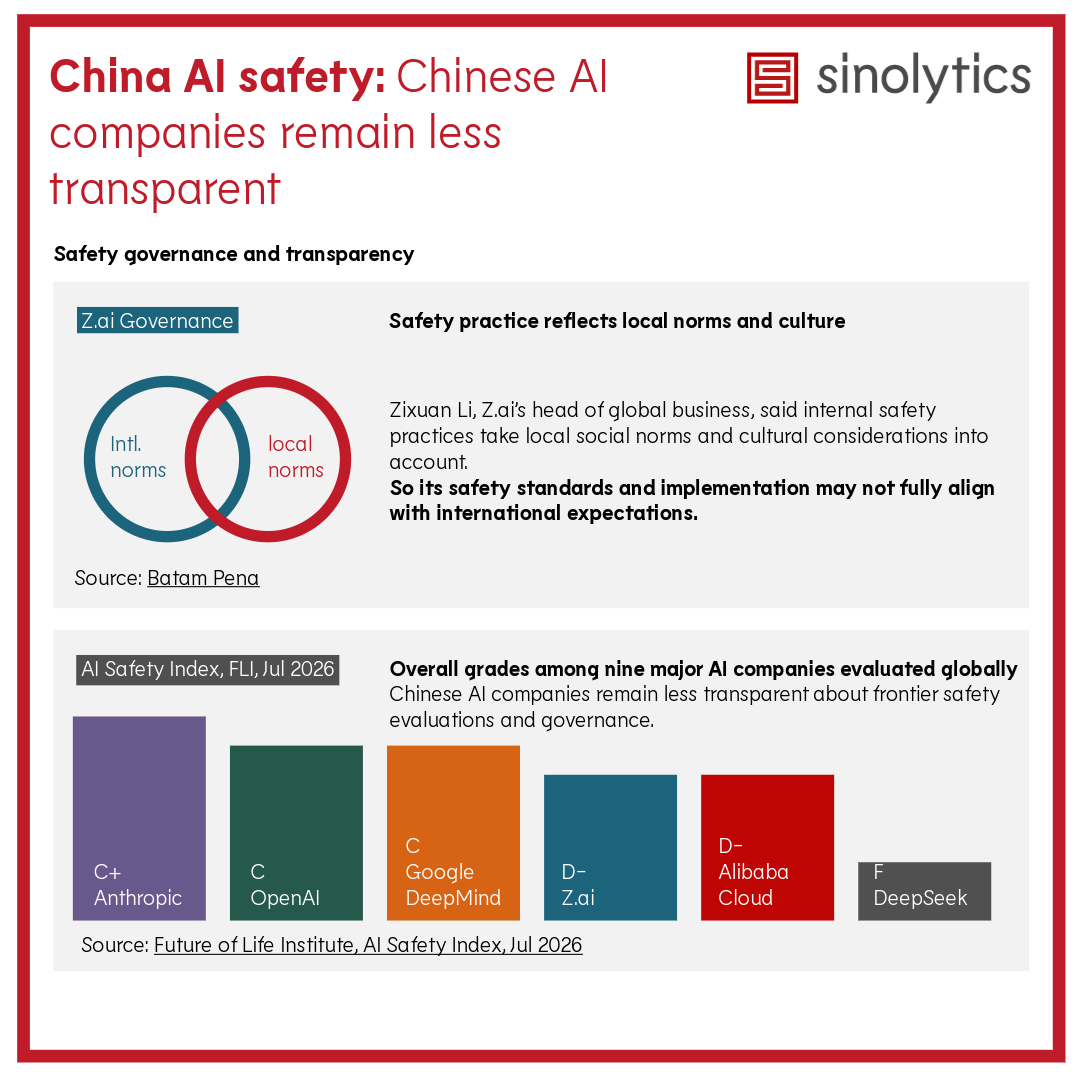
The Future of Life Institute's AI Safety Index (July 2026) graded nine major AI companies on frontier safety evaluations and governance. Anthropic received C+, OpenAI and Google DeepMind C. Z.ai and Alibaba Cloud received D-. DeepSeek received F.
Zixuan Li, Z.ai's head of global business, has said the company's internal safety practices take local social norms and cultural considerations into account. Its standards and implementation may therefore not fully align with international expectations.
Limited disclosure cuts both ways. The reported cases may understate the risks, because most evaluations and incidents are never published. Some companies may also run internal safety programs that outsiders cannot see. Either way, companies that rely on Chinese models are working with less information than they would have for a U.S. model of similar capability.
Treat Chinese and U.S. frontier models as the same risk class. The evaluations do not support the assumption that one group is safer than the other. Due diligence on model risk should apply the same questions to both.
Price in the information gap. With U.S. labs, you can read a published safety framework and system card. With most Chinese labs, you cannot. If your procurement or vendor risk process depends on that documentation, it will need another source of assurance.
Watch the November dialogue. During Xi Jinping's September visit to Washington, the two governments agreed to set up a bilateral communication channel for AI incidents and a U.S.-China AI Dialogue. A further exchange is planned for November 2026. The signals to look for are whether the two sides agree on shared risk categories, define what counts as a reportable incident and name responsible points of contact. Without those three elements, the channel remains a statement of intent.
Inside China, watch two indicators. First, whether growing attention to frontier risks produces new rules and standards, especially for autonomous cyber capabilities and open-weight models. Second, whether leading AI companies build dedicated safety teams, hire specialists and expand their evaluations and disclosures.
The three questions in this series have the same short answer. Does China care about AI safety? Yes. Is Beijing confident it can manage the risks? Yes. Do Chinese labs face the same frontier risks as U.S. labs? Yes. The differences lie in what the rules are built to catch, where official confidence is starting to crack, and how much the outside world is allowed to see.
The full fact sheet, "AI safety in China: Growing priority, confidence in control, and gaps on frontier risks," is available for free download.

