

Technology
Test 3 20260303
Read more


Part 2 of our three-part series on AI safety in China. Part 1 looked at which risks China's rules are built to catch. Part 3 examines what external evaluations show about Chinese frontier models.
Very. Available evidence suggests the leadership treats AI risk as something that government oversight and technological progress can handle, not as a threat beyond human control. That confidence has a history, and it has started to meet its limits.
In January 2025, Vice Premier Ding Xuexiang told the World Economic Forum in Davos: "China has a strong governance and regulatory system, supported by robust institutional measures. We are confident in our ability to manage and use AI effectively."
Alibaba Chairman Joe Tsai suggested in October 2025 that this confidence extends to frontier loss-of-control risks. Officials "don't talk about it too much because they believe that they could control it better, maybe better than in a society here in the U.S.," he said, adding that "there's some lingering fears."
Within the national security establishment, the view is that today's safety shortcomings can be closed over time. Wu Shizhong of the Chinese Academy of Engineering wrote in August 2025 that "through technological innovation and innovative approaches to governance, we can effectively manage and mitigate risks." Zhang Zhen of CNCERT went further, describing AI as "an important tool for safeguarding overall national security."
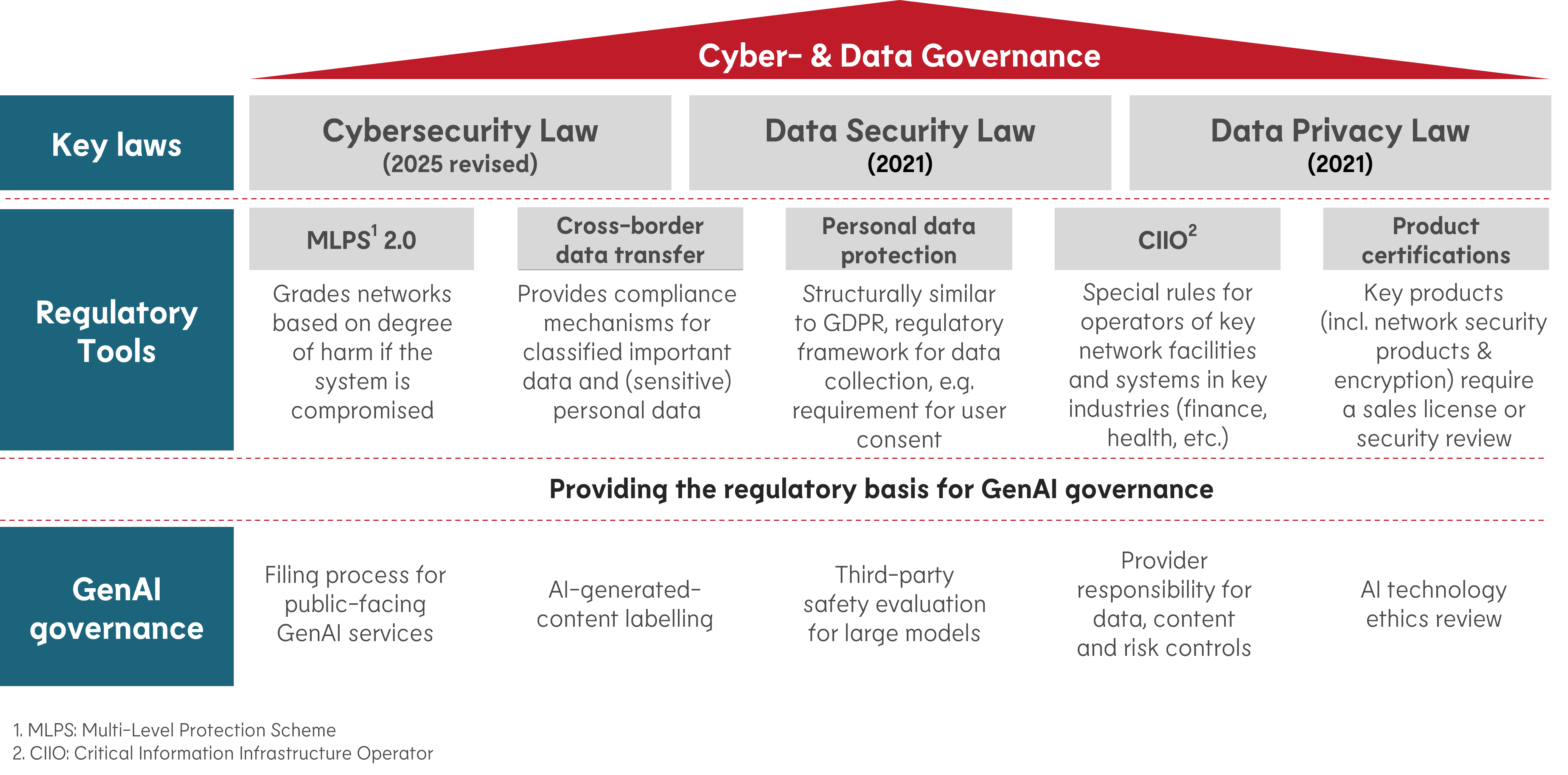
Beijing has spent a decade building a regulatory system for the internet, cybersecurity and data security. That experience appears to have reinforced the belief that AI risks can be handled by adapting existing mechanisms.
Enforcement is the clearest evidence. In 2025, the Cyberspace Administration of China extended its long-running Qinglang campaign to AI. The first phase acted against more than 3,500 noncompliant AI products and 3,700 accounts and removed more than 960,000 pieces of content.
In 2026, the campaign moved into model security and corporate compliance. The first phase covered more than 14,000 AI products and 26,000 accounts. The CAC reported corrective measures by Alibaba, Zhipu, DeepSeek and MiniMax on content screening, training data security and safeguards against AI-assisted cybercrime, backed by inspections and interviews. By September, the second phase had removed more than 5.61 million content items and acted against more than 49,000 accounts.
A regulator that can summon the country's leading AI developers and publish their corrective measures has reason to believe it can hold them accountable.
Since 2026, Chinese officials have become more explicit that frontier AI could outpace existing safeguards. On September 1, 2026, Wang Lihong of the CAC's Cybersecurity Coordination Bureau said that "rapid advances in AI model capabilities are disrupting traditional security paradigms and heightening risks of extreme loss of control." Some frontier models, he said, have improved vulnerability discovery capabilities that challenge "conventional cybersecurity defenses based on patching and static rules."
Two weeks later, Minister of State Security Chen Yixin wrote that "the rapid advancement of AI has outpaced traditional governance frameworks, leaving existing laws, ethical principles, and oversight mechanisms struggling to keep pace."
The AI Safety Governance Framework 3.0, published the same month, states that autonomous learning and recursive self-improvement could exceed human ability to predict and control AI behavior. It names unreliable safety mechanisms and unintended model behavior as key risks, including models that undermine safety constraints or evade human intervention.
An August 2026 article co-authored by local cyberspace authorities and a CNCERT branch found "significant gaps" in AI agent security, with existing safeguards "falling short of the requirements for large-scale deployment."
These warnings do not mean Beijing has lost faith in state governance. They point to a distinction that is becoming visible in official language: regulating AI companies is one task, and maintaining technical control over highly autonomous systems is another.
The first task plays to China's strengths. Market-entry approval, registration, inspections and campaigns give the state direct leverage over developers. The second task does not respond to leverage. A model that can discover vulnerabilities faster than defenders can patch them does not become safer because its developer received a regulatory interview.
Kevin Rudd, former Australian Prime Minister, made a related point about cyber defenses in August 2025. Chinese officials, he said, "have a level of self-confidence about their own cyber defences that, in my judgment, exceeds the reality," because those defenses were built against domestic information risks rather than against autonomous technical threats.
Expect enforcement to keep expanding. The Qinglang campaigns show how Beijing responds to a risk it believes it can manage: with inspections, published corrective measures and content takedowns. Companies operating AI services in China should assume the next campaign is already being planned and that model security, training data and open-source practices are on the list.
Watch where the confidence breaks down. The gap between regulatory control and technical control is where new rules will appear first. Autonomous cyber capabilities, AI agents and open-weight models are the current candidates.
Do not read confidence as complacency. Officials who publicly acknowledge that their frameworks are struggling to keep pace are preparing the ground for stronger measures. That is a signal to act on, not to discount.
Part 3 of this series looks at what external evaluations show about Chinese frontier models, and how transparent their developers are about what they find.

