


Technology
Chinese memory chips: State-backed players rise to challenge global giants
Read more


Dajin Heavy Industrial has overtaken Sif Holding as the leading supplier of offshore wind foundations to the European market. Measured by monopile sales value, Dajin's share rose from 18.5% in 2024 to 29.1% in the first half of 2025, while Sif's fell from 23.1% to 18.2%, according to Frost & Sullivan. Dajin's export revenue, the bulk of which derives from foundation deliveries to Europe, grew by 165% year-on-year in 2025 and by a further 20% in the first half of 2026.
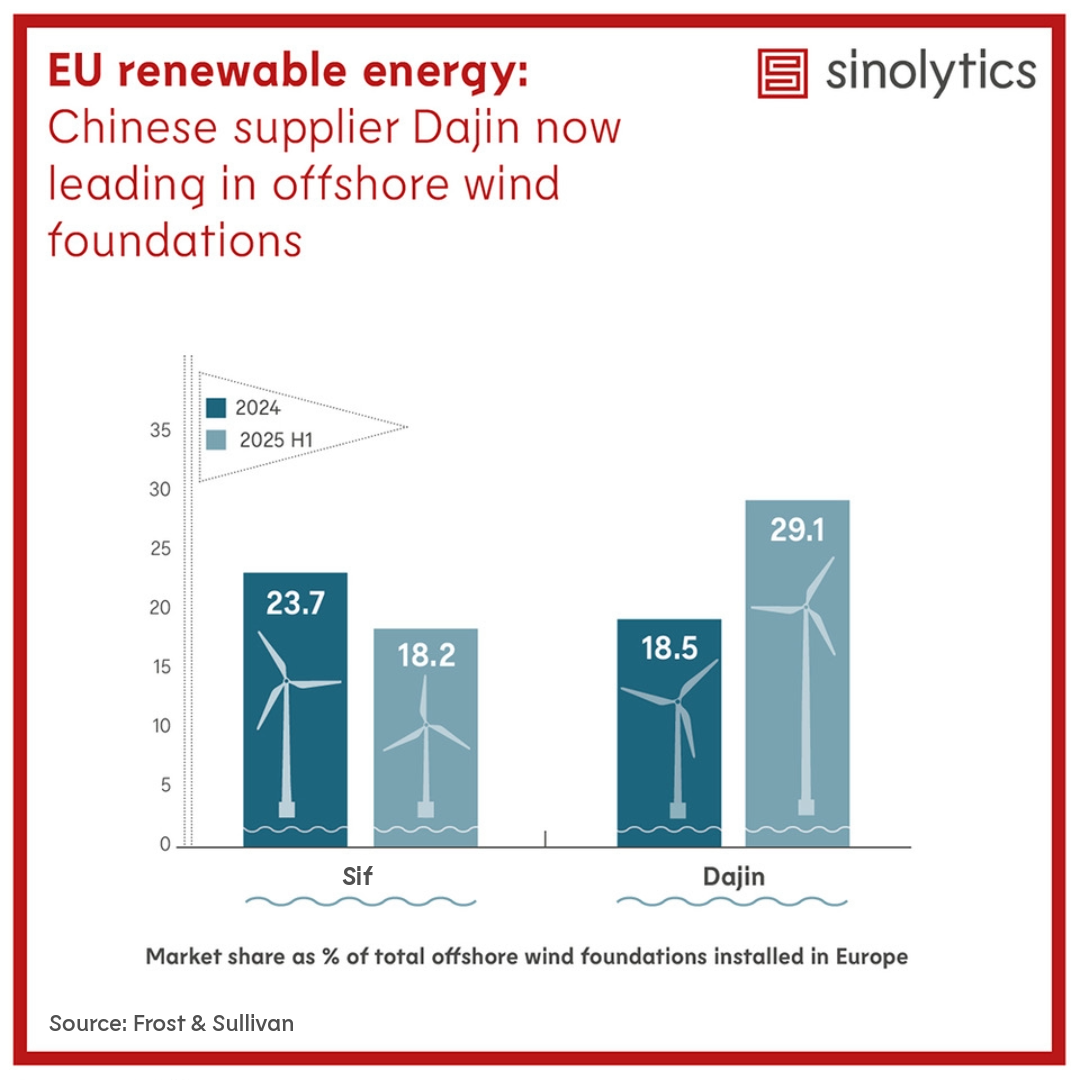
Dajin's H1 2026 interim report discloses export deliveries of offshore structures approaching 120,000 metric tons, consisting mainly of monopiles shipped on delivered-at-place terms from its production base in Penglai, Shandong Province, to Europe. Set against export revenue of 2.68bn RMB, this implies roughly 2,820 EUR per metric ton, compared with approximately 3,535 EUR per metric ton for Sif.
Dajin therefore lands finished monopiles in Europe some 20% below Sif's price at the quay, and does so despite bearing the freight costs from Shandong, which Sif does not incur. The true price gap is more likely to be wider than narrower.
Crucially, this is not achieved at the expense of profitability. Dajin's export gross margin reached 39.36% in the first half of 2026, an increase of 8.67 percentage points year-on-year. The company is expanding its margin substantially while gaining share, rather than discounting to buy position. This indicates that it retains considerable room to absorb a moderate trade measure and continue competing.
Dajin's advantage extends well beyond factory cost. It has systematically dismantled the constraint that previously insulated European yards. Specialist heavy-transport capacity is the recognized bottleneck in this market: vessels capable of carrying XXL monopiles are scarce and typically booked one to two years in advance. Dajin now operates its own fleet. Its first 40,000 dwt deck carrier entered service in February 2026 and has already completed two monopile voyages to European ports, with further vessels to follow.
The company has moved downstream as well, securing four wind port terminals in Germany, Spain and Denmark spanning the North Sea, Baltic and Atlantic corridors, and winning a first marshalling contract worth 1.34bn RMB in November 2025 covering manufacture, transport, storage and assembly.
Manufacturing capacity underpins this position: approximately 700,000 metric tones a year across two bases, with rolling capability of up to 16 metres in diameter against an industry average of around 12.5 metres, and specification for floating foundations.
Four regulatory developments will determine whether Dajin's leading position in Europe proves durable.
Europe requires roughly 7 GW of new offshore wind capacity a year to 2030, and its own yards cannot deliver it, constrained as they are by land, ports, skilled labor and cost. Developers including Ørsted and RWE turned to Chinese supply precisely because European fabricators failed to deliver on schedule. Restricting that supply would raise project costs and place timetables at risk; permitting it entrenches dependence on Chinese manufacturing for critical energy infrastructure, at a time when Europe's incumbents are operating under financial pressure.
Dajin's hedge is to build inside Europe. It has allocated 20% of its listing proceeds to a European assembly base. European manufacturing would blunt origin-based duties and satisfy local-content criteria simultaneously. In that case, trade defense alone would be unlikely to alter the competitive position, unless restrictions based on ownership and control were introduced alongside it.

