


Technology
China's embodied intelligence frenzy: Capital, big tech, automakers, and policy warnings
Read more


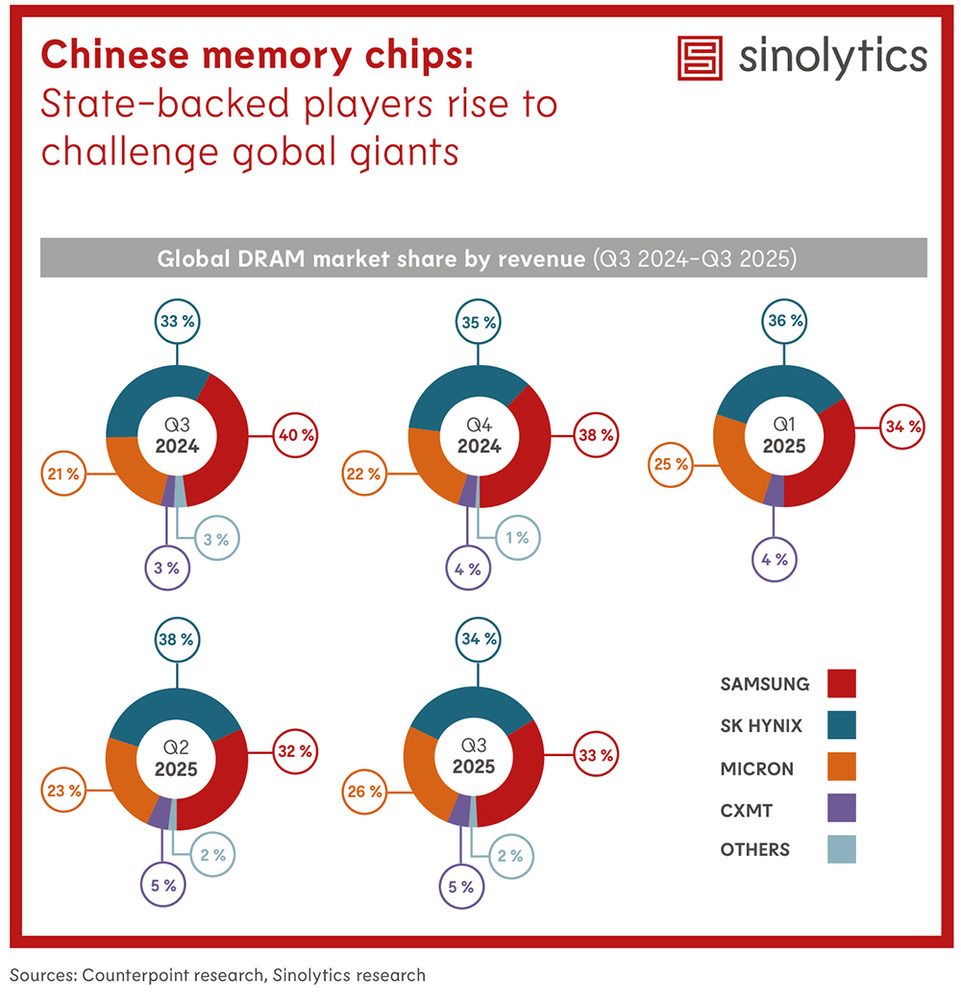
China's memory chip sector is experiencing a boom, driven by the surge in AI computing power demand. Domestic players like Yangtze Memory Technologies (YMTC) and ChangXin Memory Technologies (CXMT) are rapidly expanding, with YMTC's revenue doubling and CXMT becoming a top global DRAM manufacturer.
The rapid ascent of these firms is no accident. It is the result of a concerted industrial strategy driven by “national will, local execution, and long-termism”. The inland cities of Wuhan and Hefei, where YMTC and CXMT are based, have become epicenters of this strategy. Local governments have poured billions into these ventures, taking on significant risk to nurture them through the capital-intensive R&D phase. For instance, the Hefei government provided 80% of the initial 18 billion RMB investment for CXMT and continued its support through years of losses, demonstrating a powerful commitment to building a sovereign chip industry.
Despite their impressive growth, China’s memory champions face a steep climb. The global market remains dominated by three giants—Samsung, SK Hynix, and Micron—who collectively control over 90% of DRAM revenue. Chinese firms are still in the role of “supplementary suppliers” with limited pricing power. To secure their future, they must innovate beyond the current AI-driven boom.
As expert Sishi Xie notes:
“Leveraging China’s vast domestic market and a highly collaborative local supply chain, domestic memory champions are accelerating their R&D and process improvements. This strategy is proving effective at narrowing the technology gap with established overseas giants.”
The rise of YMTC and CXMT signifies a crucial geographic shift in China's tech landscape. It is fostering a new semiconductor hub in Central China, moving the industry's center of gravity away from the traditional coastal areas. Both Wuhan and Hefei are building extensive industrial clusters around their leading firms to enhance efficiency and resilience. Wuhan is developing a “5-minute collaboration circle” around YMTC to create a world-class memory and storage ecosystem. This cluster strategy not only drives local economic growth but also strengthens the security of the national supply chain.
Article header image generated with AI.

