


China Business
China's exports to Africa surge: Capital goods drive Belt and Road expansion
Read more


Bin: A significant part of my work involves tracking and analyzing China's economic development: monitoring macroeconomic trends, identifying growth drivers, and understanding how economic shifts connect with policy. Beyond that, much of my sector focus is on cleantech and renewable energy, particularly when viewed through an international and geopolitical lens. The central question is often what China's role in these sectors means for foreign companies and how they are responding to increasingly strong competition from Chinese players.
Bin: Cleantech, without question. Economic analysis is certainly a core part of what I do, but cleantech is probably the most distinctive focus of my work, from the electric vehicle sector, where I have been deeply involved for some time, to wind power, and more recently hydrogen energy. What makes it particularly interesting is the extent to which these two dimensions, economic development and the energy transition, are intertwined, as China is increasingly relying on the cleantech sector for its economic growth.
Bin: Because it is rapidly becoming a major field of strategic competition. Chinese companies already hold very strong positions across many cleantech sectors globally, and that creates real pressure for companies in Europe and elsewhere. The question is no longer simply what China is doing, but how foreign companies navigate decision-making in sectors where Chinese firms are already highly competitive, and in many cases dominant.
Bin: Yes. The assumption that China's competitiveness is essentially the product of government subsidies. That is part of the story, but it is far from the complete picture. Chinese companies have also emerged from extraordinarily fierce domestic competition and have invested heavily in R&D. That is a significant reason why they are so competitive today, not just on price, but at the technology and product level as well. In that respect, the research focus on the China policy should not only cover subsidies but also support for innovation and consumer demand.
Bin: Precisely. Policy discussions tend to remain anchored on the subsidy question, as though government support alone explains everything. But that does not reflect the full reality. If you look more closely at the market, it becomes clear that the pace of competition, speed of iteration, value chain integration and sophistication of product development all play a critical role.
Bin: On the China side, the most meaningful shift is in hydrogen. China has established strong positions across many cleantech sectors, but hydrogen has been a relative gap. And that is now changing. The government has elevated hydrogen as a priority growth sector in the current planning cycle, which I think marks a genuine inflection point.
On the European side, I would say there is a clear and accelerating trend toward stronger trade defense measures and public procurement preferences for domestic cleantech vendors. Looking at the relationship between China and Europe as a whole, cleantech is increasingly becoming a major strategic and economic battleground. Both sides view it as a sector of the future, and neither is willing to cede ground.
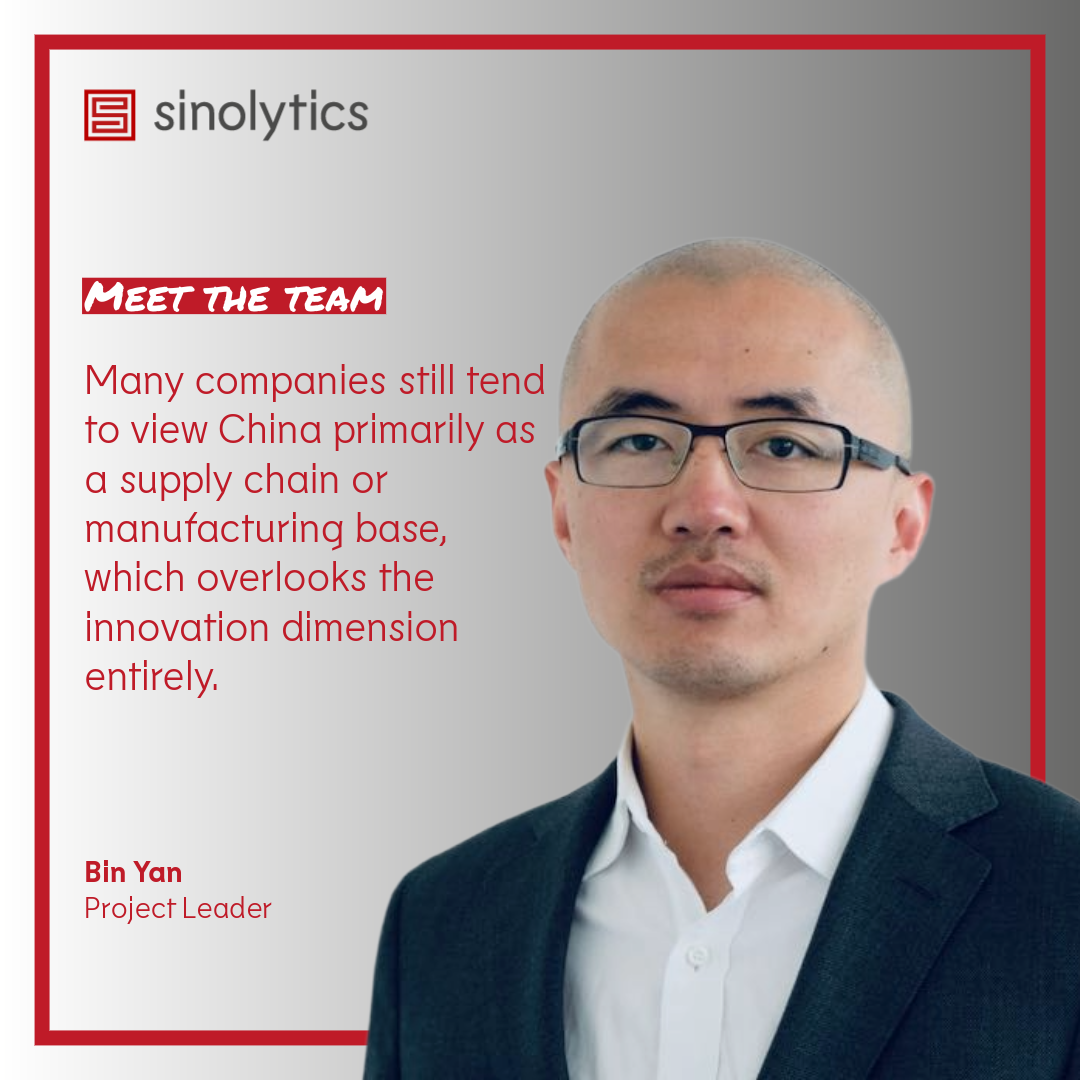
Bin: One that I find particularly relevant is how companies can make better use of China's R&D capabilities. Many companies still tend to view China primarily as a supply chain or manufacturing base, which overlooks the innovation dimension entirely. A more productive question is how to integrate China's R&D strengths into a company's broader global strategy.
There is also a persistent stereotype that China offers weak intellectual property protection. That view is increasingly outdated. As China's own technology companies have grown, the country has had stronger incentives to strengthen its legal infrastructure and protect domestic innovation. That is a meaningful consideration for any company seriously evaluating R&D operations in China.
Bin: It is. In a number of sectors, the Chinese market has changed profoundly over the past decade. Companies that are still operating on outdated assumptions, or relying on past success, risk misjudging how significantly the landscape has shifted, not only at the policy level, but also in terms of competition, consumer expectations, and societal dynamics.
Bin: The dashboard is designed for those who need a clearer and more structured picture of China's current economic trajectory. It brings together key indicators and presents users with a coherent view of where things stand, across demand-side and income-side dimensions, and in historical context. The real value, however, lies not just in the data itself, but in our analytical layer: how we interpret that data and how we assess the broader economic outlook.
Bin: Good analysis must connect policy, market dynamics, and international implications in an integrated way. In areas like cleantech, it is simply not sufficient to focus only on subsidies or only on trade tensions. You need to understand the full system, including industrial policy, corporate behavior, competitive dynamics, and how all of that ultimately affects the strategic decisions of companies operating internationally.

