


China Policy
Karl Heinlein on export controls, supply chains, and where the real risks sit
Read more


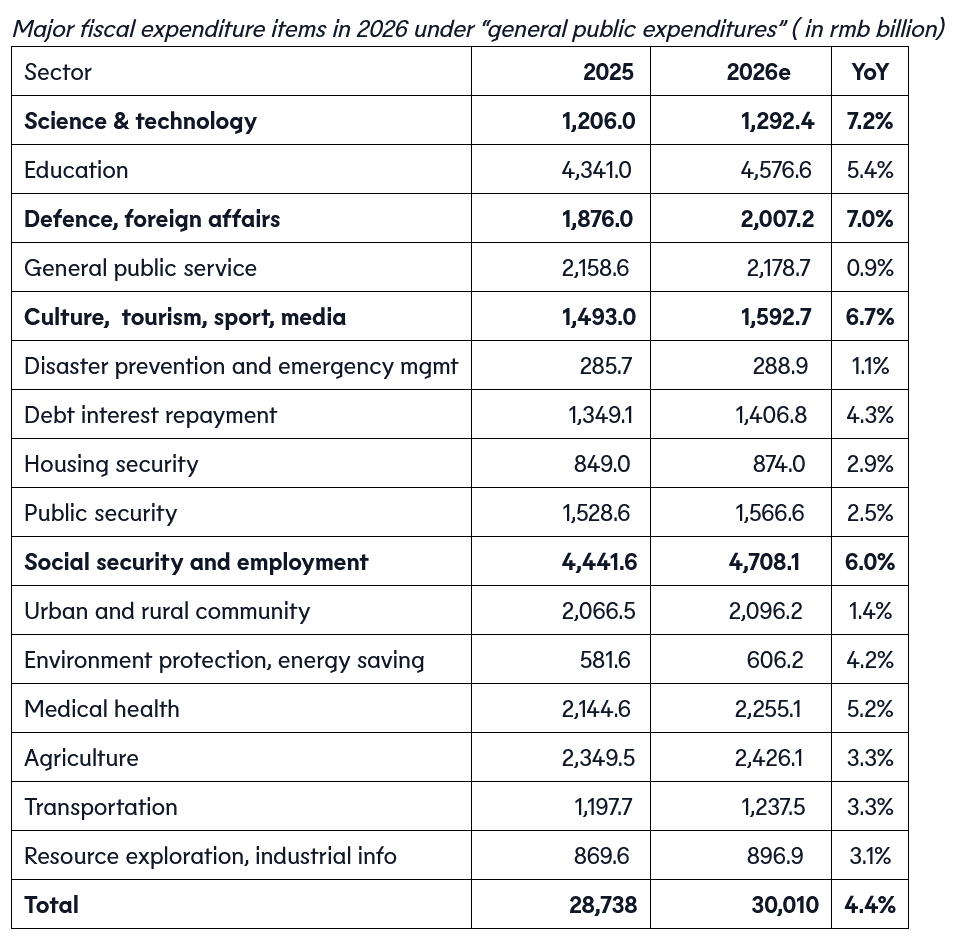
Beijing has set its official fiscal deficit target for 2026 at 4% of GDP, identical to the previous year, signaling a commitment to fiscal stability. However, the “broad” fiscal deficit, which accounts for special sovereign bonds and stabilizing funds, is projected at 9.2% of GDP. This indicates that while the official budget remains controlled, the government will continue to leverage off-budget channels to inject stimulus into the economy and support key sectors. Overall general public expenditure is budgeted to grow by 4.4% to 30.01 trillion RMB , aligning with the lower bound of the 2026 GDP growth target.
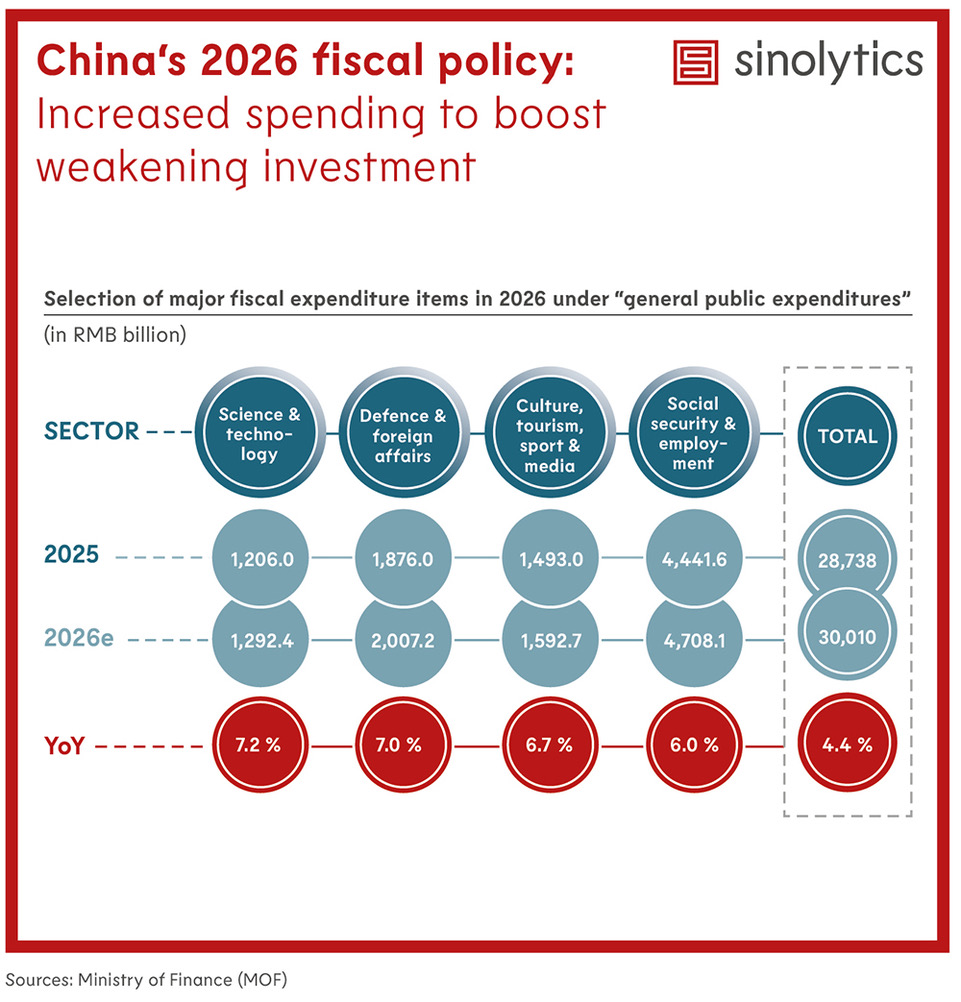
The 2026 budget clearly reflects the government’s strategic priorities. Spending on Science and Technology is set to increase by 7.2%, and Defense and Foreign Affairs expenditures will grow by 7.0%. This underscores the leadership’s focus on fostering indigenous innovation and bolstering national security. As one analyst notes, “The significant spending increases in science, technology, and defense underscore China’s commitment to its long-term strategic goals of self-sufficiency and national security.” While social security spending will also outpace the overall budget growth at 6.0%, the government has avoided ambitious plans for a major expansion of the social safety net.
In a direct response to weakening investment—which saw a 3.8% decline in 2025—policymakers are expanding support for infrastructure projects. The government will deploy 800 billion RMB in “policy financing instruments” to boost infrastructure investment, a substantial increase from the 500 billion RMB allocated in 2025. Conversely, support for consumption is being scaled back. The national trade-in scheme for consumer goods will be extended but its funding is reduced from 300 billion RMB to 250 billion RMB. This adjustment signals that despite the long-term goal of rebalancing toward a consumption-driven economy, Beijing is prioritizing investment to ensure short-term economic growth.

