


Technology
China's semiconductor M&A: More deals, rising failure rates
Read more


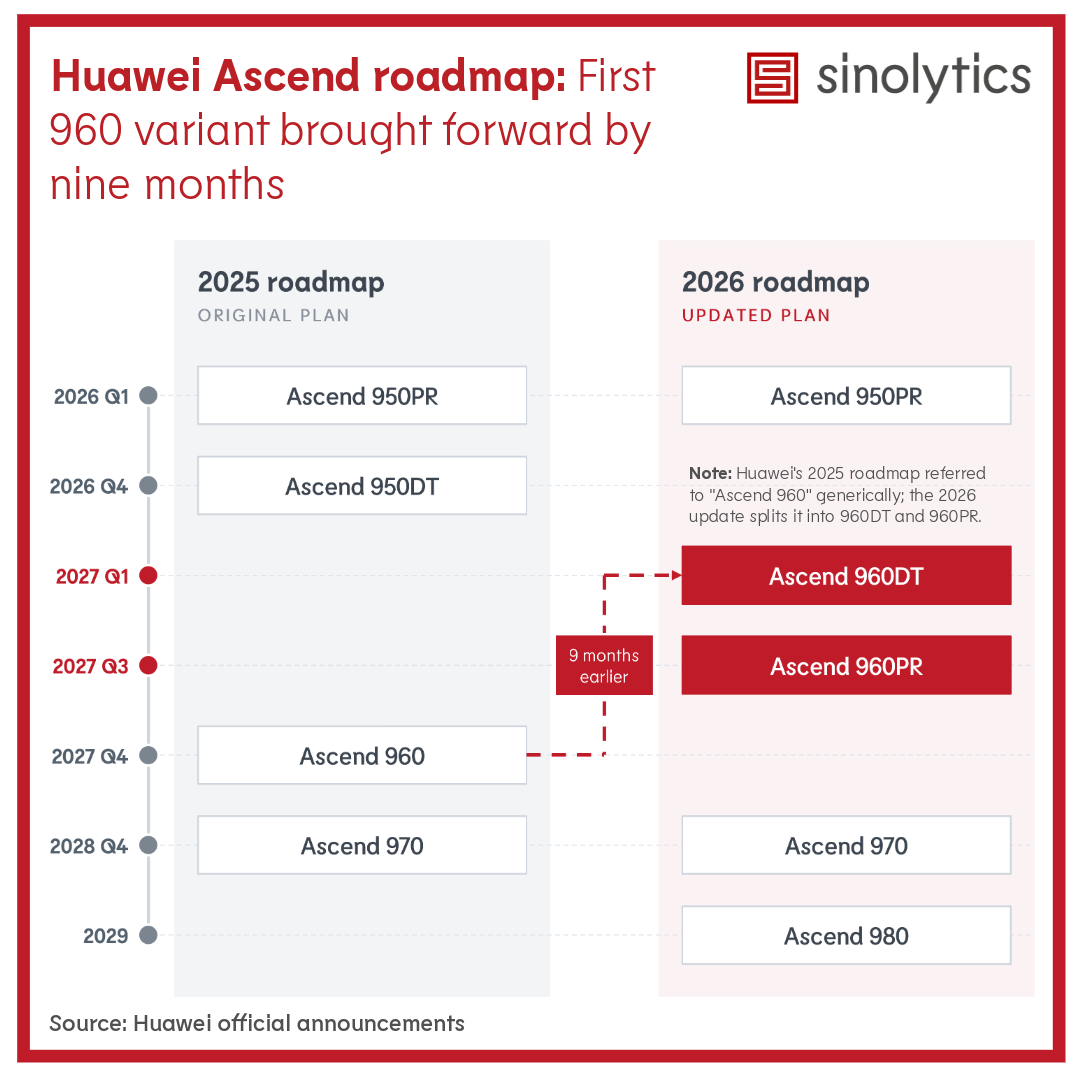
At HUAWEI CONNECT 2026, Huawei announced that Ascend 960DT AI accelerator will be launched in Q1 2027, three quarters earlier than previously planned, while 960PR is scheduled for Q3 2027, one quarter earlier than planned. Huawei also confirmed Ascend 970 for 2028 and, for the first time, added Ascend 980 to its public roadmap for 2029.
Huawei’s roadmap shows each new Ascend generation handling more AI calculations. Listed FP8 performance rises from 2 PFLOPS on the 960DT/960PR to 3.6 PFLOPS on the 970 and 7.2 PFLOPS on the 980. At FP4 precision, the 970 and 980 are listed at 14 and 28 PFLOPS, respectively.
The Ascend 980 is also listed with 38.4 TB/s of HBM bandwidth and 8 TB/s of chip-to-chip bandwidth. These figures describe how quickly the chip can access memory and exchange data with other chips.
- FP8: FP8 is an 8-bit format for representing numbers in AI calculations.
- FP4: FP4 is a 4-bit format for representing numbers in AI calculations.
- PFLOPS: One PFLOP is one quadrillion (10¹⁵) floating-point calculations per second, a measure of computing speed.
- SuperPoD, Huawei’s system for connecting thousands of AI accelerators into a single large-scale computing unit.
Huawei said that more than 1,000 SuperPoD systems based on Ascend 910C have already been deployed in commercial data centers, while Ascend 950 SuperPoD has entered volume commercial use. Meanwhile, an Atlas 950 SuperCluster with 256,000 accelerator cards is already being deployed. The newly announced Ascend 960E SuperPoD further scales a single system to 4,096 cards, targeting 8 EFLOPS of FP8 compute and 1 PB of HBM, while introducing NPO optical interconnect for the first time.
DeepSeek is emerging as an important validation of demand for Huawei Ascend chips, although adoption is more advanced for inference than for training.
Bloomberg reported that DeepSeek plans to deploy at least 160,000 Ascend 950DT accelerators at a data center in Inner Mongolia, mainly for running models and inference rather than training. Separately, The Information reported that DeepSeek has made expanding the use of domestic chips for training a priority and expects to receive a new batch of Huawei chips for training as early as Q4 2026; however, its most advanced models still rely on Nvidia chips for training.
Huawei acknowledged that supply constraints are limiting its overseas expansion: Huawei said it is still unable to fully meet domestic demand for AI computing equipment and therefore does not currently plan a "full-scale" international expansion. While the company is already supplying some overseas markets, volumes remain limited.

