


Technology
China's embodied intelligence frenzy: Capital, big tech, automakers, and policy warnings
Read more


On 10 July, a Long March 10B first stage returned after an orbital mission and was captured by a flexible net system on an offshore platform. The architecture differs from a conventional vertical landing: the booster descended toward the platform using landing hooks, while the net absorbed its remaining energy before the stage was secured.
The mission marked China’s first successful recovery of an orbital-class first stage. CASC has said it plans a reused first-stage flight test by the end of 2026, but no such reflight had been publicly confirmed at the time of writing.
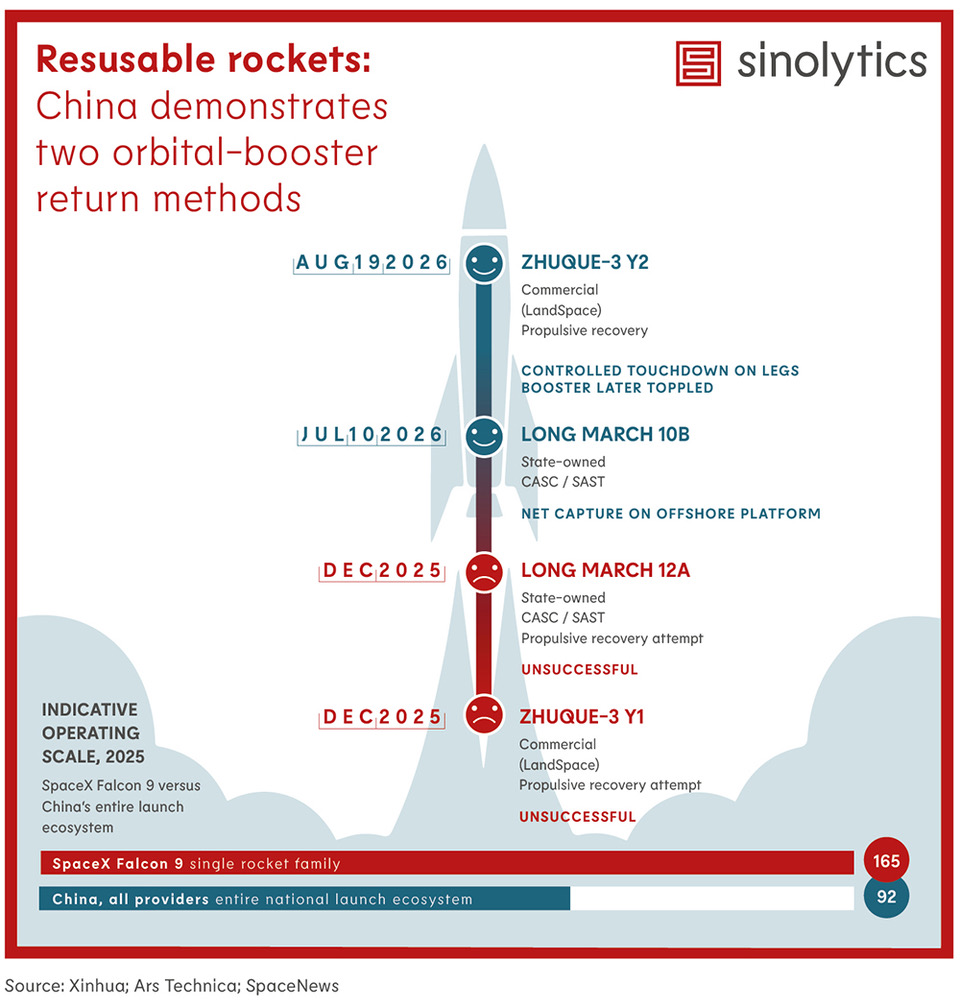
On 19 August, LandSpace’s Zhuque-3 Y2 launched a payload into orbit and its first stage completed a controlled touchdown on deployable legs at LandSpace Landing Site #1 in Minqin County, Gansu. The event marked China’s first successful land-based, legged touchdown by an orbital-class booster.
LandSpace described the mission as a full success. However, subsequent reporting indicated that the booster toppled after landing. That distinction matters: a controlled touchdown is a significant technical step, but the stage’s condition for refurbishment and reflight remains unclear.
“This mission marks China’s first-ever successful recovery attempt of the first stage of an orbital-class launch vehicle using landing legs, and China’s first successful booster recovery on land.” — LandSpace, 19 August 2026
The two missions demonstrate different approaches. Long March 10B used a state-backed offshore capture system, whereas LandSpace pursued a propulsive return and landing-leg architecture closer to the basic operating concept used by Falcon 9.
This division is strategically relevant. Beijing’s push towards a “strong aerospace nation” has unleashed not only state-owned assets but also given rise to a crowded commercial space sector. They pursue separate technical paths towards reusable-launch development. The next test is whether either can convert a one-off recovery milestone into repeatable operations.
SpaceX flew 165 Falcon 9 missions in 2025, compared with 92 orbital launch attempts across China’s entire launch sector. These figures are not directly comparable: Falcon 9 is one predominantly reusable rocket family, while China’s total spans many state-owned and commercial vehicle families. Still, they show the scale of SpaceX’s operating advantage.
The more consequential gap is not the ability to return a first stage once. It is the accumulated capability to inspect, refurbish and refly boosters at high cadence. China has now demonstrated recovery architectures; it has not yet publicly demonstrated a confirmed reflight of a recovered orbital-class first stage.
Reusable launch systems can reduce hardware demand per mission and support higher launch frequencies—but only when recovery leads to reliable, rapid reuse. The technology can also provide nations with a strategic advantage as space increasingly becomes a domain linked to military power and defense capabilities on Earth. China’s 2026 results move the country beyond unsuccessful landing attempts and give its launch sector data from two recovery approaches.
For European companies, the signal is not that China has already matched SpaceX in reusable launch operations. It is that China is building technical options to support a more scalable domestic launch ecosystem and large satellite-constellation deployment. Relevant indicators to monitor are the first verified reflight, turnaround time, successful reuse cycles, launch cadence, and demonstrated cost performance.

