


Technology
"The nature of our work pushes you to become a nerd." — Mengying Tao on tracking China's AI ecosystem
Read more


The pace of district-level action in early March was striking. Shenzhen's Longgang district moved first on March 7 with a 10-point plan, followed quickly by Wuxi High-Tech Zone, Changshu, and Hefei High-Tech Zone, with Hangzhou's Xiaoshan and Nanjing's Qixia joining shortly after. The policy toolkit across all of them looks nearly identical: free deployment, compute subsidies, OPC community programs. What's notable is that this entire wave has played out at the district level, Beijing and Shanghai have not issued OpenClaw-specific incentives in this cycle, and appear mainly as boundary-setters rather than promoters.
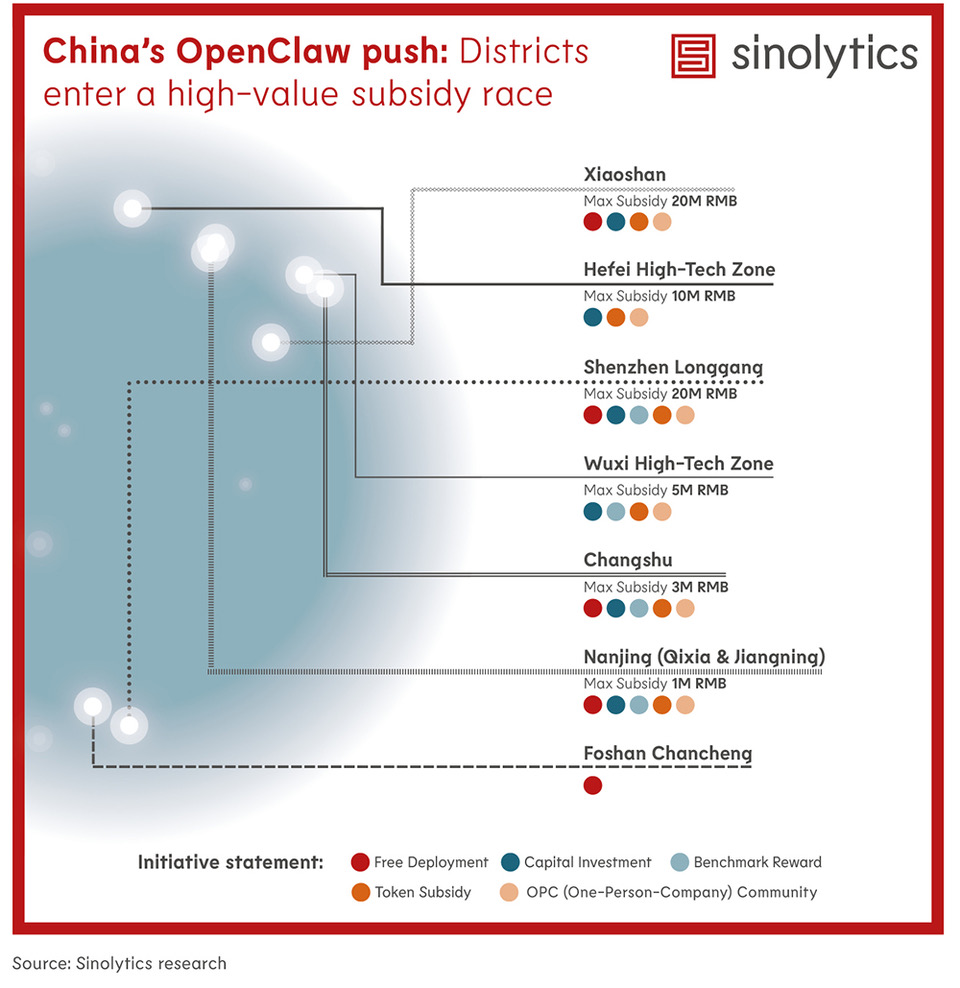
The subsidies are substantial and deliberately tied to actual usage. Hefei High-Tech Zone offers the most comprehensive package, up to 10 million RMB covering compute vouchers, data resources, scenario access, and equity support. Longgang matches that ceiling with up to 10 million RMB in equity financing. Wuxi's support is more targeted, capped at 5 million RMB for manufacturing-adjacent applications. Changshu extends coverage to deployment services, developer training, and access to government datasets. Running alongside all of this, China's National Vulnerability Database has publicly flagged that improperly configured OpenClaw deployments carry meaningful cybersecurity risks.
Across these districts, the policy instruments are converging, so the real competition comes down to intensity: how large the subsidies, how broad the eligible scenarios, how deep the cost reduction. Beneath that lies a more significant structural shift: local governments are quietly moving away from the old playbook of attracting firms and headcount, and toward a new metric, active agent deployments and compute consumption. OpenClaw adoption is becoming a contest over operational volume, and high-tech zones across China are now effectively bidding to host the most running agents within their jurisdiction.

