China's AI+ Energy Plan: New opportunities and new barriers for foreign firms

Beijing's push to integrate artificial intelligence into the energy sector is accelerating. A new policy released in September 2025 outlines ambitious goals for AI-driven transformation across power grids, renewables, and fossil fuels, with implications for foreign companies that include investment opportunities as well as data restrictions.

Written by
Mirjam Meissner
Published on
October 15, 2025
Attachment

Strategic goals: AI as a catalyst for energy security

The Implementation Opinions on Promoting High-Quality Development of "AI+" Energy, jointly issued by the National Development and Reform Commission (NDRC) and the National Energy Administration (NEA), sets a clear trajectory: by 2027, China aims to establish foundational innovation systems and launch 10+ demonstration projects and 100+ application scenarios. By 2030, the goal is global leadership in AI-energy integration, supported by advanced platforms and policy frameworks.

The plan positions AI as a strategic enabler of national energy security, with applications spanning predictive maintenance, smart dispatching, and autonomous operations.

Sectoral scope: From smart grids to hydrogen

The policy outlines eight core application areas:
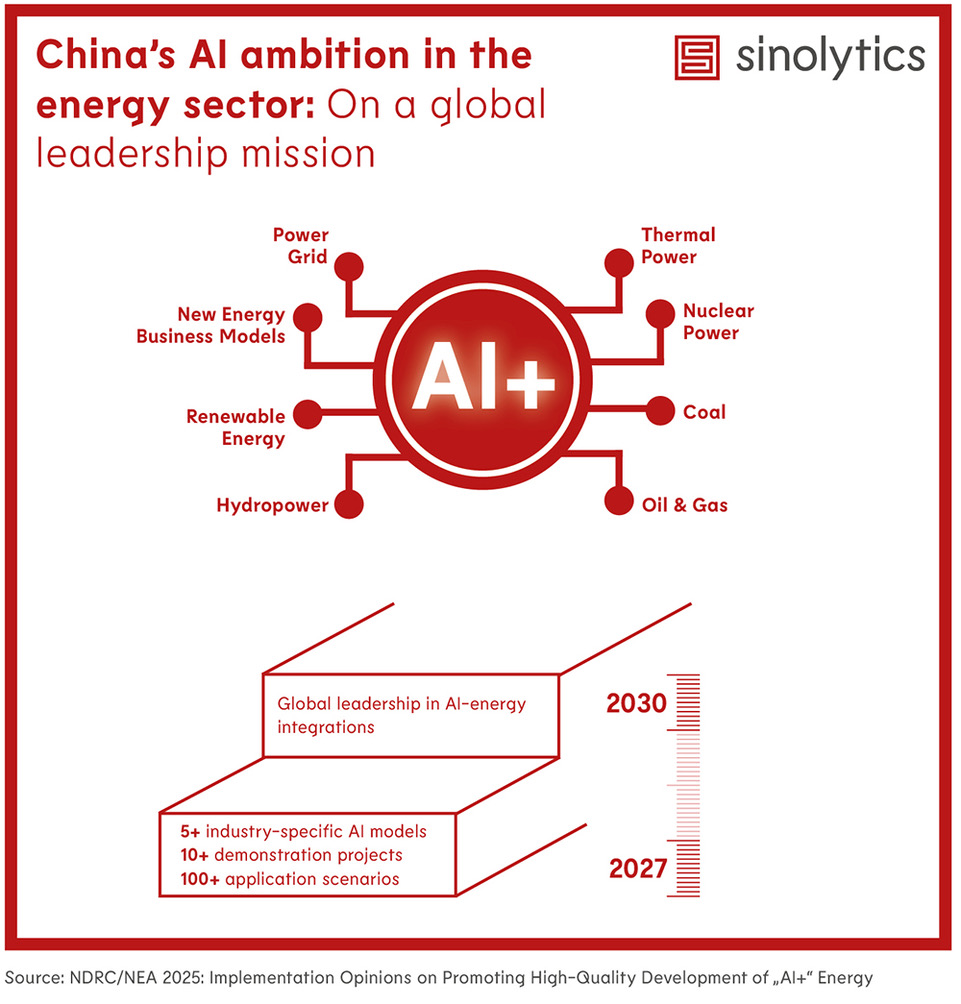
  • AI + Power Grid: Smart planning, intelligent dispatching, predictive maintenance.
  • AI + New Energy Business Models: Virtual power plants, EV-grid interaction, carbon tracking & trading.
  • AI + Renewable Energy: Forecasting, smart operations, intelligent maintenance.
  • AI + Hydropower: Smart construction, operational optimization, safety monitoring.
  • AI + Thermal Power: Emission reduction and fuel efficiency, lifecycle management.
  • AI + Nuclear Power: Real-time monitoring and anomaly detection, intelligent diagnostics.
  • AI + Coal: Autonomous mining, hazard detection, efficiency enhancement.
  • AI + Oil & Gas: Exploration & drilling, pipeline operations, intelligent equipment (robots, drones, sensors).

Sinolytics Radar 204 China's AI ambition in the energy sector

Foreign firms: Investment potential meets regulatory friction

For foreign companies, the plan presents a mixed landscape. On one hand, new provincial pilot projects offer fresh funding and partnership opportunities. On the other hand, regulatory constraints are tightening, as data localization rules require AI applications in the energy sector to store data within China and restrict cross-border transfers. Additionally, there are technology requirements in some cases, such as the need for firms to use domestic AI chips and to share model parameters with local partners or authorities.

Download

Curious about other topics?

All Insights & News
Timely analysis, strategic foresight, and expert perspectives on China's evolving position in the global economy.

You may also be interested in the following topics