


Geopolitics
Targeted cut: China halts tungsten exports to Japan, threatening a quarter of global chip gas supply
Read more


In this interview, Randolf talks about moving from describing global trends to developing practical recommendations for companies. He also discusses the detailed pattern of US-China technology restrictions and why supply-chain mapping is one of the projects he would most like to work on.
I would say team in the middle. I don't really want to make that kind of distinction. Of course quite a few people at the company have been working on China for years. They know particular sectors or policy fields in much more depth than I do, and many of them also have a strong academic background in China studies.
I have worked on China for several years as well, including in my previous role at the Munich Security Conference. But the perspective there was different. The questions were more along the lines of: What role does China play in the world? How is China’s geopolitical environment changing? What does that mean for its relations with neighboring countries, the United States, and Europe? How is the global balance of power shifting?
Those are still relevant questions at Sinolytics, because, increasingly, they are also questions for companies.
Yes, definitely. It is a change in perspective and in the level of detail. Before, I was often looking at medium- and long-term geopolitical trends and trying to describe and explain them. Now, the focus is much more on translating those trends into concrete recommendations for companies. That can mean strategic advice, but it can also mean looking at specific business functions or operational units.
Every smaller part of a company interacts with geopolitical risks in its own way. Procurement, compliance, public affairs, logistics, and technology teams will all be affected differently. The interesting part is figuring out what those risks mean in practice and what each part of the organization can actually do about them.
One is the U.S.-China technology rivalry. I have followed it for quite a while, but since joining Sinolytics two months ago, I now look at it in much more detail.
When you follow it on a daily basis, you notice how much is happening. There is a kind of tit-for-tat dynamic: New measures are introduced almost every week, sometimes even more frequently. They can be very targeted and specific, and they are often calibrated to respond to the other side.
In public debates, these developments are often described using broad terms such as “trade war” or “escalation.” Those terms can be useful for larger trends, but they can also blur how precise and limited some of the individual measures are. It is worth analyzing exactly what has been restricted, who is affected, and how the other side responds.
For me, the challenge is finding the right balance between the highly detailed level and the 30,000-foot view. If you only look at the details, you can lose sight of what they mean. You end up reporting every small development one by one, almost like a news ticker. That does not help anyone make a decision.
At the same time, if you stay too far above the details, you may miss the signals that show how a broader trend is developing.
Recognizing trends requires looking across different sectors and policy fields, but also across a meaningful period of time. You need to choose the right lens. Sometimes you need to look at what happened over the last few weeks. Sometimes you need to go further back to understand whether something is genuinely new or part of a longer pattern.
I am still figuring out exactly where that balance is. My previous work gave me a strong focus on the big picture, so one challenge now is to connect that perspective with the details that matter for individual companies.
I might not be the best person to formulate this, but the dynamic is often presented as a race to one finish line. The assumption is that one country will reach a certain level of AI capability first, perhaps something like artificial general intelligence, and then become impossible to catch.
That may be the American way of framing the issue, but in China, the focus seems to be more practical. There is a lot of attention on specific applications and on narrower forms of AI that can be integrated into everyday life and business. The idea of an all-powerful AI that changes every aspect of human activity isn’t as prominent in China.
The two countries may therefore be developing AI in different directions and toward somewhat different goals. That does not mean there is no rivalry. It means we should be careful about assuming that both sides are working toward exactly the same endpoint.
I would be very interested in supply-chain mapping and dependency analysis.
The European Commission has been talking for years about carrying out detailed assessments of supply-chain dependencies across strategic industries. It is an important task, but it is also very difficult. The European Commission cannot do it alone, and most companies do not have a complete view of their own supply chains either.
Many companies know their direct suppliers, but the picture becomes much less clear beyond that first tier. A company may have several suppliers outside China and conclude that it is not dependent on China. But if those suppliers rely on Chinese inputs or on a Chinese-produced precursor, the dependency may still be there, just further down the chain.
That is why supply-chain mapping needs to go beyond the first tier. At Sinolytics, we support clients with this kind of analysis, tracing dependencies through the supply chain to Tier-N. We can also visualize where critical materials, components, and intermediate products come from and where several suppliers may depend on the same upstream source.
That level of detail is very useful, but most companies do not have the resources to build it themselves. I find it interesting to work on something that is both analytically demanding and directly relevant to a company’s decisions.
Observing trends, describing them, and putting them into context can be exhausting when there is so much concerning news. I find it motivating that Sinolytics can take that analysis one step further, looking at how specific companies are affected and what options they have within their own constraints.
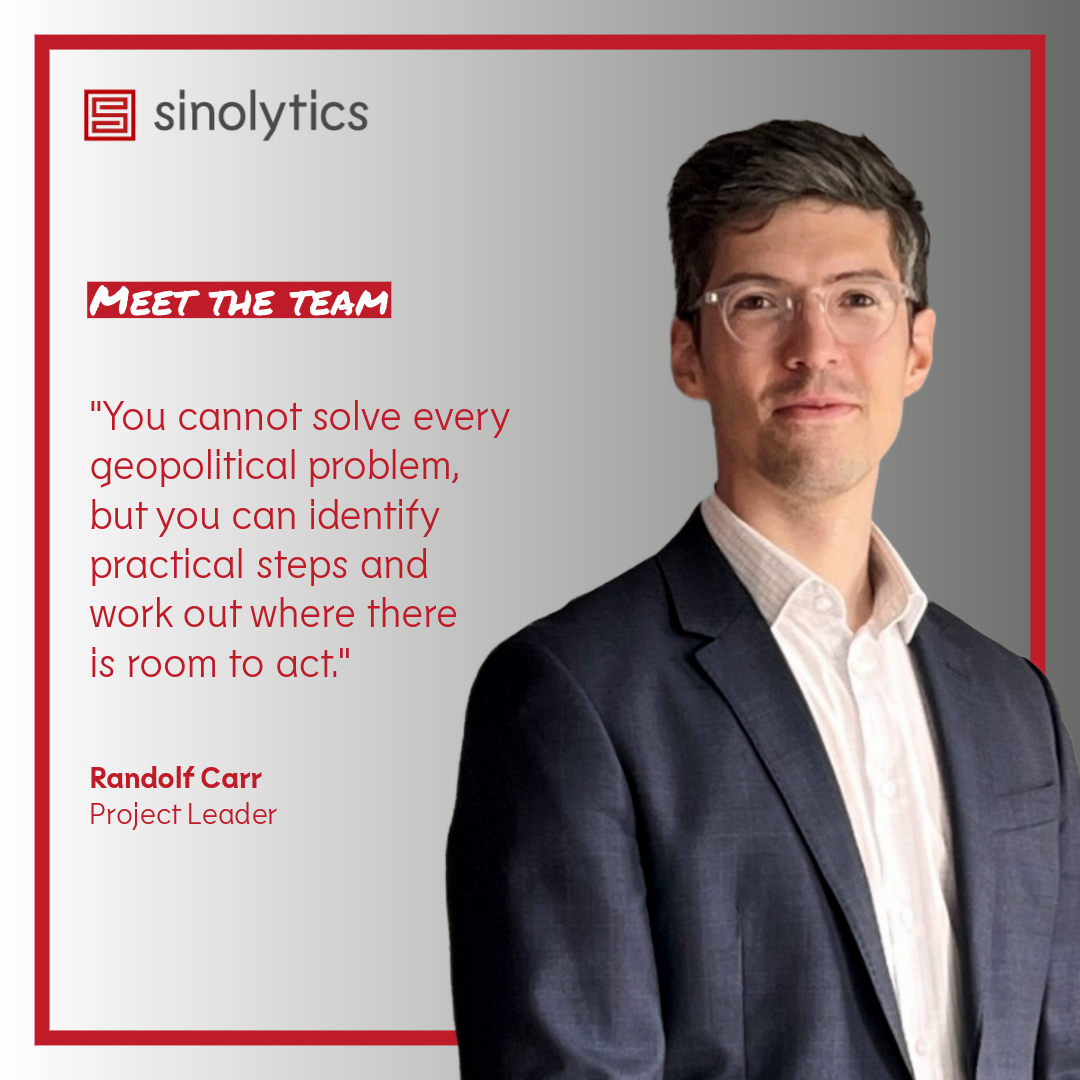
You cannot solve every geopolitical problem, but you can identify practical steps and work out where there is room to act.

