


Geopolitics
U.S. trade policy: Report on "transshipment scam" raises rhetorical heat
Read more


Launched in 2021, Malaysia’s five-year AI plan is built around three pillars: cutting-edge and affordable infrastructure, a skilled domestic talent pool, and generous investment incentives. These foundations are designed to propel the country to the forefront of the region’s digital transformation.
The Malaysian government has created a highly attractive environment for international tech investors. The Digital Ecosystem Acceleration Scheme (DESAC), introduced in 2021, rewards digital infrastructure investments with tax breaks. A cross-agency Data Centre Task Force coordinates these efforts, preventing bottlenecks such as delays in grid access for new data centers.
The results are tangible: new facilities often move from approval to completion within just one to two years.
In parallel, Malaysia benefits from structural advantages. AI development requires inexpensive energy and land—resources that are abundant in Malaysia but scarce and costly in neighboring Singapore. Yet proximity to the financial and technological powerhouse of Singapore remains a bonus: regions such as Johor are positioning themselves as strategic hinterlands for Singapore’s tech expansion.
Malaysia is also gaining relevance in global data flows. Submarine internet cables connecting Europe and Asia increasingly land on Malaysian shores, offering a natural foundation for developing into a global data hub.
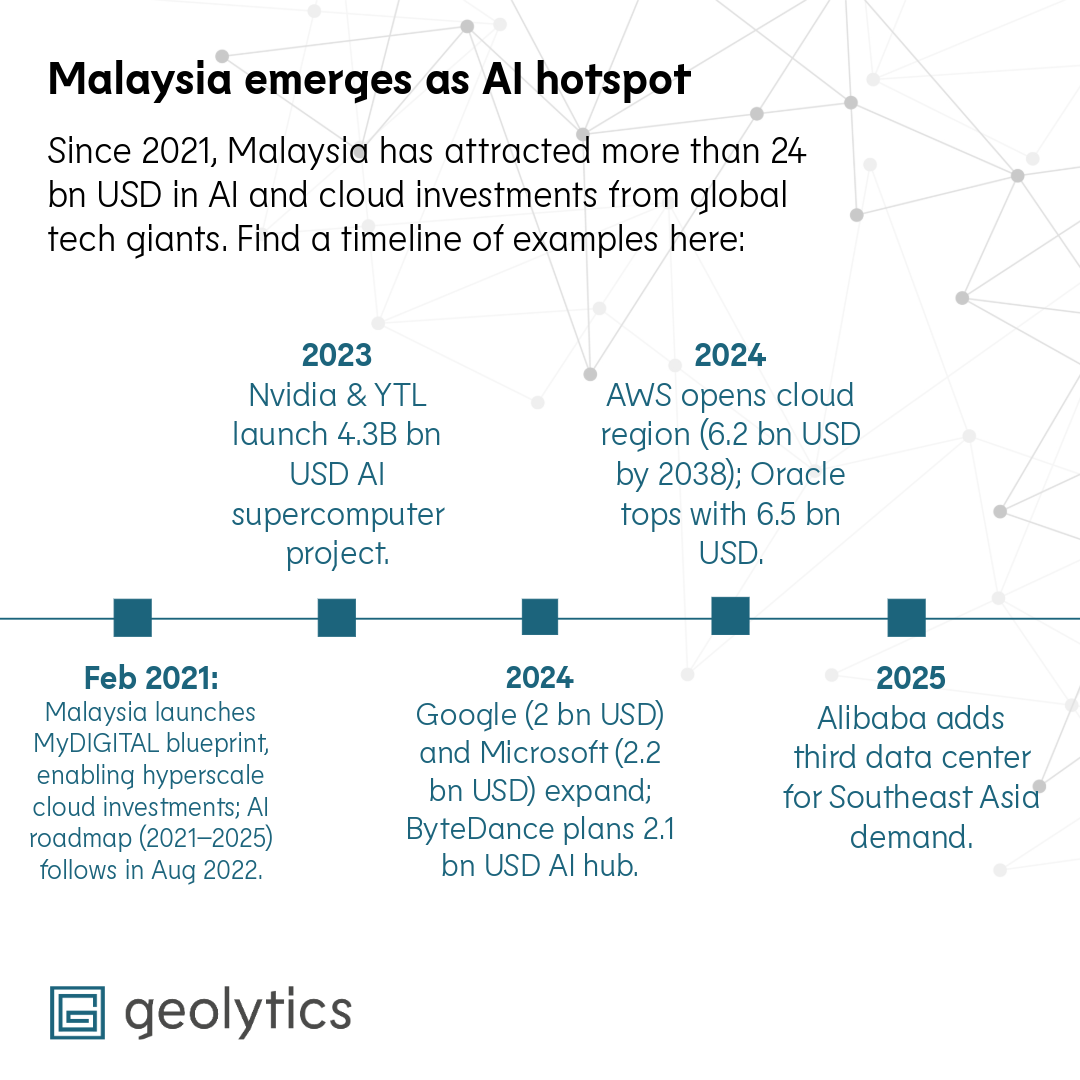
The country is witnessing an unprecedented wave of digital investment. Major US companies including Microsoft, Google, Amazon, and Oracle have committed billions to AI and cloud infrastructure projects in Malaysia. Chinese tech players are also entering the race: ByteDance (parent company of TikTok) is investing approximately 2.5 billion USD in an AI data center in Johor, and Alibaba has already established multiple cloud facilities in Kuala Lumpur.
According to Sinolytics research, planned digital investments between late 2022 and 2025 amount to over 24 billion USD. Additional projects have been announced, though without disclosed volumes. While US firms tend to favor greenfield investments, Chinese companies are pursuing strategic partnerships with local businesses.
But Malaysia’s AI success comes with a geopolitical price. In May, the country signed a wide-ranging memorandum of understanding on AI and the digital economy with China. Yet just two months later, under pressure from the United States, Malaysia introduced export restrictions on AI chips to limit China’s access to US-made semiconductors.
The balancing act became even more difficult when Malaysia shelved a flagship AI project involving Huawei and DeepSeek, which was set to use 3,000 Huawei Ascend chips. The move followed objections from US export control authorities.
These incidents underscore the precarious position Malaysia finds itself in: a nation caught in the crossfire of great-power rivalry, striving to build prosperity and innovation on a global scale.
For now, the strategy is working. Malaysia has rapidly become a leading data and AI hub in the region. But whether it can maintain this course amid intensifying US-China tensions remains uncertain. The country's digital ascent is impressive, yet rests on fragile geopolitical ground.

