China's export controls: It's all about implementation

With its export controls, China is exerting tight control over the global supply of critical materials. The additional measures announced on October 9th came as another shock to global markets. Although the United States and China have agreed to roll back the most recent round of restrictions, export controls will remain a defining feature of international trade. The key question is no longer whether such controls exist, but how they are applied — whether China enforces them strictly or allows greater flexibility.

Written by
Dr. Jost Wübbeke
Published on
November 5, 2025
Attachment

Three patterns of impact

Since some controls have been in place since 2023, there is now enough historical data to assess their impact. Export trends for 15 materials were analyzed over this period (only 4 are shown here for simplicity):
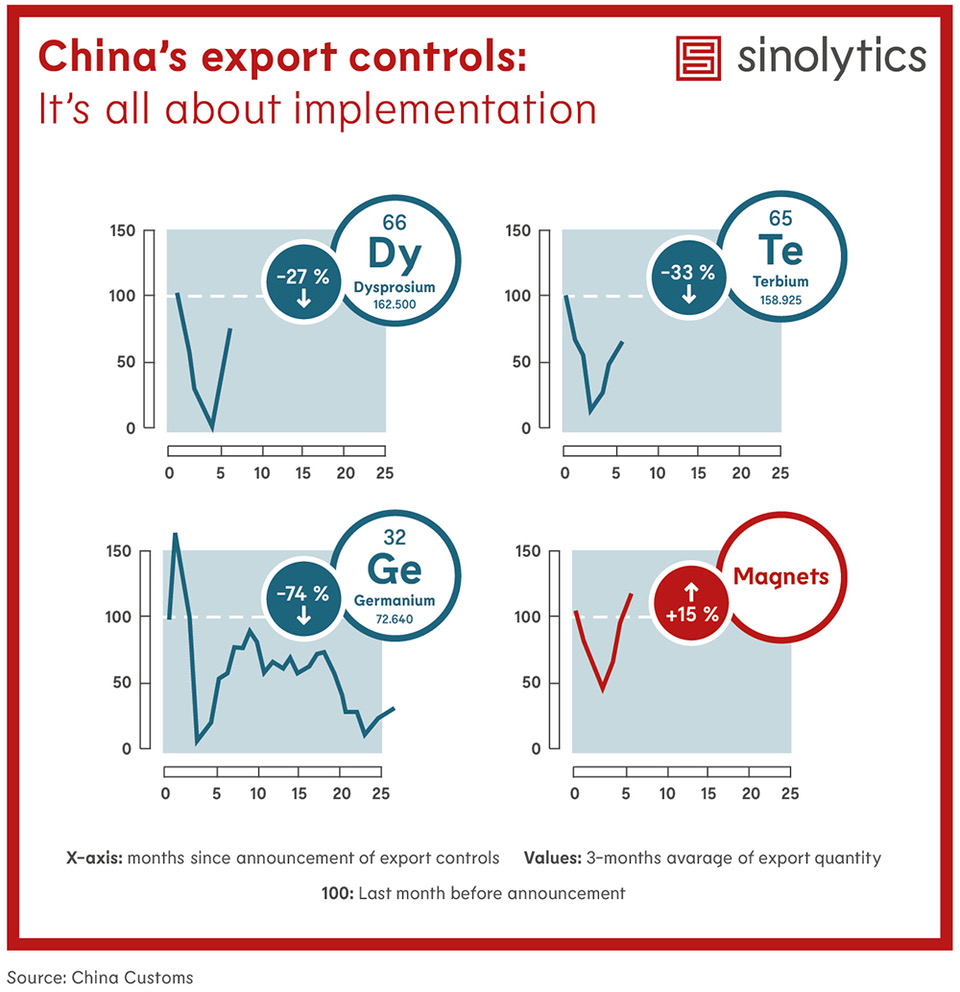
  • Minimal impact: Not all controlled materials experienced sharp declines. For example, only certain types of natural and synthetic graphite were restricted, leaving overall export volumes largely unaffected.
  • Sustained drop: Others saw a steep and sustained drop in exports with no signs of recovery. This group includes antimony, lutetium, tellurium, and bismuth.
  • V-shaped rebound: A third group of materials displayed a V-shaped recovery pattern. In some cases, such as magnets, molybdenum, and scandium, exports even surpassed pre-control levels. In others, including dysprosium, terbium, yttrium, and tungsten, exports rebounded but remained well below earlier volumes.


Sinolytics Radar 207 Export Controls implementation

Volatile cases: Germanium and Gallium

Germanium and gallium represent special cases, as they have been subject to controls since mid-2023. Germanium initially showed signs of a V-shaped rebound but experienced a sharp decline roughly 20 months after the controls were introduced (in 2025). Gallium, meanwhile, has been the most volatile: exports fell sharply after the initial 2023 restrictions, peaked about a year later, plunged again in 2025, and have recently recovered once more.

Outlook

Overall, these cases highlight that export controls have made imports from China increasingly fragile. The coming months and years are likely to remain challenging for global supply chains dependent on these critical materials.

Download

Curious about other topics?

All Insights & News
Timely analysis, strategic foresight, and expert perspectives on China's evolving position in the global economy.

More from: Geopolitics

Geopolitics

China's semiconductor strategy: Anti-dumping probe targets U.S. analogue IC chips

Geopolitics

China's gallium exports: Exports to U.S. completely dried up