


Geopolitics
China–Switzerland trade: Upgraded FTA would raise duty-free coverage to 99.8%
Read more


The FCC’s Covered List is a list of communications equipment and services considered to pose an unacceptable risk to US national security. Equipment on the Covered List is prohibited from receiving FCC equipment authorization. Since most electronic and radiofrequency devices require FCC authorization before they can be imported or sold in the US, being placed on the Covered List amounts to a de facto market ban.
When introduced in 2021, the Covered List narrowly targeted specific Chinese telecommunications and surveillance equipment producers, including Huawei and ZTE. Since December 2025, the FCC has agency has pivoted to a much broader strategy, implementing "production-location-based" restrictions that cover entire product categories. This approach now blocks the import and sale of foreign-produced drones, consumer routers, advanced robotics, and power inverters unless a specific exemption is granted.
Although principally aimed at reducing dependence on Chinese technology, these measures are not formally China-specific: they cover products manufactured in any foreign country, regardless of the manufacturer’s nationality. There are channels for companies not producing in China to get temporary exemptions, but many companies of US allies not yet received nor not yet filled requests for exemption.
In parallel, a new component rule that took effect in October 2026 will deny authorization to any device containing a "logic-bearing” (synonymous with "smart") component —such as a semiconductor or IoT module—produced by an entity on the Covered List, even if the finished device is manufactured by another company. This effectively extends import controls deep into the supply chain: a single internal component can prevent a finished product from entering the US market.
The FCC is also proposing to require equipment certification applicants to submit written and signed hardware and software bills of materials (HBOMs/SBOMs). If adopted, applicants would need to identify, for each component:
These requirements would make compliance more complex by requiring companies to provide and maintain detailed information on their products, supply chains, and the distribution of value added.
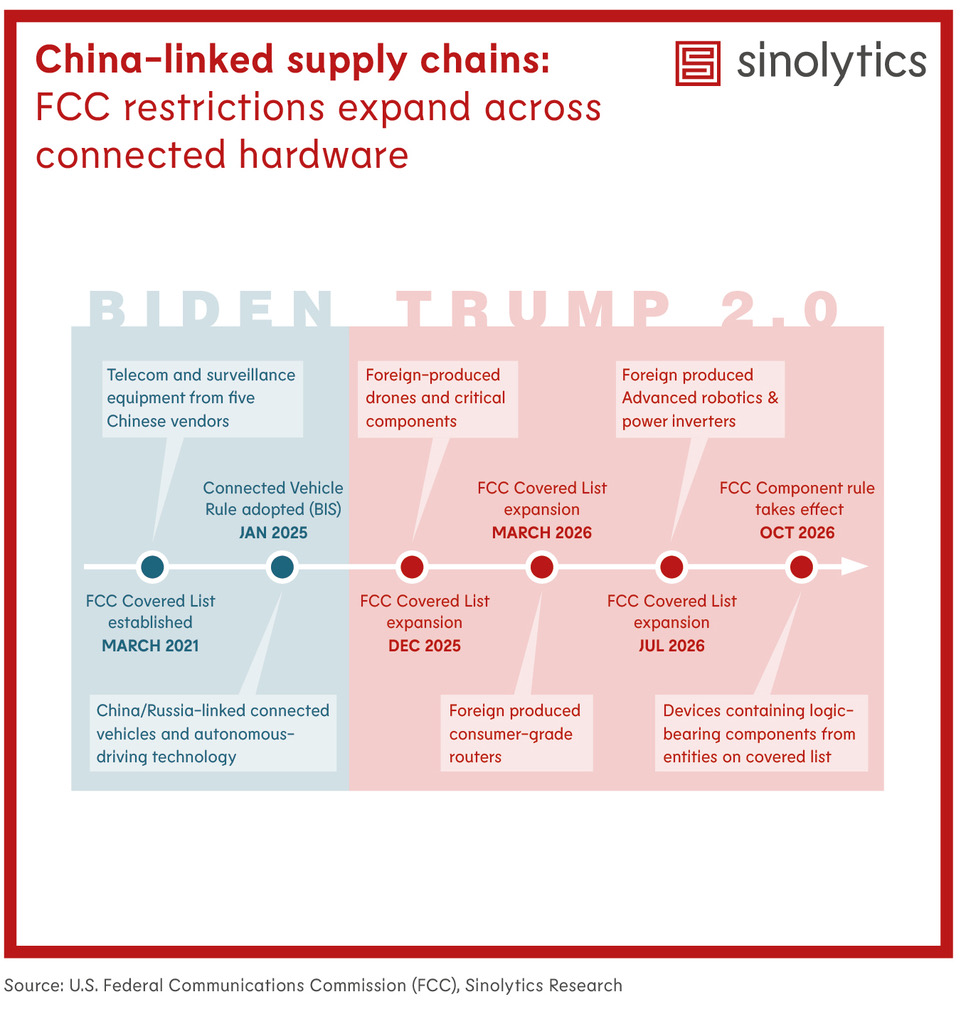
Going forward, the FCC’s authority over technology imports into the US is set to expand further. The agency is expected to formally reorganize its rules to distinguish between producer-based and production-location-based restrictions. For the latter, the FCC proposes introducing the concept of a "Covered List sector". Additional sectors are expected to be added, likely targeting technologies that combine connectivity, data collection, and the risk of remote access.
Where blanket production-location restrictions would be too disruptive, the FCC is more likely to rely on targeted company-specific listings. This could particularly affect Chinese semiconductor companies: chips have repeatedly been identified as relevant logic-bearing components, while bipartisan pressure in Congress to restrict Chinese-made semiconductors from entering US supply chains is growing.
Finally, the FCC is considering whether equipment authorizations, currently valid indefinitely, should expire after a fixed term, with ten years suggested.

