


Geolytics
Why pharmaceuticals are becoming geopolitical in 2026
Read more


In China, WeChat and Alipay bundle messaging, e-commerce, financial services, and even government services, and they dominate the market with little effective competition. This market power also gives them geopolitical salience. Governments in multiple countries treat WeChat as a potential channel of national influence. The United States and India, for example, have restricted its use, citing data security concerns and potential national security risks.
Despite their different home markets, Southeast Asian and Chinese superapps are now entering a new stage of evolution. Their scale and deep integration into daily routines make them strategic vehicles in the global AI race.
That geopolitical dimension is visible in how these platforms are adopting AI, revealing two distinct influence models. Southeast Asian superapps, such as Grab, are partnering with leading U.S. technology firms like OpenAI to integrate AI capabilities quickly into their regional networks, effectively committing over time to a U.S.-shaped tech stack. Chinese technology companies such as Tencent, by contrast, are prioritizing their own AI models. This supports China’s goal of technological self-reliance and promotes the spread of Chinese technology standards through a vertically integrated, more closed ecosystem. In both cases, superapps can create user dependence through pervasive AI integration and broader lock-in effects that reinforce the separation of technology spheres and contribute to geopolitical bloc formation.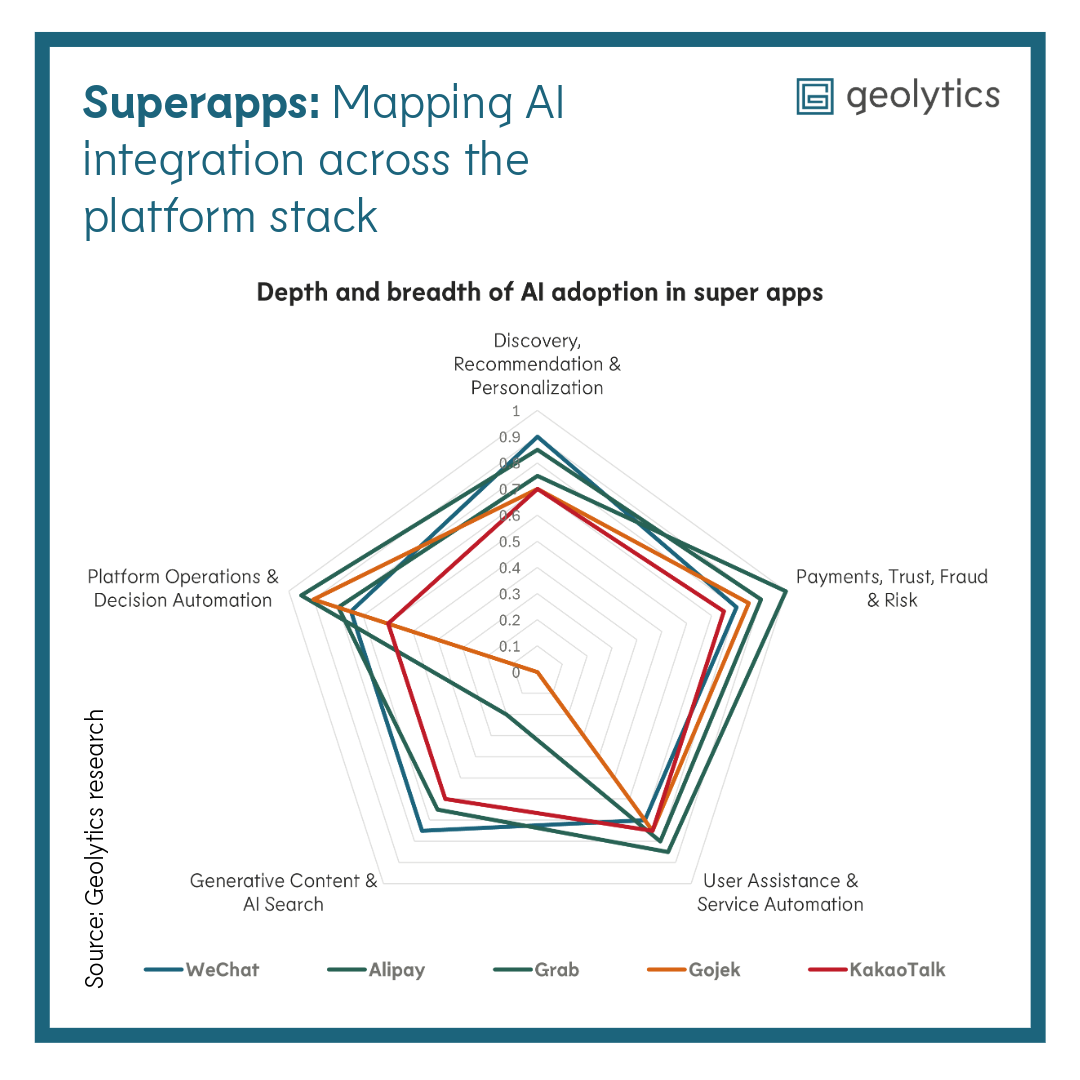
Note 1: Ratings range from 0 to 1 and reflect Geolytics' assessment of the depth and breadth of AI integration across each rated dimension, based on publicly available sources (as of April 2026).
For Europe, the implication is straightforward: regulation cannot substitute for infrastructure. In the AI era, infrastructure determines who can deliver intelligent services at scale. The key question is whether Europe can enforce its rules at the digital chokepoints through which AI is increasingly distributed: cloud services, app stores, and payment and authentication systems. As long as these layers are largely controlled from outside Europe, the challenge is less "digital sovereignty" than practical capacity to act.
Originally published on F.A.Z. in German.
Artificial Intelligence: Strategic Impact — How AI is reshaping global value chains and competitive advantages. Read more
Semiconductors: Global Dependencies — Understanding the chokepoints in technology supply chains. Read more
China Strategy Consulting — Insights on navigating China’s technology self-reliance and market regulations. Read more
Regulatory Risk Assessment — Europe’s evolving role in the global digital governance landscape. Read more

