


China Policy
Early warning, not hindsight: Meet Leonhard Xu on reading geopolitical signals
Read more


Together with the FERI Cognitive Finance Institute, we have analyzed this shift in the study "China's 'Third Wave': Global Disruption in AI, Robotics and Future Technologies". It is published today by FERI and available, in German, in the FERI Content Center. This post summarizes the core argument.
We use "wave" to describe the dominant logic of Chinese industrial and technological development.
Waves 1 and 2 share one logic. Western companies set the technology paths, product categories and standards, and Chinese companies tried to close the gap along largely the same path. Wave 3 breaks with this pattern.
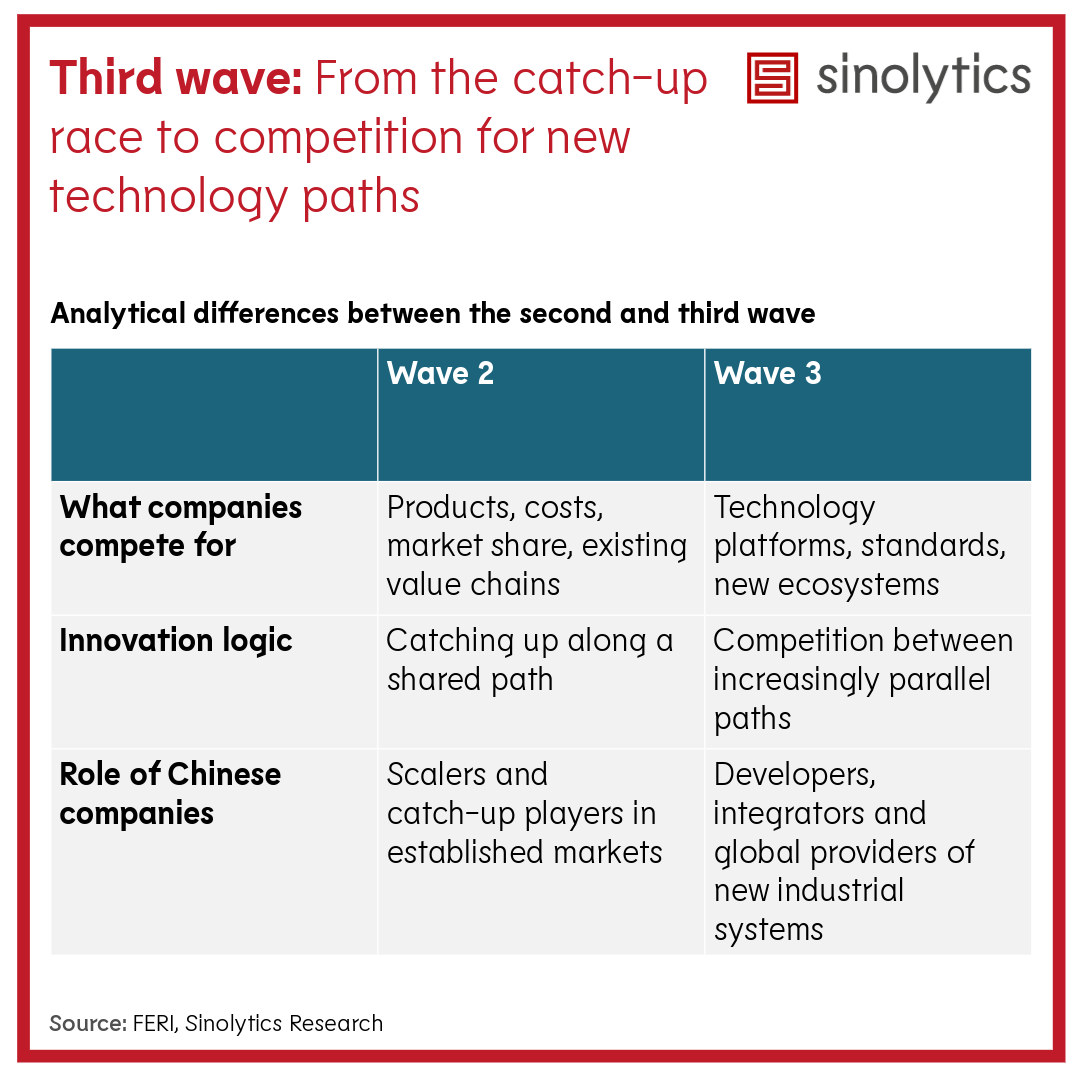
The timing matters. In AI, robotics, quantum computing or new energy storage, end products, standards and value chains are not fully formed yet. China is trying to shape them early and expand globally afterwards.
The waves overlap and reinforce each other. The scale and catch-up of wave 2 create the production base for wave 3. In turn, cross-cutting technologies of wave 3, above all AI and robotics, raise productivity and innovation speed in existing industries, which increases the competitive pressure of wave 2.
Industrial robotics shows how quickly this works. In 2014, Chinese manufacturers accounted for 28% of newly installed industrial robots in China. By 2024, their share was 57%, and they sold more robots in China than their foreign competitors for the first time. China's robot density reached 567 units per 10,000 manufacturing employees in 2024, ahead of Germany (449) and Japan (446). In 2019, China ranked 15th.
The study structures China's industrial policy to 2030 around five connected goals:
New tools support this. State-guided venture capital now invests earlier, in smaller companies and over longer research cycles. The new national venture capital guidance fund plans to mobilize a fund network of 1 trillion RMB (about 131 billion EUR) in the long term. Authorities and state-owned enterprises open real test environments and act as first users, shortening the path from prototype to broad adoption.
The consequence reaches beyond China. The global technology system is dividing into at least two decoupled spheres, with different and partly incompatible architectures, standards and supply chains. This is already becoming institutional. The U.S.-led Pax Silica initiative, formed in December 2025, aims to secure strategic high-tech supply chains. Beijing countered in July 2026 with the World Artificial Intelligence Cooperation Organization (WAICO), which promotes Chinese-shaped AI solutions, infrastructure and standards, particularly in the Global South.
For European companies, this creates a real dilemma. Chinese technologies are powerful and cost-efficient. At the same time, U.S. procurement and market-access restrictions make it harder to sell products with Chinese components. Interoperability and global economies of scale decline, while switching costs rise. Depending on the sector, companies will need to build parallel technical systems and separate supply chains.
The study does not argue that China will win everywhere. The pace differs by field. Chinese AI models are already spreading internationally, and AI and robotics lift productivity in the existing industrial base. In semiconductors, large capacity for less advanced chips contrasts with critical dependencies for advanced chips and key manufacturing equipment. In humanoid robotics, production scales faster than productive use. Technology bottlenecks, geopolitical countermeasures, overcapacity and capital misallocation can all slow the rise. But even if China does not reach all of its goals, the attempt alone will redistribute profits, investment flows and market share.
Europe reacted late to wave 2. The response to wave 3 will help decide where technological leadership, industrial value creation and economic strength emerge. For companies, especially the German Mittelstand with its deep technology and process know-how, the key question is whether they can defend and extend their innovation strength in the fields of the next industrial revolution. For investors, the central question is where the value creation of the next technological stage arises.
The full analysis covers the sector chapters on semiconductors, generative and industrial AI, robotics and the low-altitude economy, the brakes on China's rise, and implications for Europe.
Download the study (German): FERI Content Center
Authors: Leonhard Xu, Björn Conrad, Melda Kubat (Sinolytics). Published by the FERI Cognitive Finance Institute.

