


China Policy
Tight balance: German Chancellor Merz concludes China visit
Read more


Countries trying to establish domestic solar manufacturing have concentrated heavily on downstream production. China held 95.3% of global polysilicon capacity, 96.4% of wafer capacity, 90.3% of cell capacity and 76.2% of module capacity in 2025, according to the China Photovoltaic Industry Association (CPIA). Outside China, manufacturers accounted for 23.8% of global module capacity but only 3.6% of wafer capacity. Overseas manufacturing has thus expanded much further in finished-panel assembly than in upstream wafer production.
On 16 October, the Ministry of Commerce (MOFCOM) and Ministry of Science and Technology (MOST) proposed adding 12 photovoltaic technologies to the catalogue of prohibited or restricted technology exports. They cover specified polysilicon, wafer and cell manufacturing methods and certain core equipment carrying controlled technology. MOFCOM explicitly noted that such technology can be transferred while exporting, installing, commissioning, modifying or upgrading a production line. It also said ordinary equipment that does not contain listed controlled technology is generally outside this proposal.
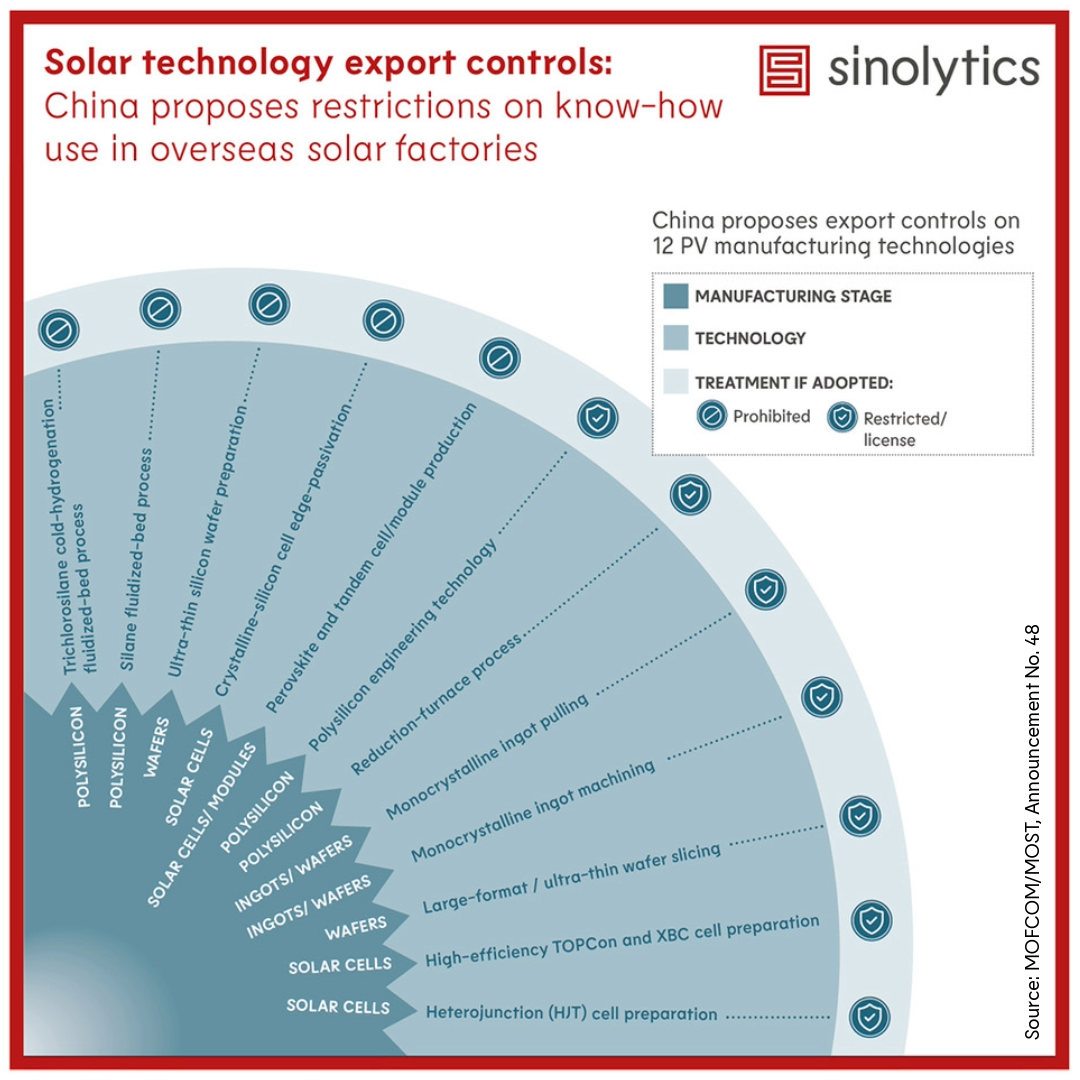
Chinese solar companies are expanding manufacturing across Asia and the Middle East. Trinasolar opened a 1 GW solar-cell and module factory in Indonesia in June 2025. In Saudi Arabia, PIF announced joint ventures with TCL Zhonghuan for 20 GW of ingot and wafer capacity and JinkoSolar for 10 GW each of cell and module capacity. These investments illustrate how overseas production can continue to depend on Chinese equipment and technical expertise.
An earlier proposal covering solar-wafer know-how was not carried into the December 2023 final catalogue. In its October 2026 commentary, CPIA now publicly supports technology-export management and argues that overseas localization requirements can expose Chinese manufacturers’ proprietary processes to unwanted transfers. This is the association's stated position. The shift makes sense in a market where Chinese firms want access to foreign customers but also want to retain the returns from their own technology.
The immediate rule is temporary export registration for specified transactions involving listed technologies; the proposed bans and restrictions remain subject to public consultation through 15 November. After adoption, the effect on a given factory would depend on its technical specifications and any license decision. For foreign industrial-policy planners, local production capacity and independence in operating or upgrading that capacity are different objectives. The latter requires understanding which production processes, software and technical services remain controlled by the Chinese technology provider.

