


China Policy
Ambitious targets: China's automotive industry growth plan (2025–2026)
Read more


China's Ministry of Industry and Information Technology (MIIT) has issued a 2026–2028 action plan to accelerate the deployment and integration of IoT across industry, consumption, and public governance. The goals are ambitious: by 2028, the plan aims to have approximately 10 billion IoT devices connected, grow the core industry to over 3.5 trillion RMB, and establish more than 50 new technical standards. The policy focuses on upgrading key technologies like sensors and edge computing while promoting integrated “end–edge–cloud” platforms and expanding applications in priority sectors.
While the headline figures for device count and industry size are impressive, the underlying strategic pivot is more significant. The policy emphasis is clearly shifting from pursuing connectivity at any cost to achieving “controllability” over a governable digital infrastructure. This involves a deeper focus on data flows, platform integration, and system-wide security. The plan explicitly prioritizes industrial IoT—in manufacturing, energy, logistics, and smart cities—framing consumer IoT as a secondary extension of the core ecosystem, not its primary driver.
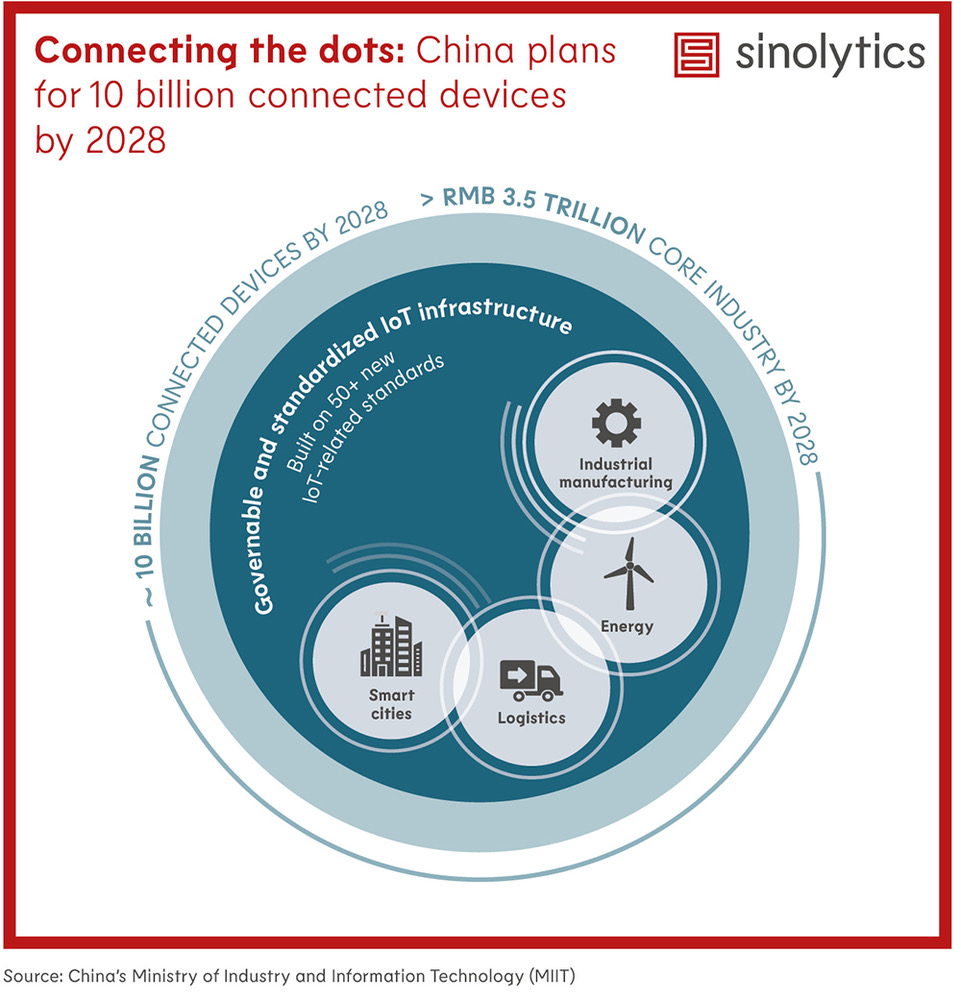
A core component of this strategy is the push to establish over 50 new IoT-related standards. This approach mirrors Beijing's successful playbook in other digital industries, most notably 5G, where it has built significant global influence by defining the underlying technical architecture. By creating and promoting its own standards for interoperability, China aims to create ecosystem lock-in that extends beyond hardware to the platforms and data layers, fundamentally shaping the competitive environment for all players. This raises the bar for multinationals, for whom data compliance and localization will become even more critical.
Sinolytics supports clients in understanding and responding to China's evolving digital and industrial policy environment.
Our services help companies translate regulatory ambitions, such as the IoT Action Plan—into actionable strategies:
Sinolytics combines policy expertise with sectoral insight to translate China's technology policies into practical implications for global businesses.

