


China Policy
Connecting the dots: China plans for 10 billion connected devices by 2028
Read more


The inaugural visit primarily served to enable better personal acquaintance and to stabilize German Chinese relations. By emphasizing partnership and dialogue while not ignoring critical dependencies and security related issues, Merz succeeded in doing so. Concrete concessions from the Chinese side on sensitive topics (the war in Ukraine, industrial overcapacity, export restrictions) had not been expected.
In Beijing, Merz adopted a more diplomatic tone towards China than at the Munich Security Conference and the CDU Party Congress in Stuttgart. Ahead of the visit, his trip was viewed in the press as a balancing act between strengthening economic relations and the necessity of addressing critical political issues. The guiding principle of his approach can be best described as “partnership with differences” rather than confrontation.
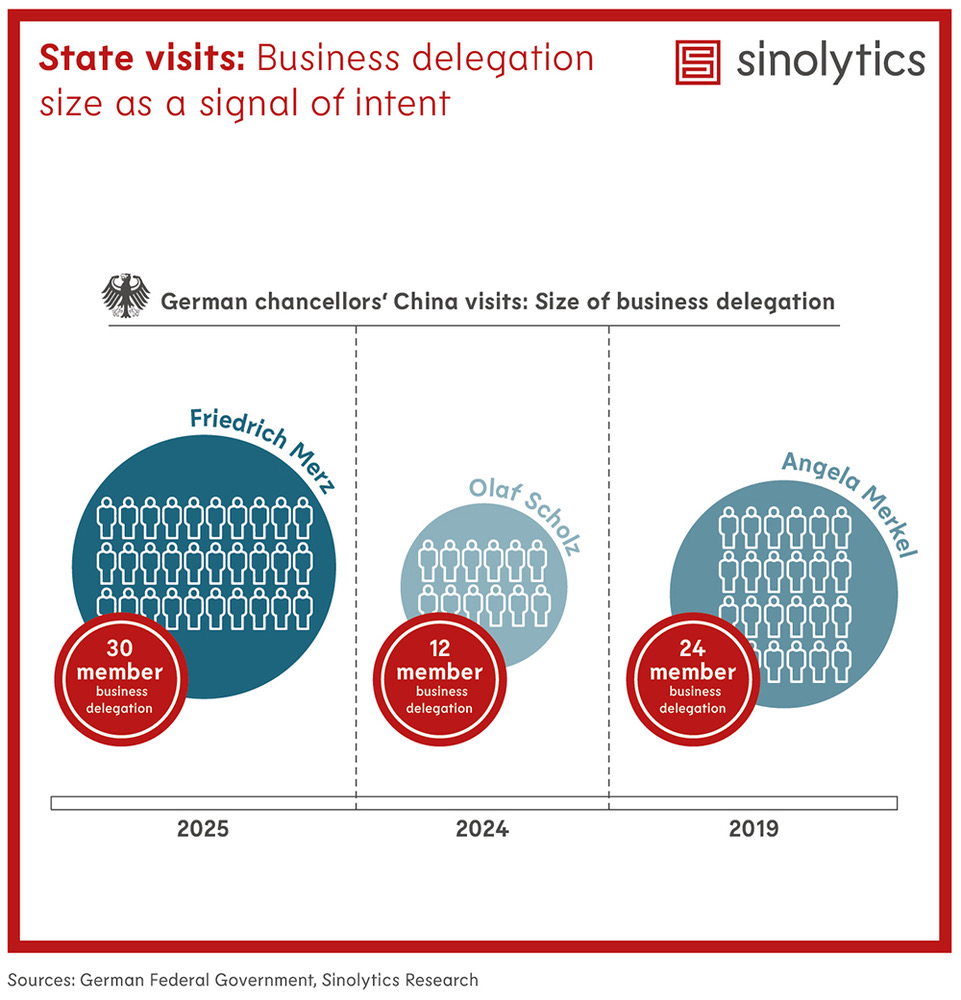
The presence of a 30 member business delegation travelling with Merz highlights the strong economic focus of the trip.
In 2025, China replaced the USA once again as Germany’s largest trading partner. The trade deficit amounted to about €90 billion and has increased fivefold since 2020. Merz demanded improved market access, fair competition, an appreciation of the Chinese currency, and a reduction of Chinese overcapacity—which significantly contributes to trade imbalance—for German businesses. As anticipated, there were no definite outcomes on the economic front. The German government has published the full list of agreements signed during the visit, available here. It remains to be seen how the asymmetries in economic relations will develop.
The second day of the trip at the tech and AI metropolis of Hangzhou underscored the recognition of China’s transformation into a technological powerhouse. Merz met with Wang Xingxing, founder and CEO of Unitree (robotics), and got a demonstration of technological innovation “made in China”. He also visited Siemens Energy, underlining German industrial engagement in China. With its economic rise, China has also become a major political power. Germany’s China policy must therefore be recalibrated: making use of opportunities for cooperation without ignoring risks.
Europe is also paying attention, as discussions continue about how best to engage with China, particularly given the current challenges facing transatlantic relations. The trip also comes against the backdrop of ongoing frictions between Berlin and Paris about the scope of “Buy European” and “Made in Europe” mandates that will be part of the Industrial Accelerator Act (IAA) scheduled to be announced by the EU Commission on March 4, 2026.
The timing of the German Chancellor’s visit — shortly after the Chinese New Year and just before the opening of the “Two Sessions” — underscores its significance for the Chinese side. China views Germany not only through the lens of its economic weight as the world’s third largest economy, but also as a political leader within Europe.
Chinese state media framed the message clearly: “Germany and China should be strategic partners, not systemic rivals.” Merz's cooperative approach was likely welcomed, as China—dealing with weak consumption, industrial overcapacity, and U.S. unpredictability—has a clear interest in pragmatic economic ties with the EU.
Whether the rhetorical openness will translate into concrete concessions from China over the course of the year remains uncertain. At present, there are no indications of a shift in China’s underlying economic model. The 15th Five Year Plan, scheduled for adoption in March, continues the established priorities of China’s economic development without signaling structural change.

