


China Business
China's innovative drugs: Deepening integration into global pipelines
Read more


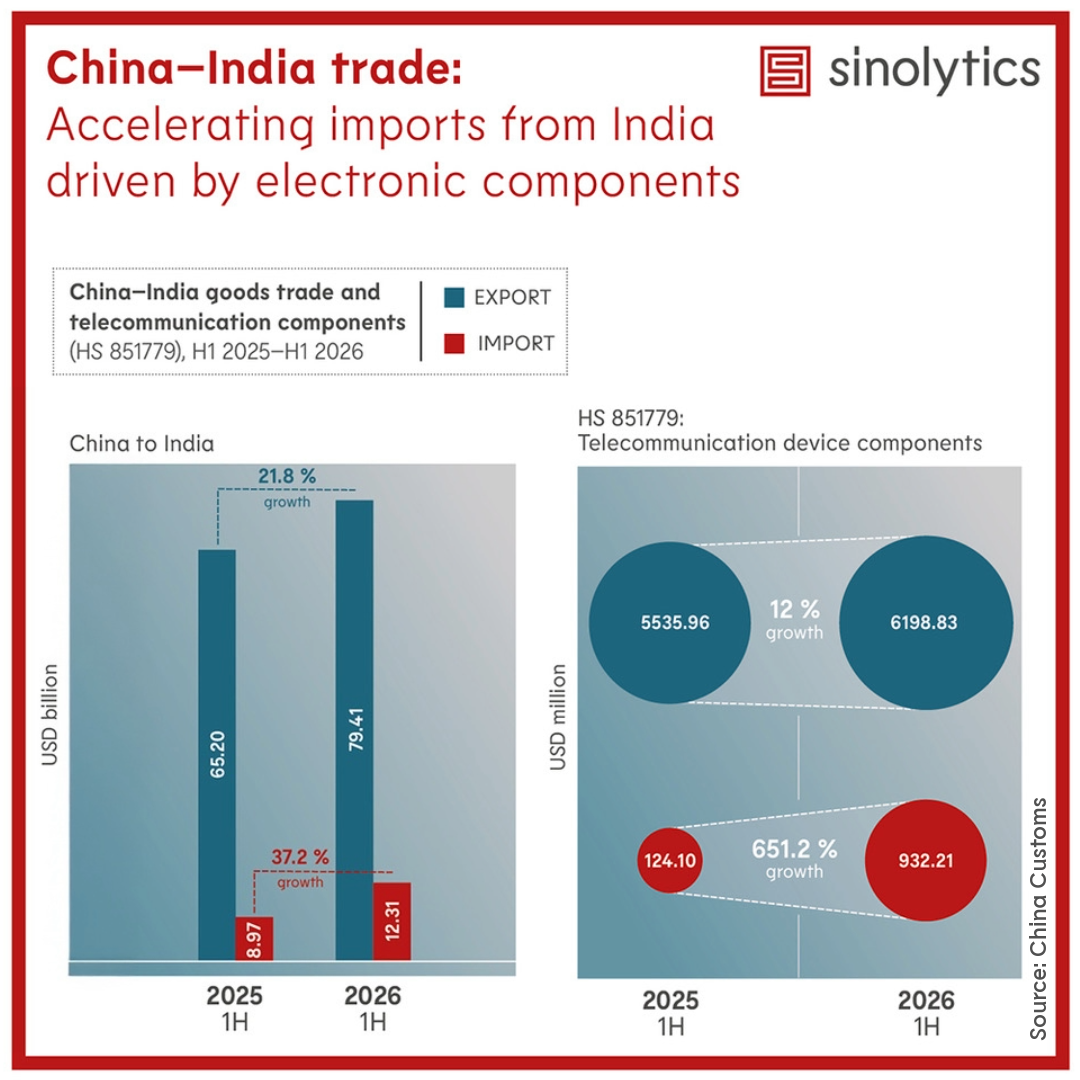
China became India's largest trading partner in goods in the first half of 2026, surpassing the United States. Bilateral trade between China and India reached 91.7 billion USD, compared with 75.6 billion USD in trade between India and the United States. The relationship remains highly imbalanced in China's favor. China's exports to India increased from 65.20 billion USD in the first half of 2025 to 79.41 billion USD in the first half of 2026, representing year-on-year growth of 21.8%.
During the same period, China's imports from India rose from 8.97 billion USD to 12.31 billion USD, an increase of 37.2%. China's trade surplus with India consequently expanded from approximately 56.23 billion USD to 67.10 billion USD.
Although China's trade surplus continued to grow, the stronger increase in imports from India indicates that Indian suppliers are beginning to make measurable gains in the Chinese market. India continues to depend heavily on China for machinery, electronics, intermediate goods, chemicals, and other industrial inputs. These imports support India's expanding consumer market as well as its domestic manufacturing ambitions. At the same time, the increase in Chinese imports from India suggests that India is gradually developing the capacity to supply selected manufactured inputs back into Chinese and global production networks.
The most significant example is trade under HS code 851779, which covers components used in telecommunication devices, including printed circuit boards. China's exports of these products to India increased from 5.54 billion USD in the first half of 2025 to 6.20 billion USD in the first half of 2026, representing growth of 12.0%. By contrast, Chinese imports of the same category from India surged from approximately 124 million USD to 932 million USD, equivalent to growth of 651.2%.
The exceptional increase points to India's rapidly expanding electronics manufacturing ecosystem, supported by new investments in component production, supplier localization, and assembly capacity. Apple's expansion in India has been an important catalyst. It has encouraged global suppliers and contract manufacturers to establish or enlarge local operations. Indian facilities are gradually becoming capable of supplying demand in other markets, including China, and are therefore participating more directly in global electronics supply chains.
India's gains are currently concentrated primarily in relatively standardized, labor-intensive, and lower-value segments of electronics manufacturing. In printed circuit boards, for example, India's emerging capabilities are more evident in simple boards with fewer than four layers. These products are essential for a wide range of consumer and telecommunication devices, but they require less sophisticated production processes than advanced high-density and multilayer boards.
China continues to dominate the higher end of the PCB market, particularly products requiring advanced materials, miniaturization, high layer counts, precise interconnections, and stringent reliability standards. China is especially strong in components used in artificial intelligence servers, data centers, and high-performance computing systems. AI-related demand is raising technical requirements for PCB manufacturers, including greater signal integrity, improved thermal performance, and the ability to support faster data transmission. China's established supplier clusters, production scale, engineering workforce, and accumulated process expertise provide significant advantages in these areas.
According to the China Printed Circuit Association, China's exports of PCBs above four layers grew by 47.8% year-on-year in the first half of 2026.
The first-half 2026 figures show a bilateral trade relationship that remains deeply unbalanced but is becoming structurally more nuanced. China's surplus continues to grow, while India is building export capacity in specific electronics categories at a remarkably rapid pace. If India can use its current expansion in basic components as a foundation for investment in materials, precision manufacturing, engineering, and advanced PCB technologies, it may gradually move into higher-value segments.
Until then, India's progress is more likely to complement China-centered electronics supply chains than to directly challenge China's technological and industrial leadership.

