


China Business
Bin Yan: "China's cleantech rise is about more than subsidies"
Read more


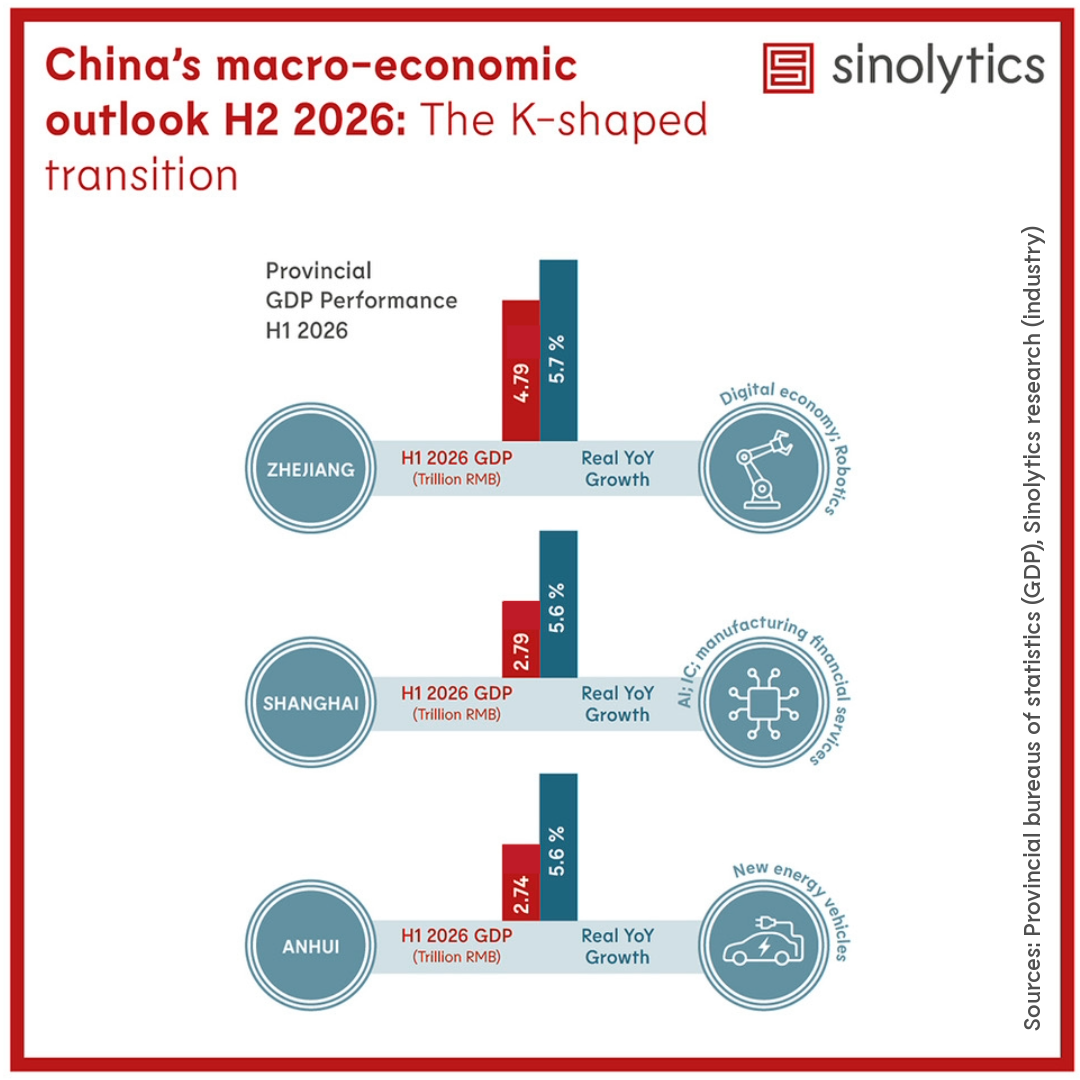
China’s first-half macroeconomic results confirm a pronounced K-shaped trajectory. While aggregate GDP expanded by a seemingly stable 4.7% year-over-year in H1 2026, a deceleration from 5.0% in Q1 to 4.3% in Q2 highlights mounting pressure on domestic demand. This divergence is most evident in the real economy: high-tech industrial centers like Zhejiang (digital economy, robotics) and Anhui (EV and battery hub) are outperforming other regions. Export performance, driven by AI products and the "New Three" (EVs, lithium batteries, and photovoltaics), expanded 13.4% YoY, vastly outstripping the meager 1.3% growth in household consumption.
In response to lagging household spending, Beijing has maintained its disciplined, supply-side approach. The landmark 15th Five-Year Plan for Expanding Consumption, approved in July, aims to boost retail sales to 60 trillion RMB by 2030 but deliberately avoids broad-based cash handouts. Instead, the plan focuses on structural upgrades, including service-oriented expansion and promoting better supply instead of demand. This strategy signals a top-level commitment to domestic demand as a core priority, but one that will be addressed through long-term industrial policy rather than short-term palliatives.
The late-July Politburo meeting acknowledged the growing economic headwinds, with official readouts showing an upgraded sense of urgency compared to earlier in the year. Following this, the People's Bank of China (PBOC) affirmed its commitment to a "moderately loose" monetary policy, favoring targeted tools like RRR cuts and interest rate adjustments over large-scale fiscal expansion. However, concrete incremental measures remain on hold. If key economic metrics deteriorate sharply, policymakers are expected to open a key stimulus trigger window around late September 2026. The decision will hinge on late-Q3 data, particularly the performance of the real estate market and the impact of trade disputes on export volumes.

