


Regulatory Strategy
China's cyber regulations: Eased compliance, yet stricter oversight in AI and data security
Read more


Together, they point to a calibrated approach that emphasizes incremental measures and faster implementation of existing projects.
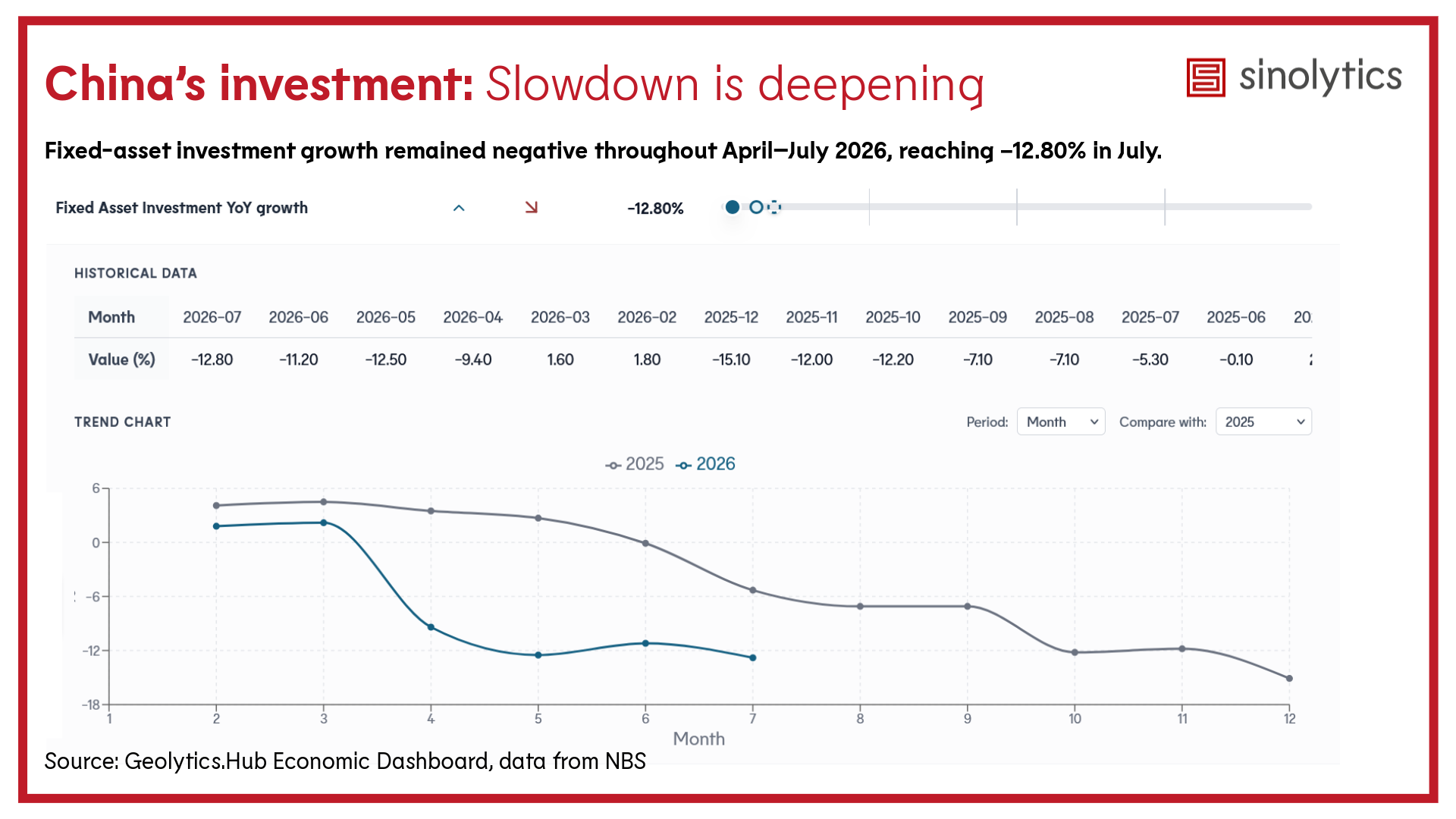 Image: Investment is weakening. Beijing’s response is selective and execution-focused.
The articles state that China has not relied excessively on strong policy stimulus and intends to avoid "policy dependency syndrome." They also say that the government has room to introduce additional measures as economic conditions change. The articles say that addressing local-government debt, property-market overhangs, and exposures among small banks may require China to accept "some price in growth." They also make clear that the aim is not to sustain a particular quantitative growth rate through a broad demand-side package.
The policy response described in the articles centers on incremental measures and faster execution. The authorities want to stop the decline in fixed-asset investment and use the third-quarter construction season more effectively. They also plan to accelerate the use of authorized funds and the approval and implementation of selected 15th Five-Year Plan projects.
The areas mentioned include infrastructure, urban renewal, logistics, and advanced computing. The articles also warn against "rushing headlong into action" and unnecessary duplication in advanced computing. The report expects targeted monetary adjustments around late Q3 or early Q4 2026. It does not expect a major shift in policy.
The articles identify services consumption as a key area for future expansion. They also call for measures to increase urban and rural residents' incomes and strengthen their capacity and willingness to spend.
For multinational consumer brands, the report identifies experience-based, health, and service-oriented offerings as more closely aligned with this direction than traditional discretionary goods volume growth. Price competition will remain a problem. The report expects continued local competition and margin pressure in sectors including electric vehicles, batteries, solar, chemicals, and steel. Multinational companies that procure components from Chinese vendors for their global operations may benefit from lower input costs.
The four articles do not set out a complete stimulus program. They do indicate where support is likely to be concentrated. Foreign businesses should not model a general infrastructure recovery in China. For capital goods and equipment companies, capital allocation and procurement orders are expected to concentrate in areas reached by the policy-based financial instrument and early 15th Five-Year Plan projects, including the "six networks," advanced computing, and urban renewal.
The available signals point to targeted support, faster execution of selected projects, a focus on services consumption and income growth, and potentially modest monetary easing later in the year. For foreign businesses, the relevant question is where policy support will be directed and whether their products, customers, and investment plans are connected to those priorities.
The full analysis covers the specific policy instruments, priority sectors, and business implications. Sign up for the demo in the Geolytics.Hub to read the complete report by Bin Yan and Bowen Han. The Economic Dashboard is included in the demo, giving you a way to track China's economic developments over time.

