Geopolitics
Randolf Carr on translating geopolitics into business decisions
Read more


The 30 bn USD tranche amounts to roughly 6-7% of Chinese goods sold to the U.S., but around 18-21% of U.S. goods sold to China, based on 2024 trade data reported by the two sides (UN Comtrade). In proportional terms, the initial lists therefore cover only a relatively small share of bilateral trade.
More important than the size of the lists is the standing Board of Trade and its role in implementation. The terms of reference establish a standing Board of Trade to oversee implementation, review bilateral trade issues and revise the product lists, with adjustments allowed no more than once a year. This gives the two sides a permanent mechanism for expanding or modifying the agreement rather than requiring a new negotiation each time.
That process is already set to continue. An agricultural working group is due to hold its first meeting before the end of 2026, while the two sides have extended their tariff truce to 10 January 2027. The initial lists therefore look less like a one-off tariff package than the first round of a standing process that could widen over time. The tariff cuts themselves will take effect only after both sides complete their domestic legal procedures.
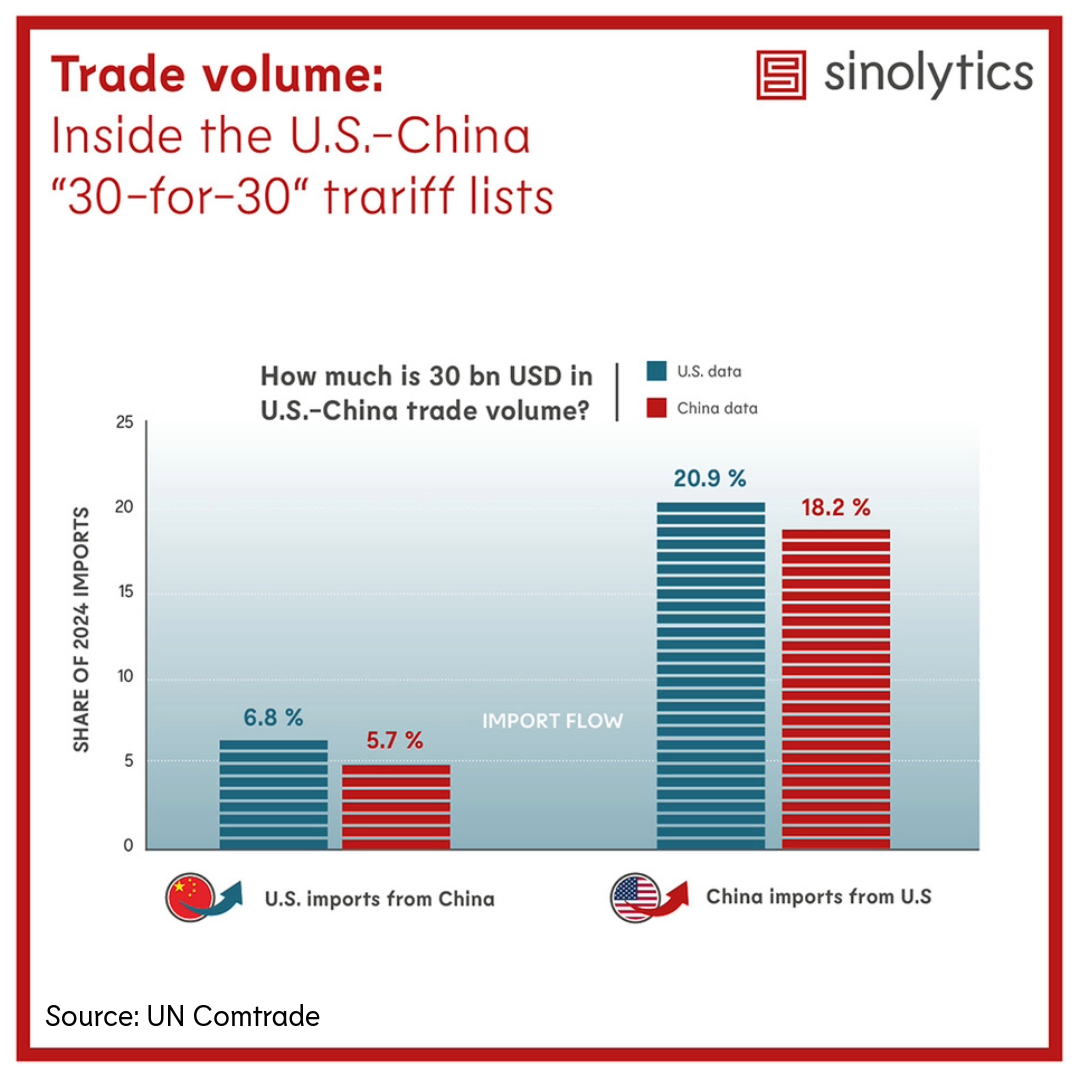 Note: The shares above use 2024 trade values because both sides define the lists by calendar year 2024.
The stark difference in the number of tariff lines says more about the structure of the two lists than about their economic size. On the U.S. side, imports from China are concentrated in a small number of high-value product categories. Toys alone account for roughly 40% of the U.S. list by trade value, and adding small appliances and plastic tableware brings the total to around 80%. At the same time, the list is tightly defined: “Ex-Out” provisions narrow some tariff lines to specific products, while certain connected toys with Wi-Fi, Bluetooth or radio-frequency functions are explicitly excluded.
China's list is much broader and more fragmented. Around three-quarters of the tariff lines are agricultural and food products, where customs classifications distinguish products in much finer detail: fresh or frozen, bone-in or boneless, seed or non-seed. Many listed lines recorded little or no U.S. trade in 2024 (UN Comtrade), and the presence of products such as primates, whale meat, reptiles, coca leaves and poppy straw suggests that parts of the tariff schedule were included relatively broadly rather than assembled only from products with significant existing trade.
The more revealing part is what China leaves out. Agricultural products make up a large share of the list, but ordinary soybeans, one of the most important U.S. exports to China, are excluded; only seed soybeans are covered. They therefore continue to face the additional 10% tariff. This makes the Chinese list look expansive in line-count terms while preserving protection on one of the most commercially significant products.
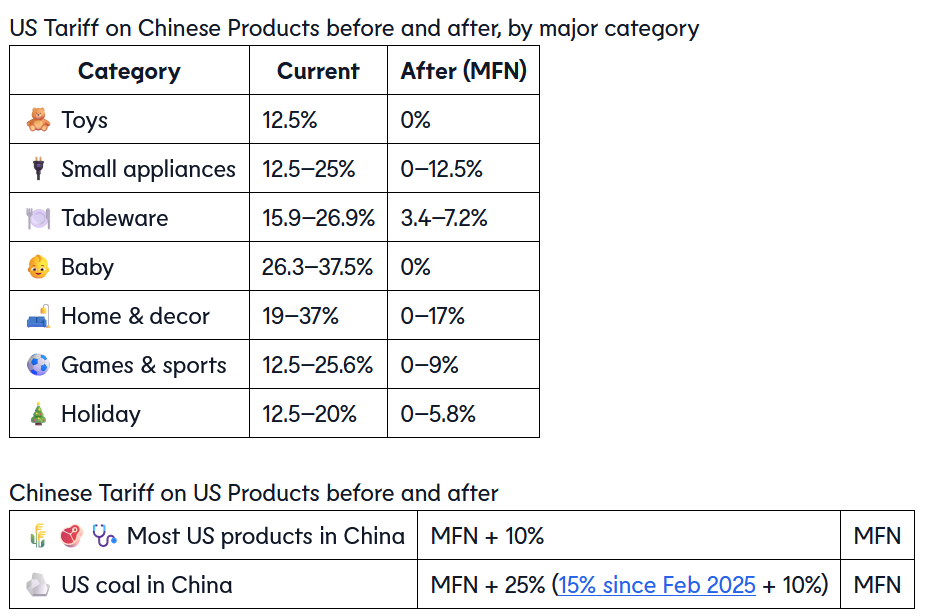
The headline commitment is substantial: according to China's Ministry of Commerce, more than 90% of listed products will be exempt from additional tariffs and return to MFN rates. On the U.S. side, this means removing the additional tariff layers imposed under Section 301, including the more recent forced-labour tariff. For many of the listed Chinese consumer goods, the difference between today's rate and the underlying MFN rate is therefore large.
The effect is less dramatic on the Chinese side. For most listed U.S. goods, the concession mainly removes the additional counter-tariff while leaving China's existing MFN duties in place. That matters particularly for agricultural products, where MFN tariffs can already be relatively high. The agreement therefore creates a larger tariff reduction for many Chinese goods entering the U.S. than for U.S. farm products entering China, even though both sides describe the measure as a return toward MFN treatment.
The table below shows how this plays out across the main product groups. Some details remain unresolved: the precise treatment of the roughly 10% of listed products not covered by the broad exemption, the final reduction for each tariff line, and the date on which the cuts will take effect have not yet been published.