


Geopolitics
China's chokepoint strategy: Export controls and the next phase of tech confrontation
Read more


Under the upgraded FTA, duty-free coverage for Swiss exports to China rises from 53.6% to 99.8%, with 77.5% covered on entry into force and the rest phased in over five to ten years. Switzerland's signature exports benefit significantly: the share of watch exports entering China duty-free rises from 1.0% to 100%, pharmaceuticals from 29.1%, and precision instruments from 85.9%. Switzerland’s own new concessions are largely confined to a select range of Chinese agricultural products, since it already eliminated duties on Chinese industrial goods back in 2014.
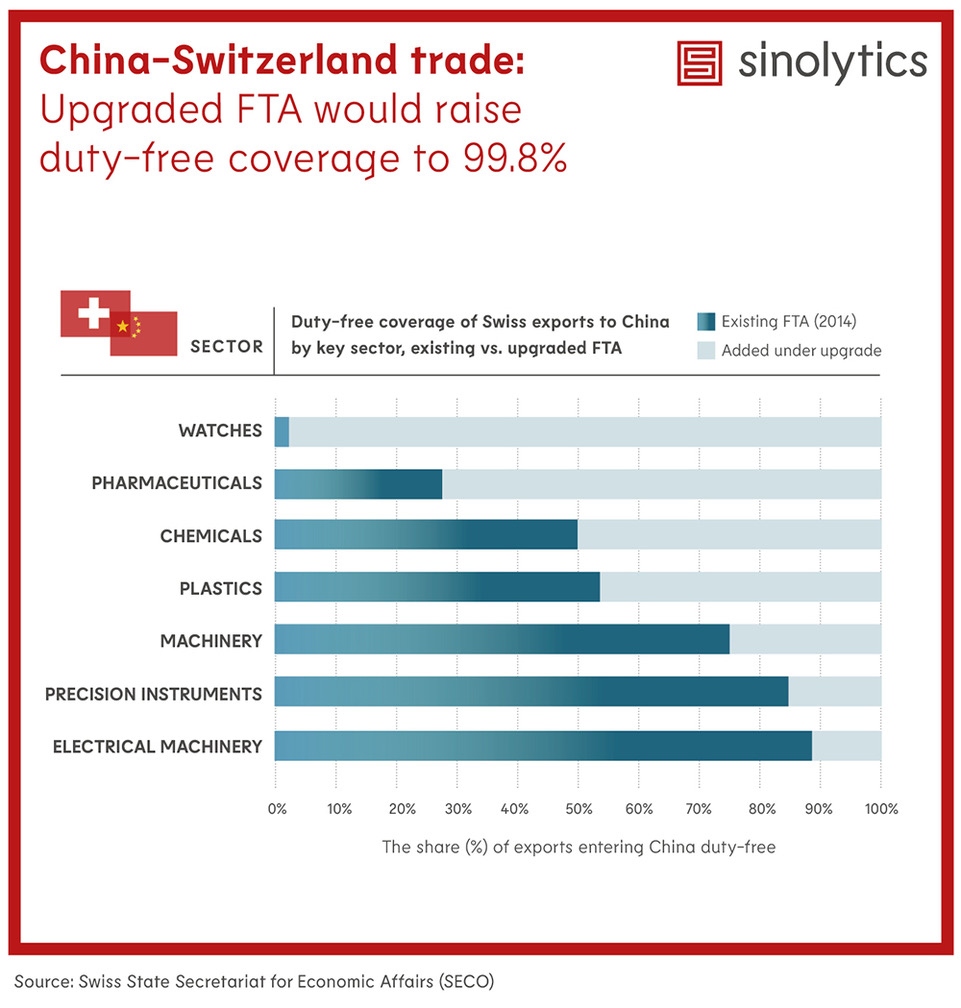
Swiss exports complement Chinese production rather than compete with it: luxury watches, patented pharmaceuticals, precision instruments. None meaningfully threatens a domestic industry China is protecting, while many support its industrial upgrading. The deal offers access to goods that enhance productivity and consumption without forcing Beijing to open sensitive sectors or cede ground in areas where it is building global competitiveness.
Negotiations between China and Switzerland formally began in September 2024, well before the second Trump administration launched its tariff actions. The agreement nevertheless became more valuable once Washington imposed a 39% tariff on Swiss goods in 2025, later cut to 15% under a framework agreement, though at the cost of a Swiss pledge to invest 200 billion USD in the U.S. by 2028. Buying tariff relief at that price is exactly the exposure Bern has an interest in diversifying away from. For Beijing, facing its own tensions with the U.S., the deal is a chance to position itself as the stabilizing and engaging partner to third countries while Washington reprices its alliances.
What Beijing gave on rules is more unusual than what it gave on tariffs, since the agreement contains the first reference to the Universal Declaration of Human Rights and the first ILO fundamental-principles commitment in any Chinese FTA. The timing is notable. In March 2026, USTR opened Section 301 investigations into 60 economies over forced-labor import bans, imposing duties on July 23 that placed Switzerland and China in the higher 12.5% tier, a worse outcome than the EU at 10%. Bern was therefore negotiating labor language with Beijing throughout the months it was itself under US investigation on that issue. Enforcement will likely be limited, but it gives both Switzerland and China a treaty reference on the issue underpinning the U.S. tariff measure.
The upgraded FTA is as much a positioning statement as a trade agreement, concluded by two parties with converging incentives: Switzerland is buying insurance against American volatility, while China is buying evidence that engagement with it remains available and worthwhile. MOFCOM's framing, that the two sides are choosing certainty and supporting free trade amid an uncertain international environment, was accordingly aimed less at Bern than at Brussels, which is weighing its own exposure to Washington. Brussels has a commercial reason to pay attention as well, since Swiss suppliers in pharmaceuticals, specialty chemicals, and machinery could gain a pricing edge that EU-origin goods do not enjoy. For Beijing, the audience is never only the country across the table. The true significance of this upgrade lies less in the tariff schedules than in the signal Beijing is sending: for middle powers willing to engage, the door is open, but the concessions are calibrated to what costs little.

