


Geopolitics
What the Trump–Xi summit in Beijing delivered for business
Read more


Aircraft purchases have long been a significant aspect of diplomatic relations between China and the US. As one of the largest and fastest-growing aviation markets in the world, China is very important for both Boeing and its European rival, Airbus. Because most Chinese airlines are state-owned, the Chinese state typically negotiates and purchases aircraft in bulk on behalf of Chinese airlines from aircraft manufacturers such as Airbus, Boeing and China’s homegrown plane maker COMAC. As such, the Chinese government has considerable leverage over aircraft purchases and has therefore used them as a bargaining chip in its diplomatic relations with the U.S. For example, during President Trump's first state visit to China in 2017, Beijing purchased 300 aircraft from Boeing for 37 billion USD as part of U.S.-China trade talks.
Aircraft purchases also reflect geopolitical relations between the two major powers. Before Trump’s most recent visit in May 2026, Boeing had received almost no orders for passenger jets from China since Beijing's 300-aircraft order in 2017, while Airbus received orders for hundreds of aircraft during the same period. This period between 2018 and 2025 notably coincides with rising geopolitical and trade tensions between the US and China, which suggests that Beijing was effectively "boycotting" Boeing as Washington waged a trade war against China and pursued a hawkish foreign policy vis-à-vis Beijing.
Purchases of Airbus aircraft are also an important part of China's diplomatic relations with France and Germany, where the European aircraft maker is primarily based. Since 1997, China has purchased over 1,100 Airbus aircraft during Sino-French state visits, most notably a 184-aircraft order during French President Emmanuel Macron’s visit to China in 2018 and a 300-aircraft order during President Xi’s visit to France in 2019. Similarly, China has bought over 600 Airbus aircraft during Sino-German state visits, including a 140-aircraft order during President Xi’s visit to Berlin in 2017, a 140-aircraft order during former German Chancellor Olaf Scholz's visit to Beijing in 2022 and most recently a 120-aircraft order during German Chancellor Friedrich Merz's visit to Beijing in February 2026.
Although these aircraft purchases are usually negotiated before the state visits themselves, orders of Airbus aircraft often symbolise or reflect friendly relations between China and France or Germany and are therefore used to "reward" Paris or Berlin for improving ties with Beijing. China’s orders of Airbus aircraft may also reflect deteriorating relations with the US; during Beijing's effective "boycott" of Boeing between 2018 and 2025, it had no choice but to purchase planes from Airbus and China's homegrown plane maker COMAC.
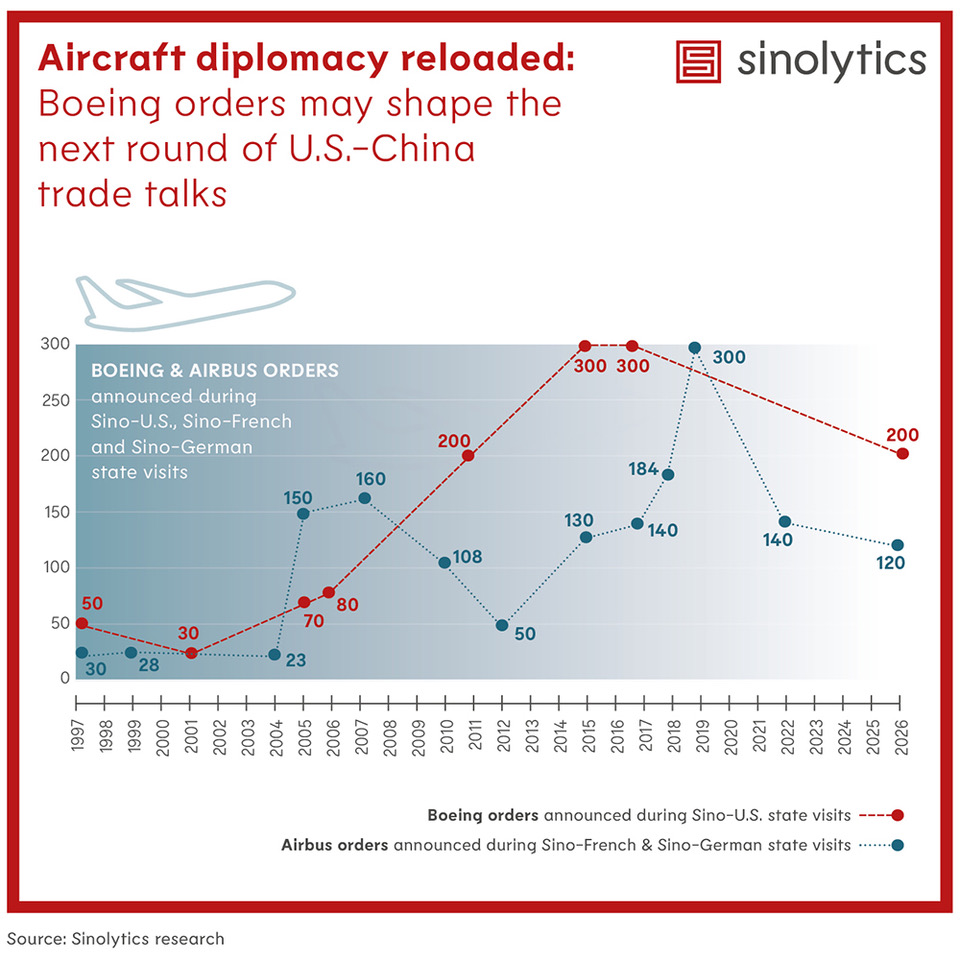
Beijing's decision to purchase 200 aircraft from Boeing caused a drop in its share price not only because it had been reported as early as August 2025 that China was considering buying 500 Boeing aircraft as part of US-China trade talks, but also because the last time China purchased any Boeing passenger planes was nearly a decade ago in 2017. It was therefore expected that Beijing would buy 500 planes to make up for the absence of Boeing orders since 2017.
That said, Boeing stated it expected that “further commitments will follow after this initial tranche [of 200 aircraft]”, though Beijing has not confirmed this. This suggests that China is continuing to use purchases of Boeing jets as a crucial bargaining chip in its ongoing trade negotiations with Washington. In other words, China may “reward” Boeing with further aircraft orders (in addition to the 200 planes it already purchased) if the US makes additional concessions in the Sino-US trade talks. So far, Presidents Trump and Xi have agreed to extend the tariff truce that the two sides had agreed in October 2025 and to seek tariff cuts on over $30 billion of goods from each country. As Beijing hints at buying more Boeing planes, Washington may make further trade concessions to China in exchange for Boeing aircraft orders.

