

Geolytics
Sinolytics launches Geolytics: A determined step towards a broadened geopolitical perspective
Read more


I help the company to turn rapid advances in AI into practical value by building agent infrastructure and tools around our expert content.
I start by asking clarifying questions to turn an ambitious idea into an actionable system design. This means uncovering the context behind the idea and defining each concept as precisely as possible. For example, when developing the Political Calendar, we first had to decide which political developments were relevant to clients, how they should be categorized, what information users needed at a glance, and which additional context would help them assess the potential impact on their business.
Once the concept is clear, I select the technical approach, design the data model and workflow, and find an intuitive way to present the results. I have considerable freedom in these decisions, but I make the reasoning transparent and consider factors such as quality, compliance, and cost.
The first version is tested internally and refined through several iterations. We conduct quality checks and assess whether it provides enough value to release to clients. This process can take several months.
A successful workflow then becomes a digital asset that runs automatically with limited maintenance. After release, I focus on making it reusable across topics and connecting it with other Geolytics products, so that each new capability strengthens the wider product ecosystem.
For us, 365° decision-support means staying close enough to each client to understand not only what is happening, but also what it means specifically for them. Traditionally, we achieve this through regular meetings, interviews, workshops, tailored slides, and continuous policy and news monitoring. These interactions give us the context needed to provide advice clients can trust.
Our digital products extend this support through the Geolytics.Hub, weekly digests, policy calendars, economic dashboards, and structured data access. Where clients need to connect these insights to their own systems and workflows, we can also make them accessible through APIs and emerging interfaces such as the Model Context Protocol (MCP).
However, simply turning these products into generic SaaS tools would risk losing the client-specific understanding that makes our work valuable. Our goal is therefore not just to deliver more information, but to use technology to make tailored support more continuous, accessible, and scalable.
A new analysis is usually triggered by a significant policy development or event that our analysts identify as highly relevant to a client or sector. It can also respond to a client request, such as a deeper assessment of an event highlighted in our Political Calendar.
After quality control, the analysis is published in the Geolytics.Hub. Depending on their preferences, users receive it immediately by email or as part of a weekly digest. This keeps clients informed without requiring them to check the platform constantly.
The Hub also strengthens knowledge-sharing internally by helping our teams follow developments and insights across different projects.
An analysis can be interesting without being worth a client’s limited attention. In an information-rich environment, relevance means that a development could affect the client’s business, decisions, or priorities.
What makes our approach distinctive is that we do not stop at describing what happened. We assess what a development means for a specific client, sector, or strategic question. This client-specific analysis is a key feature of the platform: the content is not one-size-fits-all, but tailored to the decisions our clients need to make.
We design for relevance in two ways. First, our analyses do not stop at describing what happened. They explain what a development means for a specific client, sector, or strategic question, and what actions the company should consider. This client-specific perspective is a key feature of our platform: the content is not one-size-fits-all, but tailored to the decisions our clients need to make. Second, we organize content into thematic channels, such as China Domestic or EU Foreign and Trade Policy. Clients can subscribe to the topics most relevant to their business, helping them receive targeted insights without having to filter through unnecessary information.
We are currently exploring an AI agent that could translate policy uncertainty into a measurable index. After identifying the key policies in a particular field, it would evaluate uncertainty based on their content and development over time. We would also incorporate economic data to assess real-world impact, something that is not commonly included in similar products.
By combining historical data with ongoing monitoring, the tool could help assess not only how uncertainty has evolved, but also how it may develop under different conditions. The aim would not be to predict the future with certainty, but to identify emerging patterns, support scenario-based forecasting, and alert clients when predefined thresholds are reached.
People expect magic, but AI is not a mind-reader. The misconception is that AI will somehow intuit what matters. In reality, the work happens upstream. Someone must articulate the actual question being asked, which sounds simple but is often where organizations stumble. A manager might say, “I need to reduce risk,” but risk to what, for whom, and by how much? Humans still need to define the real question, decide what matters, and take ownership.
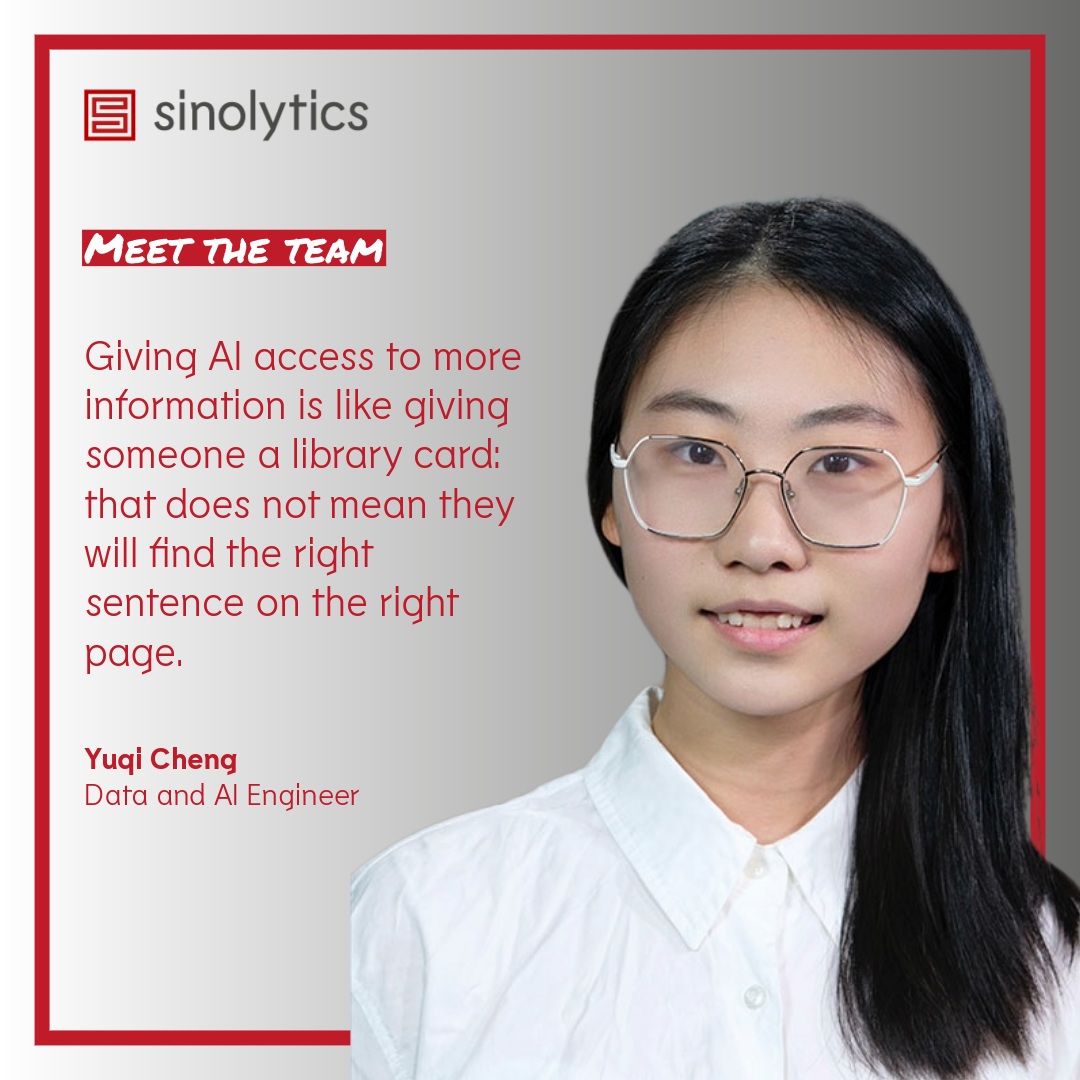
This is where the technical challenges emerge. Giving AI access to more information is possible, but simply connecting a knowledge base is rarely enough. It is like giving someone a library card: that does not mean they will find the right sentence on the right page. The same applies to real-time news. AI can monitor current developments, but precise coverage of a particular week or day requires a carefully designed search process.
These problems are solvable, but the simplest setup is not always the right one. If a strategic decision depends on that evidence, someone must understand and test these limits.
At Geolytics, we therefore treat AI as a collaboration between technology and human expertise, not as a substitute for judgment. To get real value from AI in decision-making, we first need to clarify the question being asked, structure the relevant knowledge, and test whether the system is using the right evidence.
We build feedback loops that help us identify when an AI system is relying on weak evidence, missing important context, or interpreting a question too narrowly. Transparency is essential: users need to understand what the system is looking for, why particular information is considered relevant, and which assumptions underpin the result.
For us, a well-designed decision-support system is ultimately about making clarity actionable. AI can help monitor developments, connect information, and identify patterns—but human experts still define what matters and take responsibility for the final judgment.

