


Geolytics
Navigating the new geopolitical business order
Read more


As a result, the industrialized countries committed at the G7 summit in Evian to limit dependencies on any single supplier to under 60 percent. The EU has also set an upper limit of 65 percent for imports of strategic raw materials from any one third country under the Critical Raw Materials Act.
But how can such diversification succeed? Japan is frequently cited.
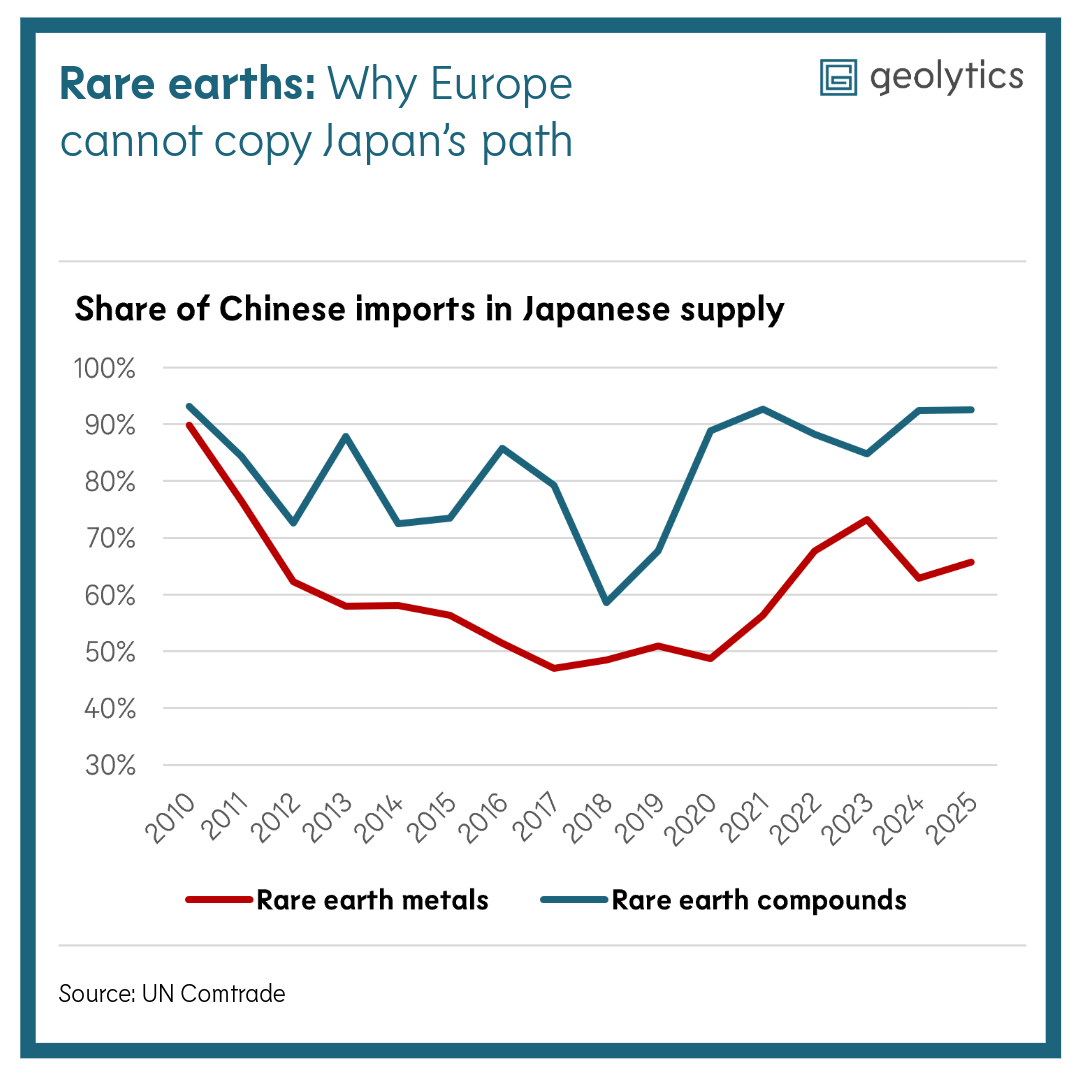
After China’s rare earth embargo in 2010, Japan reduced its dependence on Chinese supplies from around 90 percent to 60 percent. The 60 percent figure, however, paints an incomplete picture: it marked the historical low point of dependence. In the years that followed, the shares of Chinese imports rose again significantly: for rare-earth compounds to over 90 percent, and thus close to the level before the embargo.
Two factors explain this rebound. First, China can use its structural cost advantage to put alternative projects under pressure before they reach commercial scale. As long as non-Chinese sources remain permanently more expensive, industrial buyers will choose the lowest-cost provider, especially Japanese manufacturers in highly competitive sectors such as electronics and automotive. Second, demand grew due to the expansion of future technologies faster than new capacities independent of China could be built. Europe will face the same pattern.
In the political debate, Japan’s approach is nevertheless seen as proof that structural dependencies can be reduced through state coordination and targeted industrial policy. But that comparison falls short.
The core of Japan’s strategy was the early securing of alternative capacities outside China: Japan supported the Australian producer Lynas with 250 million USD and signed long-term supply contracts. Yet even these partnerships show the limits of the approach: non-Chinese producers face higher costs, including due to stricter environmental requirements. Imports from Lynas’s processing facility in Malaysia are around 50 percent more expensive than Chinese alternatives and remain permanently dependent on state subsidies.
More important than state coordination, however, was Japan’s industrial starting point. With Proterial, Shin-Etsu, and TDK, the country already had a world-leading magnet industry that linked investment, innovation, and demand. This industrial demand was a decisive factor in making alternative raw material sources economically viable and building new supply chains.
Europe is also investing in projects, such as in Malawi and South Africa, but these are still far from commercial production. Europe lacks the industrial starting point that helped Japan so decisively. There is hardly any rare-earth processing capacity: even if raw materials are sourced from Australia or Africa, they often have to be processed through China before they are ready for use. In Europe, the only significant site is a facility operated by Solvay in La Rochelle, France. But its capacities are limited; moreover, it depends on imported intermediate products. In addition, Europe lacks an integrated magnet industry as anchor demand that can bundle investment, innovation, and new supply chains.
Beyond alternative sources, material substitution also played a role. Japanese manufacturers such as Toyota and Honda were able to closely integrate research, development, and production, and as early as 2012 and 2013 developed hybrid motors that do not require heavy rare earths. Europe is also pursuing this path: the magnet manufacturer Vacuumschmelze in Hanau has presented magnets based on the same principle. But such successes remain isolated because European companies rarely combine value chains under one roof in a comparable way.
Japan’s strategy was supplemented by a functioning recycling system, supported by close cooperation between manufacturers and recycling companies. Europe lacks a comparable system. The recycling rate for rare earths is below one percent; individual pilot projects have so far done little to change this. Structurally, the starting point is more difficult than in Japan: manufacturers and recycling companies are separate actors without comparable integration, and take-back and recovery chains are fragmented. This is also reflected in the fact that in 2024 the European Commission had to initiate infringement proceedings against 24 member states because collection targets for electronic waste were not being met.
Japan’s experience provides important signposts for Europe, but it is not a blueprint. Europe can adopt many elements of Japan’s strategy, but what matters is that Japan was able to draw on an already established industrial base along the value chain, one that Europe does not have to the same extent. In Europe, by contrast, regulatory targets and state support have so far dominated, while many industrial structures still need to be built.
At the same time, demand for critical raw materials driven by future technologies is growing faster than new sources can be developed. The fact that Japan’s dependence on China has risen again in recent years shows how difficult diversification has become.
The decisive factor will be translating political impulses into competitive supply chains. One key instrument is off-take guarantees: the state, or a state-coordinated industry pool, secures demand and thereby enables the commercial scaling of alternative projects. The U.S. Department of Defense demonstrated this approach in 2023 with an off-take contract for MP Materials. Without comparable mechanisms, Europe risks that newly developed supply chains outside China will not be economically viable. Regulatory targets are necessary, but they are not sufficient as long as the industrial structures are missing that make investment in alternative sources profitable in the first place.
Originally published on F.A.Z. in German.

