


Geolytics
Navigating the new geopolitical business order
Read more


Chinese policymakers accuse Europe of continually expanding the scope of the term “national security.” In their view, Europe’s industrial problems are largely homegrown, caused by high energy costs, insufficient investment, and excessive regulation. China’s industrial competitiveness, by contrast, is primarily the result of innovation, economies of scale, and intense domestic competition.
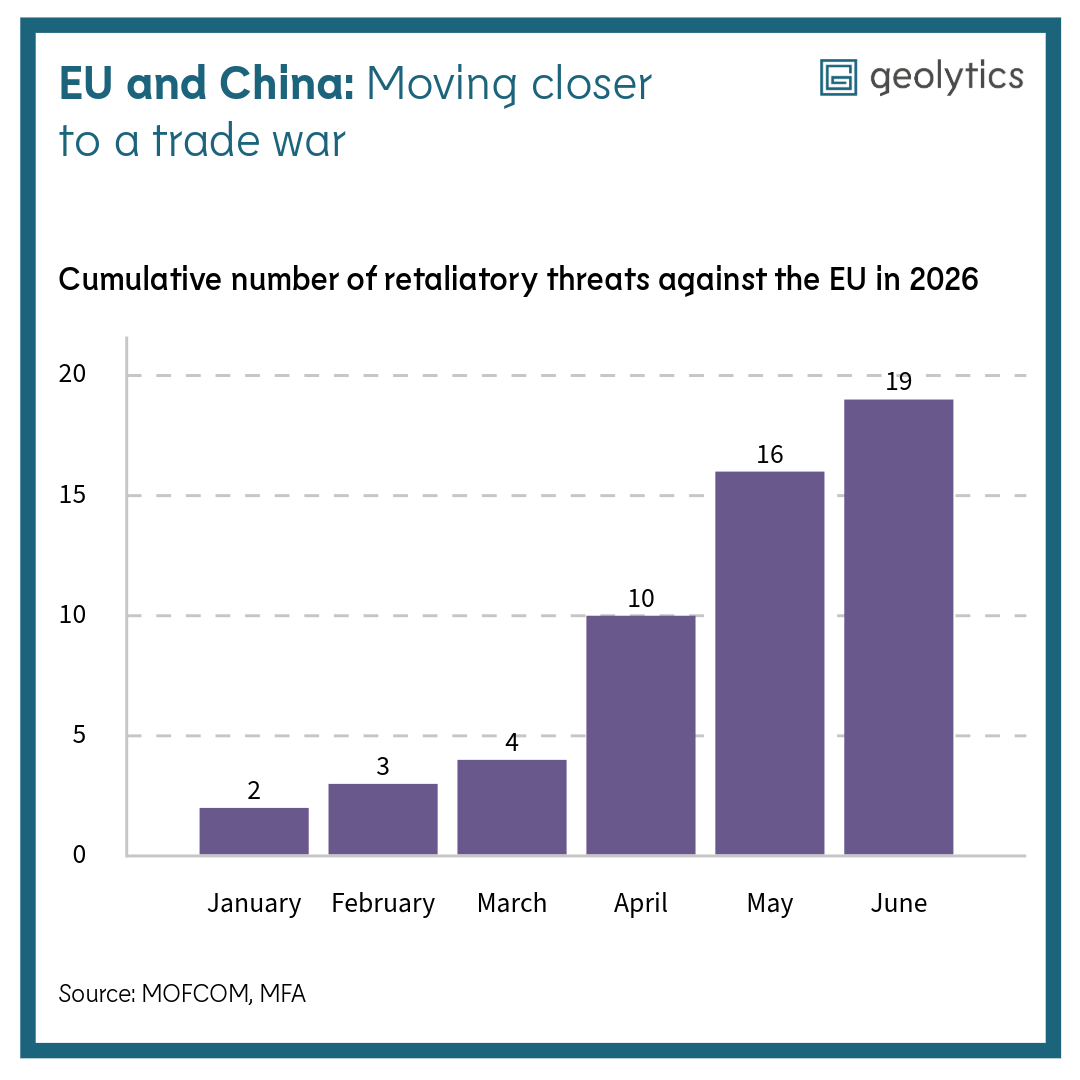
The EU is currently developing a range of new instruments to reduce economic dependencies on China and protect European industry. The planned Industrial Accelerator Act (IAA) could give preference to European production and procurement, while making foreign investment conditional on local production, employment, or technology transfer. A reform of the European cybersecurity framework could at the same time make it easier to classify Chinese companies as “high-risk providers” and restrict their access to critical infrastructure.
Brussels also intends to use existing trade policy instruments more aggressively, including anti-dumping and anti-subsidy proceedings. A new trade instrument that would allow the Commission to impose tariffs on entire sectors is currently under consideration. New requirements on supply-chain diversification could oblige companies in strategic industries to reduce their dependence on individual suppliers. Commission President Ursula von der Leyen has indicated that such an instrument could be presented later this year. This creates a risk of direct regulatory conflict: in April 2026, China introduced new rules on supply-chain security and the countering of extraterritorial measures.
Beijing intends to use these rules to take action against foreign companies that end business relationships with Chinese partners, discriminate against Chinese suppliers, or, in China’s assessment, jeopardize the security of Chinese supply chains. The trade and investment dialogue between EU Trade Commissioner Maroš Šefčovič and China’s Minister of Commerce Wang Wentao, established at the end of June, gives both sides time until the next round of talks in October.
This is unlikely to change the underlying conflicts, however. China will not fundamentally alter either its economic model or its close economic and security ties with Russia. At the same time, the instruments under discussion in Brussels are likely to continue moving forward.
In previous trade conflicts, China has generally responded to measures it considered discriminatory with targeted and reciprocal action. When the EU imposed additional tariffs on Chinese electric vehicles in 2024, China responded with measures against EU agricultural products. These measures hit particularly hard in member states that had strongly supported the European measures. When the EU restricted Chinese suppliers in major public tenders for medical equipment in 2025, Beijing responded by limiting European suppliers’ access to the Chinese procurement market.
This pattern is likely to continue. If the IAA gives preference to European products and suppliers, China could disadvantage EU companies in public tenders or procurement by state-owned enterprises. Beijing could also respond in kind to European restrictions on Chinese telecommunications providers. European software, telecommunications, automation, and medical technology companies could, for example, face more stringent security reviews and longer certification procedures. The exclusion of specific European companies from government procurement markets would also be possible. A corresponding mechanism already exists: Beijing recently placed 46 US companies from sensitive industries on a new procurement blacklist.
If the EU expands tariffs and trade defense measures, China is likely to launch its own investigations and impose tariffs on politically sensitive European exports. Agriculture, chemicals, vehicles, machinery, and medical technology are particularly exposed. Beijing can also obstruct European procedures directly. In May 2026, China prohibited the security inspection technology manufacturer Nuctech from cooperating with EU authorities.
Another example of this targeted response logic is the use of company-specific export controls. At the end of July, China’s Ministry of Commerce added 14 European companies to its export control list. The measure followed further EU listings of Chinese companies. Unlike the previous round in April, this time the companies affected were predominantly those whose chemical and semiconductor inputs are also used in civilian supply chains. This increases the risk that the exchange of targeted measures will increasingly affect broader industrial supply chains.
If the conflict expands, China also has a more powerful asymmetric option: export controls on critical raw materials and rare-earth magnets. China dominates key areas of raw-material processing and magnet production on which large parts of European industry depend. In an escalation, China could tighten export approvals for raw materials and magnets on which European companies rely. Beijing would not need to add new goods to its dual-use control lists to do so. The Ministry of Commerce could delay or deny approvals for European companies, depriving them of critical industrial inputs.
Concern about such a scenario has led Brussels and European capitals to intensify economic policy crisis simulations. A large-scale raw-material shock is not the most likely scenario, however. China’s domestic debate predominantly calls for firm but targeted countermeasures designed to put pressure on individual companies or industries.
The introduction of new European rules does not automatically trigger Chinese countermeasures. Many EU instruments first require investigations, implementing acts, or specific decisions targeting individual companies. Some of the most ambitious proposals may therefore not have a tangible impact on Chinese companies until 2027 or later. This gives Brussels and Beijing time for negotiations and tactical compromises.
Even in the best-case scenario, however, these negotiations will take place against the backdrop of a structurally more difficult relationship. Europe wants to reduce its industrial dependencies and protect its production base. China wants to preserve access to the European market and prevent European economic security policies from forcing companies to relocate supply chains and technology out of China. As long as these objectives conflict, every new European restriction increases pressure on Beijing to respond. Every Chinese countermeasure, in turn, strengthens the economic and political arguments for further European diversification.
A full-scale trade war between Europe and China remains avoidable. But both sides are increasingly creating precisely the instruments they would use in such a conflict.
Originally published on F.A.Z. in German.

