


China Policy
South-South cooperation: China is reshaping global AI governance
Read more


Soybeans are one of the most visible indicators of U.S.-China trade tensions. During the first Trump administration, agricultural purchases became a core element of bilateral trade bargaining, most notably through the January 2020 Phase One agreement. In the current cycle, the pattern has repeated: when trade tensions escalated, Chinese buyers reduced U.S. soybean purchases and shifted more demand toward Brazil; when diplomacy resumed, soybean commitments returned to the agenda.
That makes the latest rebound politically important, but analytically limited. The restart in Chinese soybean purchases shows that the post-Busan trade truce is having some effect. It does not show that agricultural trade has returned to normal.
The 2025/26 marketing year began with exceptionally weak Chinese buying of U.S. soybeans. Cumulative exports to China stood at just 0.1 million metric tons (MMT) in September, 0.2 MMT in October and 0.5 MMT in November. Purchases then accelerated after the Busan summit, reaching 2.8 MMT in December, 6.2 MMT in January and 10.8 MMT by February.
This is a meaningful recovery, but still a large gap compared with stronger years. By February, cumulative exports to China had reached 30.1 MMT in 2020/21, 26.2 MMT in 2017/18 and 22.7 MMT in 2023/24. Even the weaker 2019/20 season stood at 10.8 MMT by February, roughly in line with the current year.
The central conclusion is therefore narrow but important: Chinese soybean purchases have resumed, yet the gap persists.
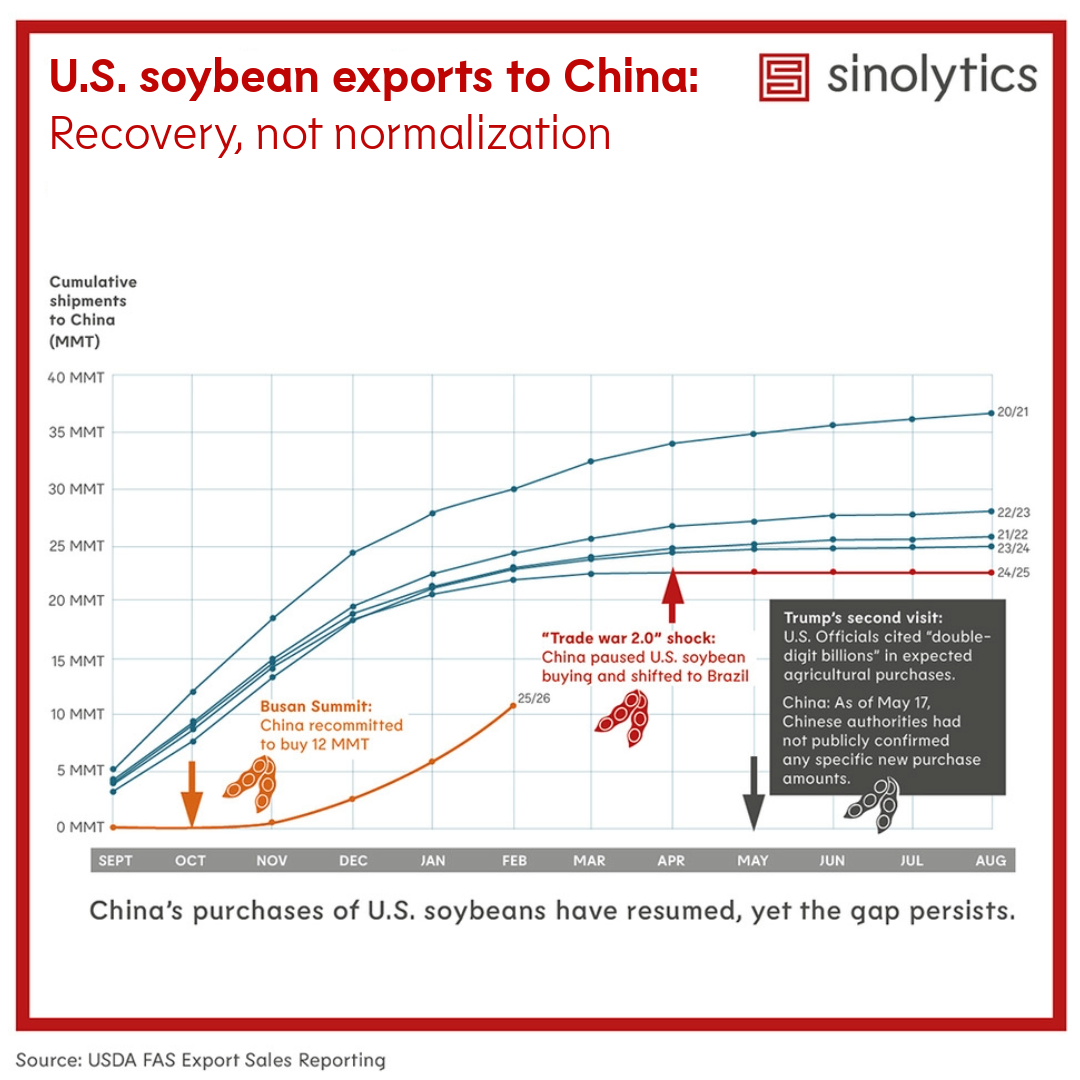
Trump’s May 2026 Beijing visit adds a new layer to the soybean story, but should not be treated as the main cause of the rebound. The U.S. side says China will purchase at least USD 17 billion per year of U.S. agricultural products through 2028, in addition to earlier soybean commitments. Beijing has confirmed additional agricultural purchases and further work on market-access issues, but has not publicly confirmed the U.S.-cited annual figure.
For companies and commodity markets, the practical takeaway is clear: agriculture remains one of the most concrete areas of U.S.-China economic bargaining, but implementation still matters more than summit language. Soybean buying has restarted; the next question is whether broader agricultural commitments translate into sustained, measurable trade flows.

