


China Business
China's export breakout: Understanding the drivers behind the growth
Read more


It depends which part you look at, but yes, building and managing the operating system, that fits. At its core, that's a fair way to put it.
When a topic grabs me, it really grabs me. Then I'm genuinely on fire and can spend day in, day out on it. That's what happened last year with AI. It had been a big topic for a while, but suddenly everything picked up enormous speed, and that's when it really caught me. I threw myself into it and into building our AI strategy, reading about it constantly, exploring the tools all day. I soak up everything a topic has to offer. What drives me is the enthusiasm: when something captures me, I have such a strong pull toward it that I absorb everything connected to it.
That's true, and it matters a great deal to me, it always has. I keep one question in the back of my mind the whole time I'm working on something: what does this actually mean? What are the implications, either for a client or for us as a company? And then how do I feed that back in. What does it tell us, what does it tell the client, and how do I get it to the point as clearly as possible.
Very much so, yes. The obvious difference is that internally I know the moving parts even better, how the gears turn here, so I can act quite differently. Working from the inside can be a hurdle in many companies, but at Sinolytics I'd genuinely call it an advantage. A lot of organizations, especially when change is on the table, are change-averse. We're not, in fact, quite the opposite. We like engaging with new ideas and new approaches rather than waving them off. And, importantly, we don't need everything to be 100 percent thought through before we act. If in doubt, we start doing, and figure out along the way what needs to be adjusted for it to succeed. That way we gather a lot of experience very quickly. We built our operating system the same way: we started, and let the path show us how to develop it further. That's fairly untypical for a company based in Germany, I'd say, and it's something we've picked up a little from China. Start, experiment, try things, then scale. I think that's an excellent quality, and it makes us very dynamic.
The courage to evolve alongside the technical developments, in particular. That takes a lot of courage and a real appetite for risk, plus the openness to say: things work differently now, so we'll try doing them differently too. That, to me, is the decisive part.
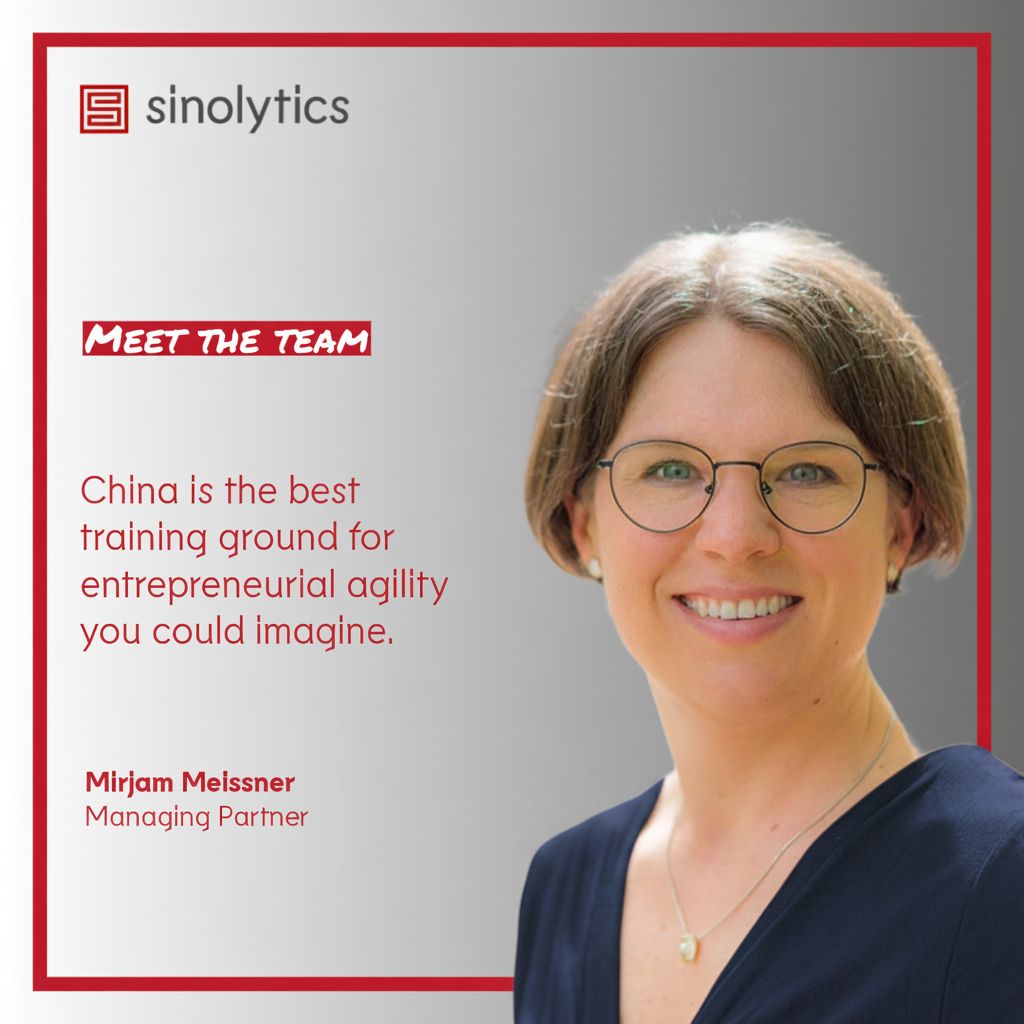
On the whole, it's a good interplay. China forces you, every single day, to look at things afresh, to act fast, react fast, and stay open to new developments rather than saying "this is just how it is, our theories say so, therefore China has to fit them." That same openness and speed, and the ability to take on other perspectives, is exactly what helps in an internal role. China is the best training ground for entrepreneurial agility you could imagine.
I think one thing we all share at Sinolytics is that we're a bit like tinkerers. We enjoy playing with new ideas, and with new technologies. My instinct is to say: "Great new technology, let's see what opportunities are in it." Always with an awareness of the risks, of course, that's relevant and worth keeping in view, but at the same time, exploring the opportunities. In this specific case, we recognized fairly early how fundamental, how upending AI could be for our work, and for us as a company in this industry. And in that situation, the only thing that helps, in my view, is to go into "doing" mode. Pull yourself in and say "we want nothing to do with this," and you've basically guaranteed you'll drift into irrelevance. The point is to stay at the state of the art and keep developing with it.
It's multi-layered. What we produce isn't just data, it's real analysis, with concrete explanations of what a development means for the specific client. You could deliver that through a different channel, but the key is meeting clients where they already are: in the digital space. That's decisive. It's also a new way of accessing information, reading it, and integrating it into your own systems — via an API, and an MCP interface, which is something we're developing and rolling out. On the client side, it has to be as comfortable as possible to get to the information, and not just one piece of it, but everything relevant around the topic they're working on.
We're ready. The real question is how ready the client is. Once a client uses their own internal AI system, we're able to plug in and make our data and analysis available — so they can work with it inside their own AI tool. And that happens without us pulling in any of the client's data; there's no need to worry that client data ends up on our platform. It's the opposite: the client can fold it smoothly into their own AI research processes. That's genuinely powerful. Imagine you're on the client side and you need a presentation on, say, the U.S.–China trade war at short notice, and you know you can combine your own client data with Sinolytics' analysis on exactly that topic, and build something sharp out of it. As a client, I'd see that as a dream scenario. And crucially, you end up with high-quality results built on expert analysis, not something an AI fished out of somewhere on the web.
Speed. Life at Sinolytics is extremely fast. And that's not only classic consulting speed, there's also the China turbine. China spins at a different tempo, so we spin with it and have to stay fast and agile. That makes it demanding, yes, but it's also where the real fun is: things keep changing, they move quickly, and we've always managed to stay with them, and hopefully always will. That's what typically Sinolytics means to me.
I'd want it said that we're one of the successful consultancies that positioned themselves smartly enough on AI to remain a relevant player in the market, rather than being eaten alive by generative AI. I believe we've already laid the groundwork and are on a good path. I'm ready to help shape the AI future of consulting, not just for us, but for the industry as a whole. And I'm very curious to see where it takes us. It's going to be a fascinating ride.

