


China Business
What does a China geopolitical risk consultancy actually do?
Read more


China's 15th Five-Year Plan signals a bold pivot toward advanced technology sectors. The proposal calls for "extraordinary measures" to achieve breakthroughs in frontier industries such as embodied AI and the low-altitude economy. This ambition goes beyond domestic growth. It aims to position China as a global innovation hub, attracting foreign capital and fostering a predictable environment for technology development.
In this context, China links IP enforcement to international competitiveness and investor confidence, driving efforts to create a stable institutional framework. Recent legal amendments strengthen rights holders in civil cases by shifting the burden of proof in trade secret disputes, provided confidentiality measures are documented. This evolution signals China's intent to align its IP regime with global standards.
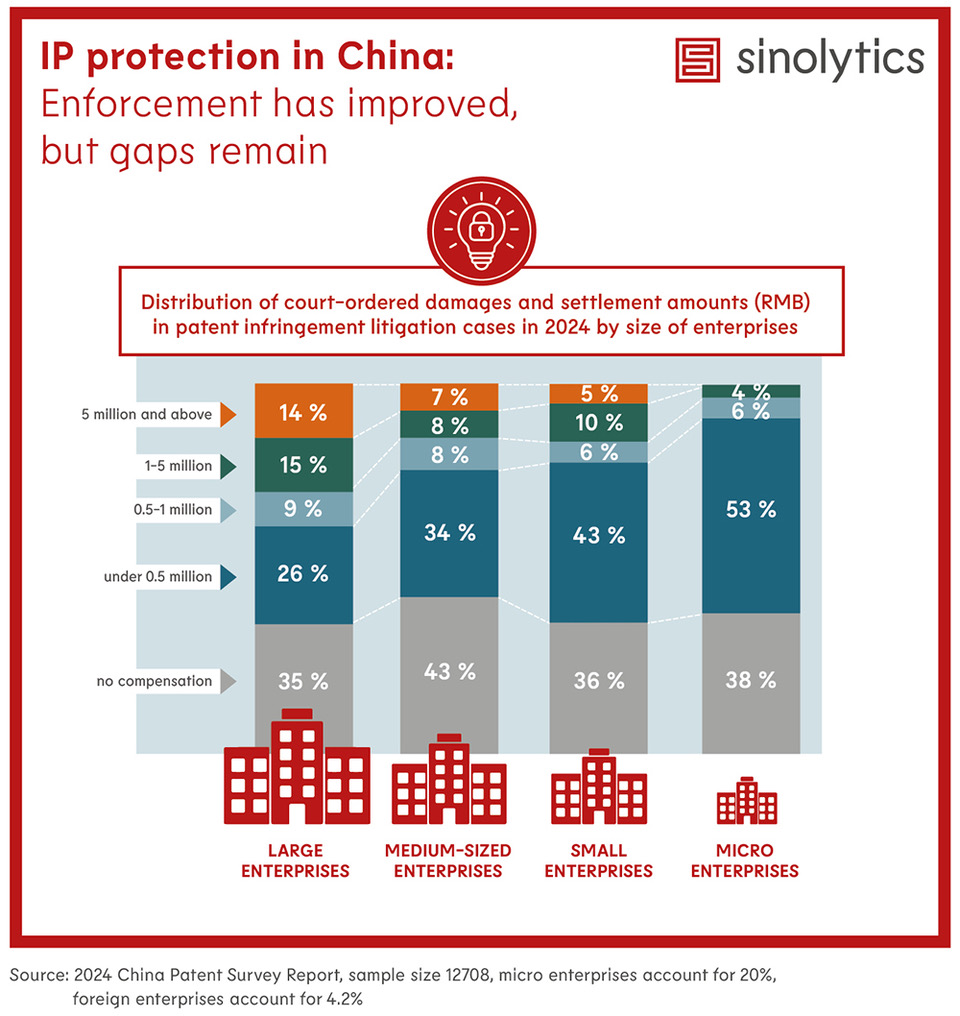
Financial deterrence is rising. Courts can now impose penalties of 1–5 times the actual infringement cost or up to RMB 5 million when losses are hard to quantify. High-compensation cases (over RMB 5 million) grew to 10% in 2024 from 8% in 2021. Yet challenges persist: over half of cases still result in payouts below RMB 500,000, and SMEs face structural disadvantages. Limited resources push smaller firms toward mediation, and their chances of securing high compensation remain slim compared to large enterprises.
For foreign firms, proactive IP strategy key. China operates on a territorial, first-to-file system, meaning rights are enforceable only if registered domestically. Design and utility model patents offer fast, cost-effective protection (typically under one year). Technical know-how can be safeguarded as trade secrets, but only if treated as confidential from the outset. Best practices include notarization, blockchain evidence, and documentation of authorship and creation.

