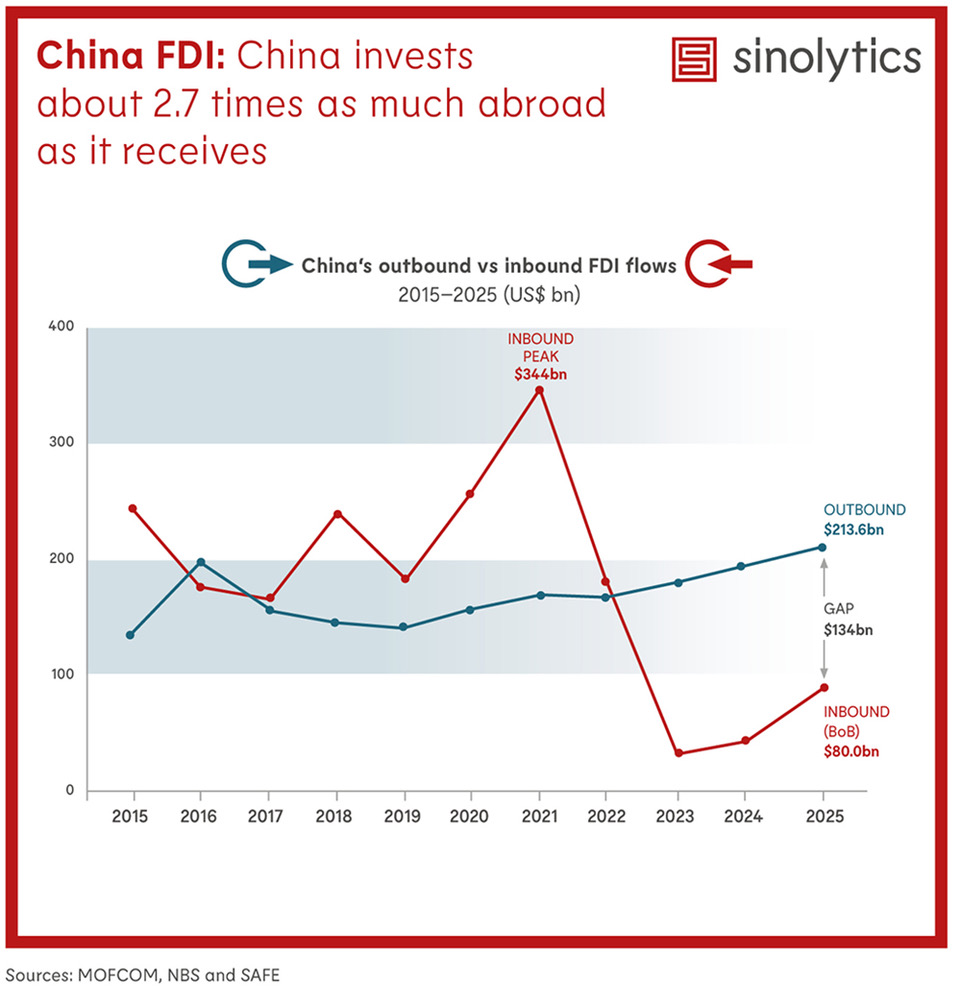
From 2015 to 2021, inbound FDI exceeded outbound FDI in every year except 2016. Inbound flows then collapsed while outbound flows climbed to a new record. The 2025 inbound rebound narrowed the gap from 150 bn USD to 134 bn USD. It did not close it.
The divergence
Outbound FDI rose for a third consecutive year in 2025, making China the world's second-largest outward investor. Inbound FDI rose 88% to 80.0 bn USD, its first increase since 2021, but still amounts to less than a quarter of the 2021 peak.
The recovery came mainly from foreign parent companies withdrawing less capital, not from new investment. Net repayments of intra-group loans by Chinese subsidiaries fell from 32 bn USD in 2024 to 9 bn USD in 2025. Equity inflows, including reinvested earnings, grew 20% to 89.1 bn USD. MOFCOM's narrower measure, which counts only paid-in capital, still declined 10% to 104.7 bn USD, with the drop concentrated in manufacturing. More foreign firms registered in China (+19.1%), but each brings far less capital: about 1.5 m USD on average, down from 4.9 m USD in 2022.
Drivers of the gap
Weak domestic demand, overcapacity in key industries, rising tariffs and geopolitical risk weigh on both flows. They make overseas production more attractive for Chinese firms and expansion in China less attractive for foreign firms.
Outbound: Chinese firms expand abroad, mostly private and mostly by building rather than buying
- Production moves behind tariff walls. Chinese firms are building battery and EV plants in Hungary and Spain, and factories across Southeast Asia. Flows to Malaysia rose 92%, flows to Thailand 17%.
- Private firms lead. Non-state firms accounted for 58.7% of non-financial outflows, up 4.4 percentage points. Outflows from local firms grew 16.5%, while those from centrally owned SOEs fell 5.3%.
- Fresh capital outweighs deals. New equity investment reached a record 122.7 bn USD (+48% YoY). Acquisitions fell to 15.3 bn USD, a historic low.
Inbound: Foreign firms have stopped withdrawing capital but are not expanding
- Capital spending contracts. Foreign-invested firms cut fixed-asset investment by 13.8% in 2025, after a 10.0% decline in 2024.
- Profits and reinvestment hold up. Their profits rose 4.2%, against 0.6% for all industrial firms, and they still generate 23.6% of industrial profits. The 20% rise in equity inflows was driven mainly by reinvested earnings.
- Manufacturing bears the heaviest burden. On MOFCOM's measure, FDI into industry and construction fell 17%, compared with a 6% fall in services.
Outlook
The gap will likely persist. Inbound flows are stabilizing, but outbound growth faces mounting friction. Tighter investment screening lies ahead: the EU's revised FDI Screening Regulation applies in full from January 2028, and the proposed Industrial Accelerator Act would attach joint-venture and local-content conditions to large Chinese investments in batteries, EVs and solar. Chinese outbound investment is increasingly shifting toward emerging markets while navigating complex regulatory conditions in the EU or the U.S. Whether the rebound in inbound investment lasts will depend on foreign firms continuing to reinvest earnings in China rather than repatriating them.
Implications for foreign companies
The divergence changes the business case for foreign firms, both inside China and at home.
- China has become a market to harvest rather than build in. Foreign-invested firms cut capital spending yet raised profits, and they have largely stopped withdrawing capital. The prevailing strategy is to localize operations for the Chinese market and fund growth from local earnings, not to add export capacity. Opportunities remain in high-tech services, free trade zones and service-sector opening pilots.
- Chinese competitors enter home markets. Chinese battery, EV and solar manufacturers are building plants in the EU, Southeast Asia and Mexico. Incumbents should prepare for local-for-local price competition, not only for imports.
- Partnerships may become the norm. If the Industrial Accelerator Act passes in its current form, large Chinese investments in batteries, EVs and solar will require EU joint-venture partners, technology licensing and EU sourcing. That gives European manufacturers and suppliers negotiating leverage and access to Chinese technology.
Download
Timely analysis, strategic foresight, and expert perspectives on China's evolving position in the global economy.


