


Technology
Chinese AI: SOEs lead adoption of Large Language Models
Read more


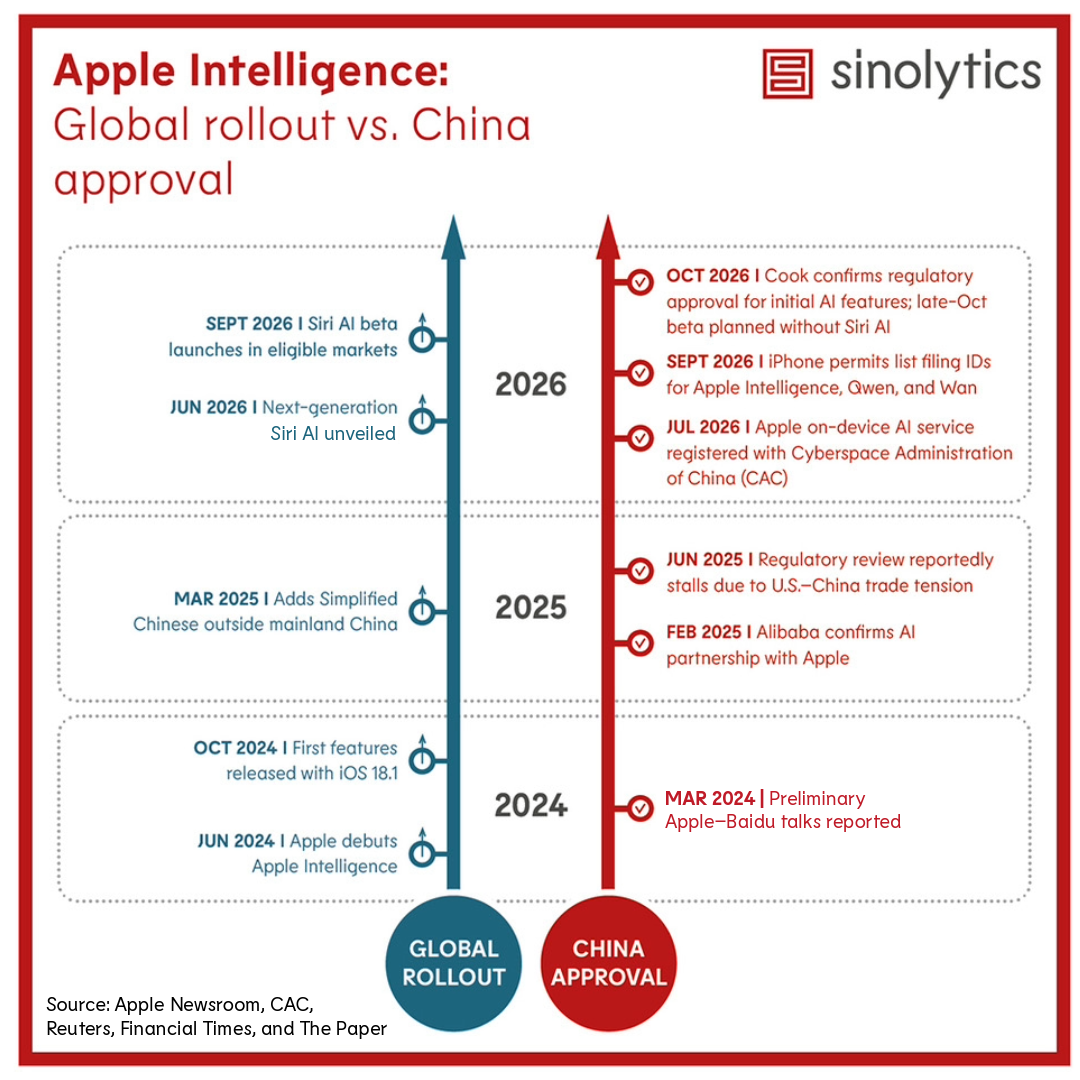
On October 15, 2026, Apple Executive Chairman Tim Cook confirmed that the first core Apple Intelligence features had received regulatory approval in China. A test version is scheduled for late October, initially offering Live Translation, Writing Tools, and Clean Up in Photos, but excluding the next-generation Siri AI.
The approval clears the way for Apple to introduce Apple Intelligence in mainland China. The service first launched in October 2024, and support for Simplified Chinese followed in March 2025. However, it remained unavailable in mainland China even as Apple expanded its capabilities and introduced its next-generation Siri AI in September 2026.
Apple's preparations for a Chinese version began before the initial launch. In March 2024, Apple reportedly held talks with Baidu, whose AI services had already received Chinese regulatory clearance. However, the collaboration subsequently encountered difficulties involving model performance and Apple's restrictions on the use of customer data.
In February 2025, Alibaba confirmed its partnership with Apple. Yet their joint AI applications reportedly remained stalled at the Cyberspace Administration of China (CAC) in June 2025. The Financial Times linked the delay to growing U.S.–China trade tensions, although Chinese regulators did not publicly confirm a geopolitical reason.
Apple's technical approach also evolved. In August 2026, Reuters reported that Apple had trained a proprietary model specifically for China with Alibaba's support, rather than relying entirely on third-party models. The arrangement therefore appears to combine Apple’s own AI technology with Chinese-developed models.
On July 8, 2026, Apple's on-device generative AI service completed a CAC registration, which the regulator announced on July 15. Updated iPhone network-access permits dated September 29 subsequently listed model registration numbers for Apple Intelligence and Alibaba's Qwen and Wan.
These milestones illustrate that registering an AI service and preparing its deployment on consumer devices involve distinct compliance steps. The October announcement confirms approval for the initial feature set, but does not establish that every Apple Intelligence capability has received clearance.
Apple's approval suggests that foreign-developed models can gain access to China’s market within a locally compliant system. Such arrangements could give multinational companies room to retain proprietary technology while allowing Chinese regulators greater influence over its deployment. They could also reinforce the role of domestic technology providers.
China's separate approval process could make it harder for foreign companies to keep pace with domestic competitors. While Apple's next-generation Siri AI began rolling out globally in September 2026, it remains excluded from the initial Chinese release. Future upgrades may also require additional regulatory clearance or technical adaptations, potentially delaying their introduction in China. Multinational companies must reconcile Chinese regulatory requirements with their global technology architecture and release schedules. This could lead to a persistent gap in AI capabilities between their Chinese and overseas offerings.
Apple's experience also illustrates a geopolitical dilemma for multinational technology companies. Partnerships with Chinese AI providers can enable market access while strengthening domestic players that Washington increasingly views as strategic competitors. Apple's cooperation with Alibaba has already drawn U.S. scrutiny over its potential to advance Chinese AI capabilities and raise data-security concerns. Such partnerships could create lasting technological dependencies and expose multinationals to conflicting regulatory pressures from Beijing and Washington. Companies may face a trade-off between maintaining access to China's market and preserving their technological and strategic autonomy.

