


Geolytics
Rare earths: Why Europe cannot copy Japan's model
Read more


Both sides seem to share two core assumptions at the moment.
First: a confrontation between the two superpowers is, in the long run, inevitable. Both Washington and Beijing are preparing intensely for it. The U.S. is reinforcing partnerships with Japan, Australia, Thailand, and Malaysia to weaken China’s dominance in critical raw materials. China, in turn, has spent decades working to replace American high technology with domestic innovation, close its semiconductor gap, and leapfrog in emerging sectors such as artificial intelligence.
Second: neither side is yet ready for a real escalation. Once threats cross a certain threshold, de-escalation follows quickly. Although China currently appears to hold a strong negotiating position, Beijing is swift to defuse tensions. The leadership knows that despite major progress, technological vulnerabilities remain — weaknesses that cannot be closed without U.S. technology. It is no coincidence that China reacts calmly to U.S. tariff threats but sharply when it comes to issues like EDA (Electronic Design Automation) software or expanded export sanctions. With U.S. firms controlling around 66% of the global market for IP and EDA software, the United States remains a critical choke point in the global semiconductor value chain — one China’s industry cannot easily bypass.
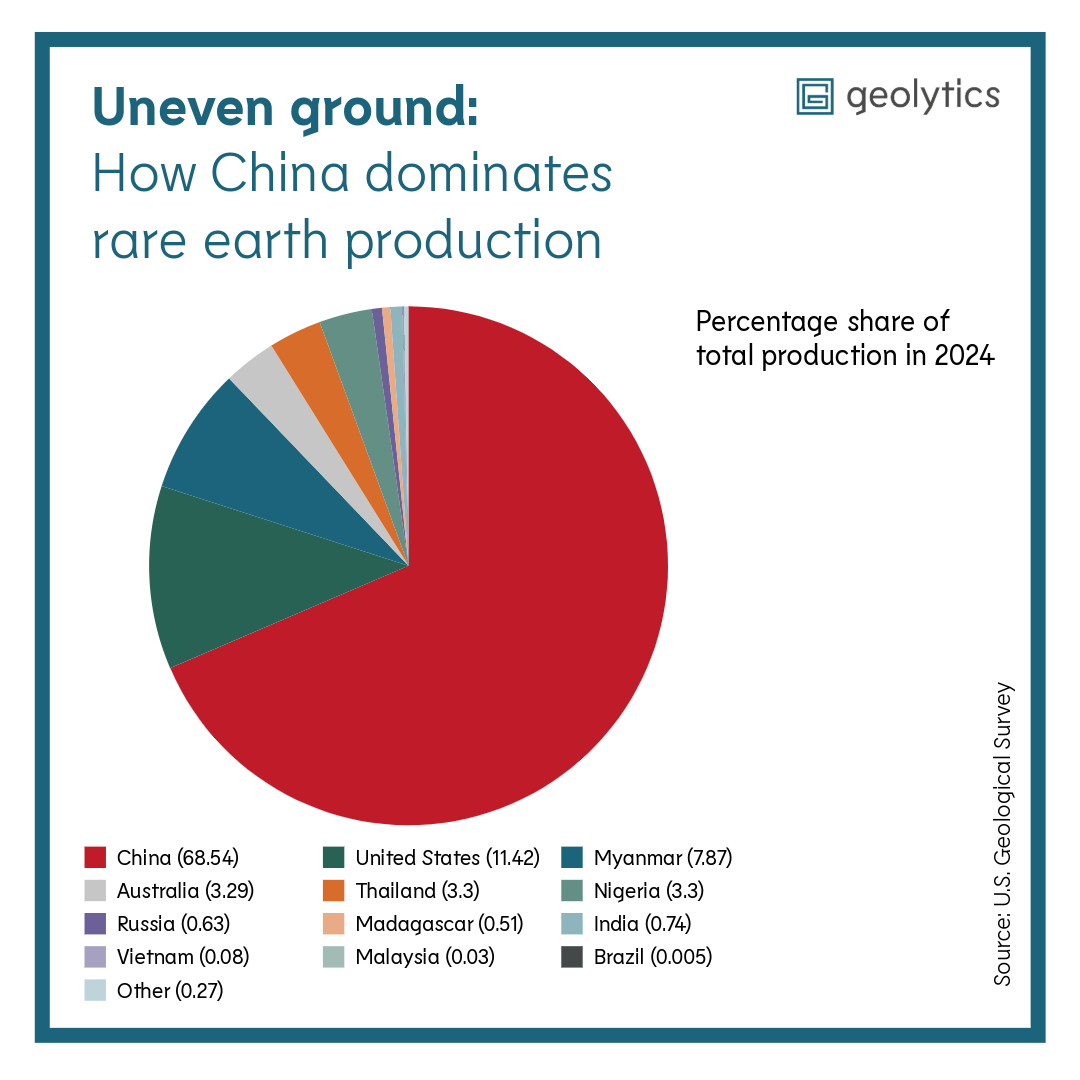
Conversely, it has been no secret for at least 15 years how deeply the U.S. and the rest of the world depend on China’s supply of critical raw materials. China accounts for nearly 70% of global rare earth production. The rare earth crisis in April likely made that dependence abundantly clear to the White House as well.
If both sides are not yet ready to push the conflict further, they share an interest in buying time — time to gradually reduce mutual dependencies. So why do these recurring escalation cycles continue?
Part of the answer lies in the internal contradictions within the U.S. administration. Two camps pursue different China strategies.
The security-focused camp views the rivalry as a long-term systemic confrontation between superpowers. Its goal is to keep Chinese products out of critical infrastructure and to prevent U.S. technology from accelerating China’s catch-up. From this perspective, restricting technology access is not a bargaining tool but a strategic necessity — even at the cost of Chinese retaliation. This position has largely dominated during the Biden administration.
Other forces in Washington — especially within the White House — take a different view. Their focus lies on the trade deficit and on achieving quick, visible negotiation wins that can be leveraged domestically. Technology controls, which the security camp treats as strategic levers, become tactical “bargaining chips.” Beijing reacts predictably: technological restrictions strike at its most sensitive point. China then plays its strongest card — access to critical raw materials. Escalation risk spikes, yet neither side is prepared for a showdown. De-escalation follows swiftly. Another cycle completed.
This tactical reset to zero creates at best the illusion of calm. The underlying assumption remains unchanged: confrontation is drawing closer, and whoever remains more dependent will lose in the end. Decoupling continues apace, as both sides play for time. The balance will only truly shift once one side believes it has achieved sufficient independence.
Originally published in a shorter form on F.A.Z.

