


Geolytics
EU and China move closer to a trade war
Read more


China has relied on cleantech as an engine of growth for years. According to Carbon Brief, clean energy technologies accounted for more than one-third of China’s GDP growth in 2025. India also wants to play a larger role in this market. The government is supporting new factories across the value chains for photovoltaics, batteries, and green hydrogen, including through its Production Linked Incentive scheme. In the 2026/27 budget, the responsible ministry received the equivalent of around EUR 3 billion, 30 percent more than in the previous year.
This is attractive to the European Union. It could accelerate its green transition while sourcing fewer products and components directly from China. The political direction has already been set. The EU-India free trade agreement concluded in January 2026 provides for a joint task force on green hydrogen. It is intended to support clean energy production and facilitate the exchange of technology and knowledge. Both sides also aim to deepen their cooperation under the EU-India Clean Energy and Climate Partnership.
The economics, however, are less straightforward. India can produce at a lower cost than Europe, but it cannot compete with China. There are three main reasons.
The first is India’s cost structure. Average hourly wages in India are only 35 percent of the level in China. However, electricity and other utility costs in India are, on average, 70 percent higher than in China. This matters particularly for energy-intensive production steps, such as processing polysilicon for solar modules or producing cathode material for batteries.
The second reason is India’s dependence on Chinese machinery. China not only dominates the production of solar modules and lithium iron phosphate batteries, commonly known as LFP batteries. It also supplies a large share of the equipment needed to manufacture them. To build its own capacity, India therefore often has to import machinery from China. This raises production costs and creates additional supply chain risks.
India also faces a technological gap. Chinese manufacturers benefit from years of experience, large-scale production capacity, and closely integrated supply chains. India has not yet matched this level of expertise and industrial integration, which further increases costs.
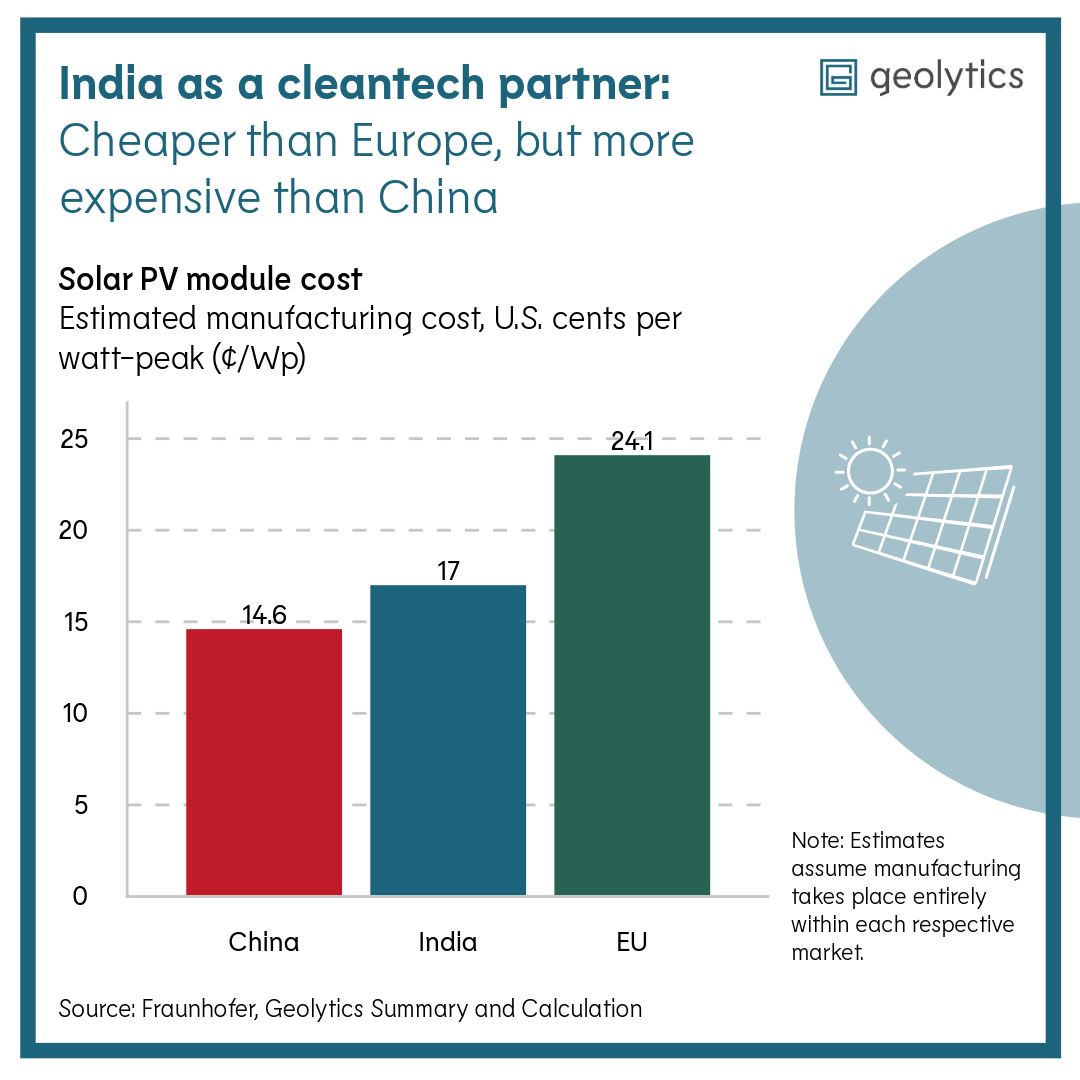
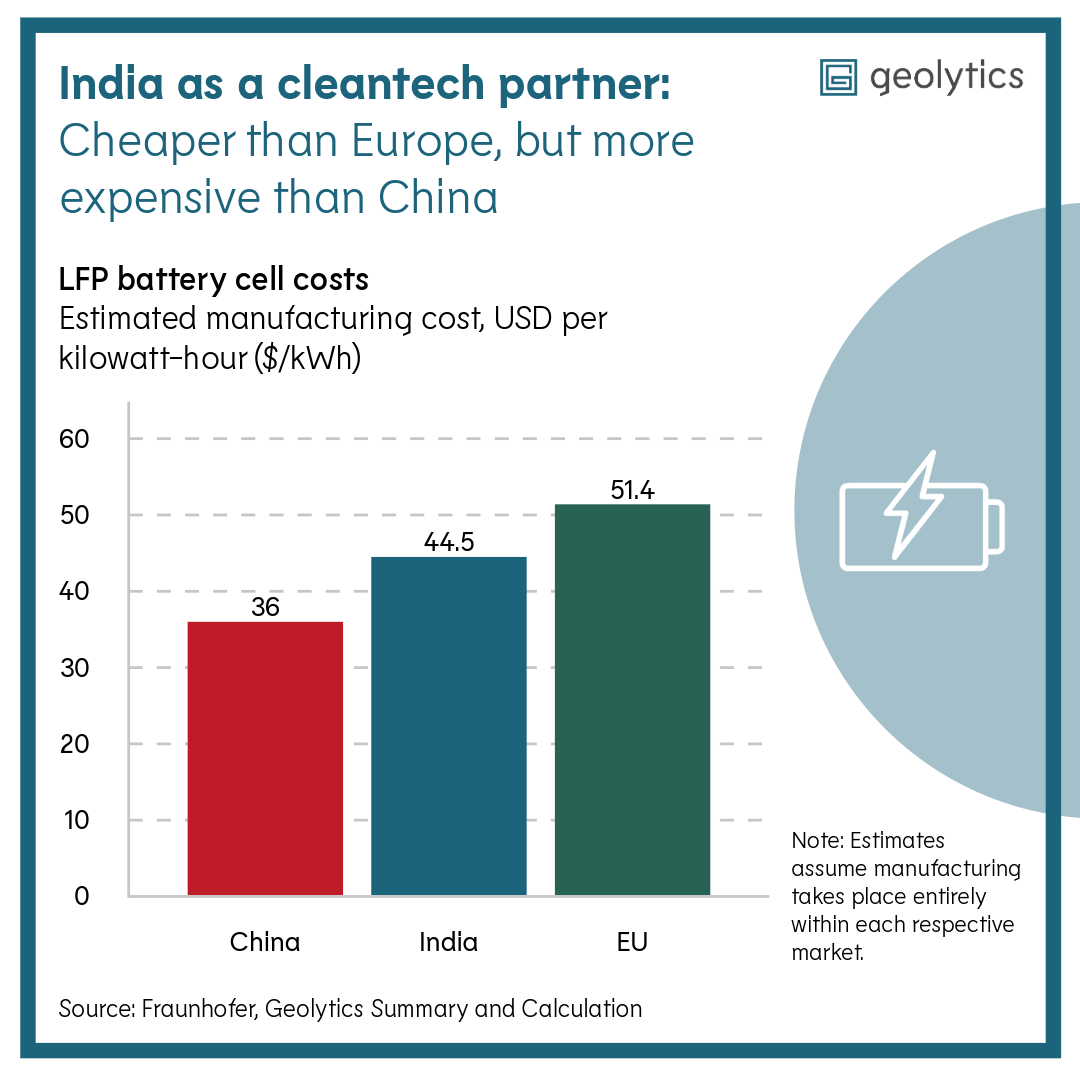
The figures illustrate the gap. According to Geolytics calculations, solar modules manufactured entirely in India would be 29 percent cheaper than European products. However, they would still cost around 16 percent more than modules from China. The picture is similar for LFP battery cells. A cell manufactured entirely in India would be 13 percent cheaper than a European cell, but 24 percent more expensive than a Chinese one.
For batteries, it also remains unclear how quickly India can build the necessary capacity. The government and industry have ambitious targets, but the country still lacks significant LFP cell production. Commercialization is progressing slowly. At the same time, raw material bottlenecks persist, with supply still largely controlled by Chinese companies.
A cleantech partnership with India could reduce Europe’s direct dependence on Chinese products. But it would come at a price, as production would remain more expensive than in China. The more fundamental dependence would also persist as long as China controls key raw materials and manufacturing equipment.
As the EU diversifies its supply chains through partnerships of this kind, it should therefore invest more heavily in commercializing new technologies. These include solid-state batteries, an area in which China has not yet established a dominant position.
This article was originally published on F.A.Z.

