


China Policy
Fourth Plenum readout: "Opening up" elevated among China's key policy priorities
Read more


China's two flagship documents on global AI governance, the 2023 Global AI Governance Initiative with its guiding principles and the newly released Action Plan that turns those principles into concrete steps, both highlight support for developing nations in building AI capacity and frame AI as a global public good "for good and for all."
This framing contrasts with the U.S. AI Action Plan, which promotes a "winning the race" narrative. The U.S. focuses on alliances with like-minded partners and uses export controls to constrain adversaries. China, by contrast, seeks to engage Global South countries through multilateral frameworks and capacity-building initiatives. Beijing aims to expand its influence in global AI governance and to counter U.S. containment.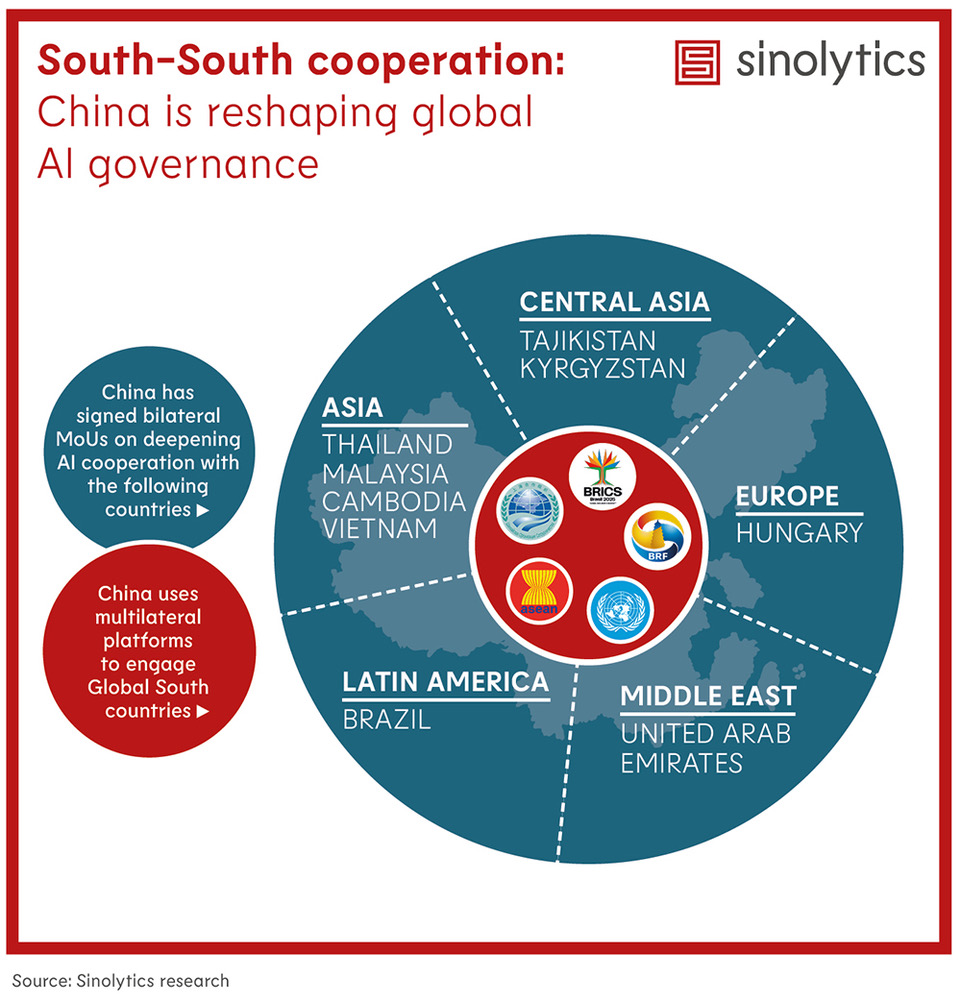
For China, engaging with emerging economies offers both strategic influence and tangible economic benefits. The Global South is generally more open to China than European and U.S. markets. With strong growth potential, these regions provide Chinese companies with major commercial opportunities and help strengthen China's competitive edge abroad.
Building on the "Digital Silk Road" under the Belt and Road Initiative, Beijing has increased AI collaboration with developing nations, signing a series of MoUs focused on capacity building. It is also using multilateral platforms where it plays a leading role, such as BRICS and the Shanghai Cooperation Organization, to broaden AI cooperation with member states.
On the ground, these efforts are materializing through concrete cooperation projects: the China-Laos AI Innovation Center is helping Laos develop a sovereign large language model; the China-ASEAN AI Lab supported Malaysia in creating the world's first Shariah-compliant LLM; and a joint lab with Brazil is working on AI applications in agricultural mechanization. These partnerships build local AI capacity and accelerate the export of Chinese technologies, from DeepSeek's open-source models and Zhipu's agentic AI solutions to Huawei's Ascend chips and cloud services.

